
Can the Cartesian coordinates JEE 2024 answer be certified?
The Cartesian coordinates JEE 2024 record does not support a certified option: the key selects C, 81, but the worked solution ends at 36, which is absent from the choices. The record labels the question 2024 but dates it 2023-01-24 Morning. Neither year nor shift can be certified without the original paper.
The problem gives triangle ABC with A at the coordinates below, equal sides AB and AC, and an included angle of sixty degrees. B lies on the positive x-axis, and BC has length four root three. Following the supplied solution, we place C above the axis and find where BC meets the given line.
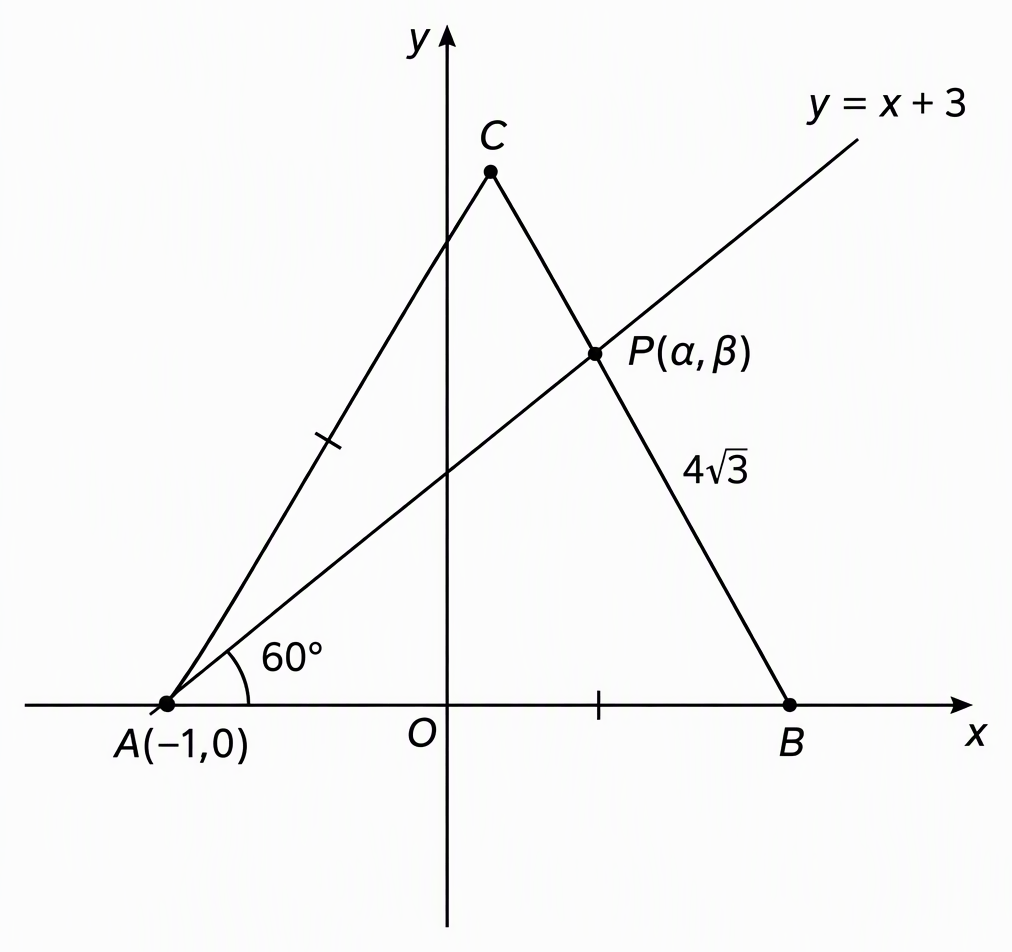
The supplied choices are:
We interpret the intersection as one ordered pair:
This is an explicit working interpretation of unclear wording, not permission to invent two intersection points.
How do you find the coordinates of B and C?
Express both vertices using the common side length, then use the distance formula to match the given base. Since B lies on the positive x-axis, its x-coordinate must be greater than zero, not merely greater than negative one.
Set:
Starting from A and moving right gives:
For the upper-half-plane construction:
Placing C above the axis follows the supplied solution. The question text alone does not explicitly specify this orientation.
Apply the distance formula:
The given base length and positive side length give:
Substituting this length gives both vertices:
The supplied cosine-rule check confirms that the base equals each of the other sides. The triangle is equilateral, not an arbitrary isosceles triangle:
How do you find where BC intersects the other line?
Write BC in point-slope form through B, then equate the two expressions for the y-coordinate. Their unequal slopes give exactly one intersection, so no quadratic or second-point construction is needed.
The slope is:
Using B:
Expand the bracket:
At the intersection, both equations give the same y-coordinate:
Rationalise the denominator:
Substitute into the given line to obtain the y-coordinate and record the ordered pair:
Check the point in both equations before using its coordinates:
Both substitutions agree. The slopes are unequal:
Extending BC along its existing line cannot create another intersection with the same nonparallel line.
Why does the supplied conclusion fail after the intersection?
The supplied solution changes the meaning of alpha and beta after finding the intersection and introduces a second point without an equation establishing it. Keep the ordered-pair interpretation fixed instead:
The relevant squares are:
Thus the result under our stated interpretation is:
This is not a verified official answer. It follows from the upper-half-plane construction and our explicit interpretation of the intersection.
Audit the supplied solution’s later assignment separately:
These numbers are negatives, not conjugates. A conjugate changes the sign of the radical term while retaining the rational term.
Its claimed simplification to 36 is therefore unsupported. Keep the source claims separate:
- Supplied worked-solution ending: 36.
- Supplied keyed choice: C) 81.
- Established status: neither follows from the supplied derivation.
An answer key cannot repair invalid algebra, as discussed in Quadratic Equations JEE 2024: Checking a Flawed Solution. This material supports a transparent solution audit, not a publishable certified PYQ solution set until the original wording, diagram and key are checked.
Can confusing line coefficients with coordinates produce option C?
Wrongly treating the slope and intercept as coordinates produces 81, but does not justify option C. This is an illustrative erroneous calculation, not evidence about student responses or the origin of the distractor.
The incorrect assignment is:
It gives:
Slope and y-intercept describe a line; they are not its intersection coordinates with another line. Check the alleged point immediately:
It fails even the given line equation. Obtaining 81 through this invalid route cannot validate the unresolved supplied key.
Which three original questions practise the same coordinate method?
Practise vertex placement, slope calculation and ordered-pair interpretation separately. All three exercises are original chapter practice, not verified PYQs from the Cartesian coordinates JEE 2024 record. Solve each before reading its working.
- Vertex placement: A has the coordinates below, the equal sides have length four, and the included angle is sixty degrees. B lies on the positive x-axis and C above it. Find B and C.
Move right from A for B; use the horizontal and vertical components for C:
- Slope calculation: Find the line through these points:
Keep the subtraction order identical in numerator and denominator:
Using B gives:
- Ordered-pair interpretation: The following lines meet at the stated point. Find the requested ratio.
Equate the expressions for the same y-coordinate:
Use the intersection coordinates, not the line coefficients:
Before evaluating any coordinate expression, substitute your ordered pair into both line equations.
Next step: photograph a doubt on JEEnius and photograph any question you are stuck on and get a step-by-step solution, with a free-body diagram when the question needs one (20 free).
Frequently asked questions
What is the correct answer to the Cartesian coordinates JEE 2024 question?
The supplied record does not establish a certified answer: the key selects C) 81, while the worked solution ends at 36, which is not an option. Neither value follows from the supplied derivation. The original paper, diagram and key must be checked, especially because the record labels the question 2024 but dates it 2023-01-24 Morning.
How do you find B and C in the given triangle?
Since AB = AC and angle BAC is 60°, triangle ABC is equilateral, so each side is 4√3. Starting from A = (−1, 0), with B on the positive x-axis and C assumed above it, the vertices are B = (4√3 − 1, 0) and C = (2√3 − 1, 6).
Where does BC intersect y = x + 3?
With C placed above the x-axis, BC has equation y = −√3x + 12 − √3. Equating this with y = x + 3 gives P = (5√3 − 6, 5√3 − 3). Substitution confirms that this point lies on both lines.
Can I use α = 1 and β = 3 from y = x + 3?
No: 1 and 3 are the slope and y-intercept, not the coordinates of the intersection with BC. The point (1, 3) fails y = x + 3 because 3 ≠ 4. Although this incorrect assignment produces β⁴/α² = 81, it does not validate option C.