
How do you solve the equation of a line JEE 2024 question?
For this equation of a line JEE 2024 question, option (4) matches the perpendicular distance, but the supplied working calculates a parallel projection and skips the final subtraction. The solution below repairs that step while keeping the supplied cross-product, line-equation and projection method.
Find the shortest distance from Q to the line L through P whose direction is perpendicular to both supplied line directions. The required distance is QH, where H is the perpendicular foot on L, not the projection length along L.
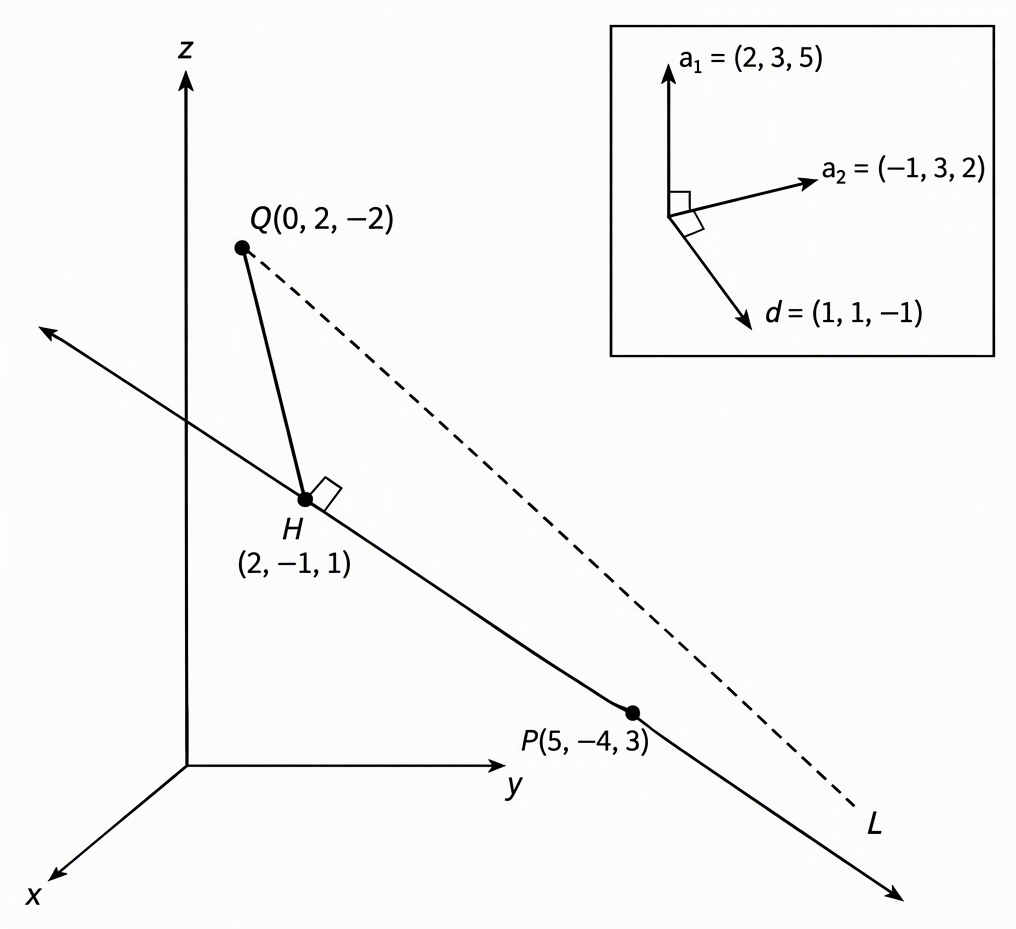
The points and intended supplied equations are:
Source check: the bank labels this JEE Main 2024 but supplies the date 2023-01-24. The exam date and shift remain unverified until that mismatch is resolved.
The supplied solution identifies option (4) as the value below. The complete option list is absent, so the other options cannot be reconstructed.
How do you find a direction perpendicular to both lines?
Take the cross product of the two direction vectors, extracted from the parameter coefficients. Do not use the fixed position vectors: those locate points on the original lines but do not specify their directions.
Keep every sign visible, especially the minus sign on the middle component:
Nonzero scalar multiples describe the same line direction, so use the simpler vector. A negative multiplier reverses the arrow without changing the line.
Verify perpendicularity by checking that both dot products vanish:
What is the equation of the required line through P?
Combine the specified point P with the direction just obtained. Using the original cross-product components gives the supplied symmetric equation:
Its equivalent vector form is:
Check that the line passes through P:
The fixed points on the two given lines are unnecessary because this construction uses only their directions and P. Do not add an intersection condition: L need not intersect either original line.
How does the projection calculation give the perpendicular distance?
Subtract the squared parallel component from the squared length of PQ. The supplied dot-product calculation correctly finds the component along the line but mislabels it as the perpendicular distance; the missing subtraction repairs the solution.
First calculate the displacement from P to Q:
Retain the supplied direction vector for the projection arithmetic:
The magnitude of the parallel component is:
In the figure, this is PH, not QH. The right triangle PQH has PQ as its hypotenuse, with PH along the line and QH perpendicular to it.
Calculate the squared hypotenuse:
Pythagoras supplies the missing perpendicular-component step:
This matches the supplied final answer, option (4). The parallel projection was an intermediate result, not the required distance.
Why is stopping at the dot-product projection wrong?
The direction vector is correct; the error is treating an along-line component as a shortest distance. Stopping at the absolute scalar projection produces the incorrect distance:
Keep the three squared lengths separate:
- Parallel component squared:
- Perpendicular component squared:
- Point-to-point length squared:
For a limiting-case check, place Q on L, away from P. Its distance from L must be zero, whereas its absolute scalar projection from P remains nonzero.
The projection value above is a demonstrable wrong distance from the supplied working, not a verified wrong option. Naming a listed distractor requires the actual option list; claiming which option students choose most often requires student-response data.
How can you apply this method to two related questions?
Use the cross product when two perpendicularity conditions determine the direction. Once the line is known, subtract the squared parallel component to find the distance. These two original practice variations, not verified PYQs, separate those stages.
How do you find the line through A perpendicular to both given directions?
Use the cross product as the direction of the line through A. Find the required line for these data:
The direction calculation gives:
Hence the required line is:
How do you find the distance of B from the given line?
Remove the squared parallel projection from the squared displacement. Find the distance for:
Using the fixed point on the line:
Therefore:
For your next attempt, follow this sequence:
- Extract the directions.
- Take their cross product when both perpendicularity conditions are given.
- Construct the line through the specified point.
- Remove the squared parallel component from the squared point-to-point length.
Next step: photograph a doubt on JEEnius and photograph any question you are stuck on and get a step-by-step solution, with a free-body diagram when the question needs one (20 free).
Read next: Equilibrium JEE 2019: FeS Answer and Worked Solution.
Frequently asked questions
How do I find a direction perpendicular to two given lines?
Take the cross product of the lines’ direction vectors, not their fixed position vectors. For (2, 3, 5) and (−1, 3, 2), the cross product is (−9, −9, 9), so you can use the simpler direction (1, 1, −1). Its dot product with each supplied direction is zero.
What is the equation of the required line through P(5, −4, 3)?
The required line is r = (5, −4, 3) + t(1, 1, −1), where t is real. It passes through P and has a direction perpendicular to both supplied directions. It need not intersect either original line.
Why is the shortest distance √74 and not 2√3?
For Q = (0, 2, −2) and P = (5, −4, 3), the displacement Q − P has squared length 86. The value 2√3 is the magnitude of its projection along the required line, not the perpendicular distance. Subtracting the squared parallel component gives D² = 86 − 12 = 74, so D = √74.
Which JEE Main 2024 date and shift is this question from?
The exam date and shift are unverified. The question bank labels it JEE Main 2024 but supplies the date 2023-01-24, so the source mismatch must be resolved before assigning a confirmed date or shift.