
What is the answer to the JEE Advanced 2023 tossed-coin question?
The JEE Advanced 2023 tossed-coin question gives 30 rotations: the same impulse produces upward motion and spin about a diameter. This numerical-answer question is from Paper 2, Physics, in System of Particles and Rotational Motion. There are no supplied options.
A thin coin of mass five grams and radius four-thirds centimetre starts horizontally in the xy-plane. An upward impulse of square root of pi over two, multiplied by ten to the power minus two newton seconds, acts two-thirds centimetre from its centre. It launches the coin vertically upward and makes it turn about a diameter.
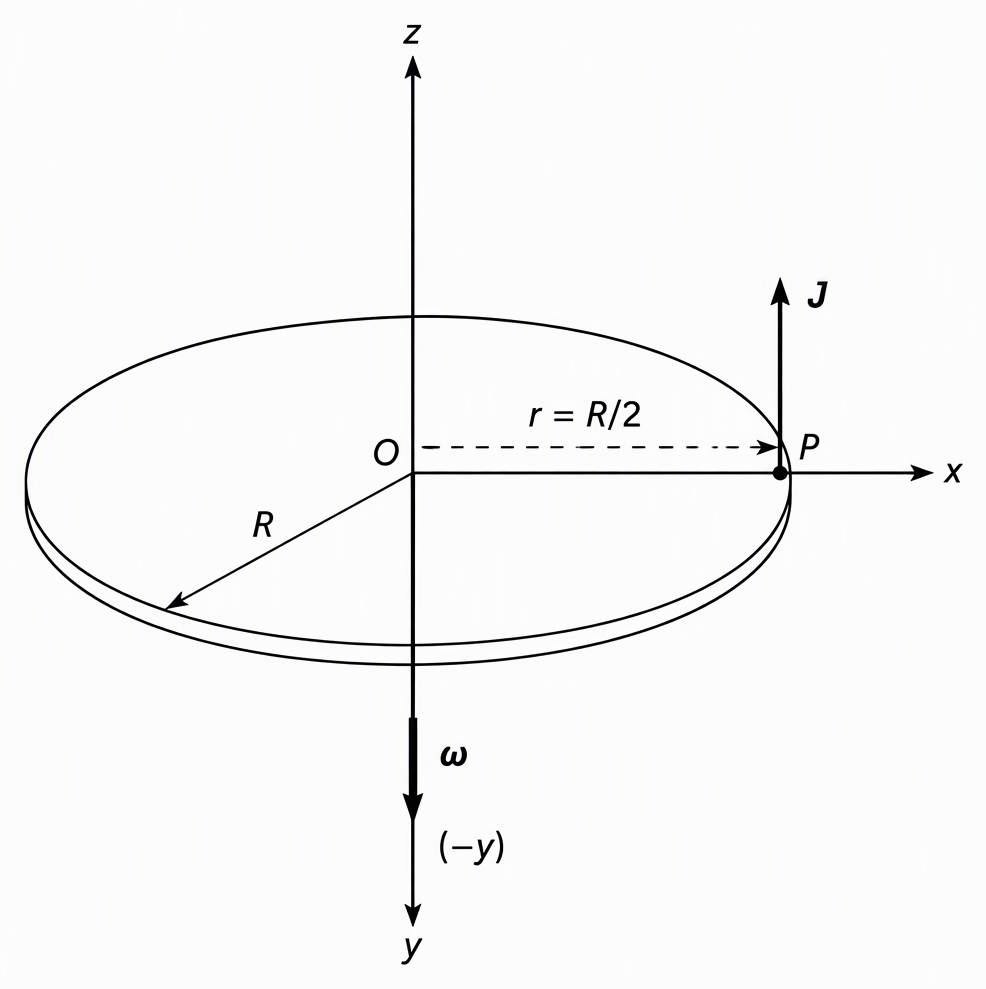
Find the rotations completed before the centre of mass returns to its launch height, taking:
The question bank suggests medium difficulty and 180 seconds. These are practice guidance, not official exam classifications.
How does the impulse determine the coin’s launch speed?
The centre of mass receives the full linear impulse, so its launch speed is impulse divided by mass. Do not split the impulse into translational and rotational portions. One off-centre impulse changes both linear momentum and angular momentum.
Start the official method by converting every given quantity to SI units:
The application point is halfway from the centre to the rim:
From initial rest, linear impulse equals the change in centre-of-mass momentum:
Keep this symbolic expression. Substituting it directly into the flight time avoids unnecessary decimal rounding.
Which moment of inertia gives the coin’s angular speed?
Use the moment of inertia about a diameter, not the axis perpendicular to the coin’s face. The radius to the impulse point is perpendicular to the upward impulse, so the angular-impulse magnitude about the centre is the impulse multiplied by that radius.
The direction follows the cross product:
With the application point on the positive x-axis and impulse along positive z, this vector points along negative y. It therefore lies along a diameter in the coin’s initial plane, not along the vertical symmetry axis.
For a thin disc about that diameter:
Apply angular impulse–momentum about the centre:
Rearranging:
During flight, uniform gravity acts through the centre of mass and gives no torque about it. The ideal coin therefore maintains this spin rate.
How do flight time and angular displacement give 30 rotations?
Use the full flight time, including ascent and descent, then divide the angular displacement by the angle in one complete turn. The stopping point is the centre of mass returning to its launch height, not reaching the highest point. At the highest point, the upward speed vanishes, but the spin continues.
For vertical motion returning to the same height:
Multiply constant angular speed by flight time:
First square the impulse. The square root disappears, and the exponent of ten doubles:
Now expand the denominator, keeping the mass conversion inside the square:
Substitute these results. Dividing the powers of ten leaves a factor of ten:
One complete rotation corresponds to:
Therefore:
Enter 30. Linear impulse determines flight time; angular impulse determines spin rate; their product determines angular displacement.
Why does using the symmetry-axis inertia give 15 instead?
Using the symmetry-axis inertia halves the calculated angular speed and produces 15, a derived wrong result, not a listed option. The source question is numerical-answer. The mistake is selecting an inertia formula from the object’s shape without checking the direction of its angular impulse.
The incorrect substitution is:
That formula belongs to the axis perpendicular to the coin’s face. Keeping the actual angular impulse but using this wrong inertia gives:
The centre-of-mass launch speed and flight time are unchanged, so:
Identify the rotation axis from the cross product before selecting the moment of inertia. Knowing only that the object is a disc is insufficient.
What happens if the impulse or its application point changes?
An impulse through the centre gives no spin; doubling the impulse changes both spin rate and flight time; moving it to the rim changes only spin rate. These are author-created variations, not additional verified PYQs. Retain the original idealisations and every quantity unless explicitly changed.
- Question 1: If the same upward impulse acts through the centre, how many rotations occur?
Answer: zero. The lever arm vanishes, so there is no angular impulse:
The centre-of-mass launch speed and flight time remain unchanged. The coin rises and falls without acquiring spin.
- Question 2: If the impulse magnitude doubles at the original application point, how many rotations occur?
Answer: 120. Angular speed doubles, and launch speed doubles, so flight time also doubles. Their product becomes four times as large:
- Question 3: If the original impulse acts at the rim instead of halfway to it, how many rotations occur?
Answer: 60. The lever arm doubles, so angular impulse and angular speed double. Flight time stays unchanged:
Before calculating a variation, mark what changes: increasing impulse alters translation and rotation; increasing the lever arm at fixed impulse alters only rotation.
Next step: photograph a doubt on JEEnius and photograph any question you are stuck on and get a step-by-step solution, with a free-body diagram when the question needs one (20 free).
Keep going with How to Study Definite Integration JEE: A Practice Plan.
Frequently asked questions
What is the answer to the JEE Advanced 2023 tossed-coin question?
The coin completes 30 rotations before its centre of mass returns to its launch height. Its angular displacement over the full flight is 60π radians, which gives 30 turns after division by 2π. This is a numerical-answer question with no supplied options.
Which moment of inertia should I use for the tossed coin?
Use I = MR²/4, the moment of inertia of a thin disc about a diameter. The angular impulse points along a diameter because its direction is given by the cross product of the position vector and the upward impulse. The symmetry-axis formula MR²/2 does not apply to this rotation.
Why am I getting 15 rotations instead of 30?
Using the symmetry-axis inertia MR²/2 instead of the diameter-axis inertia MR²/4 halves the calculated angular speed and gives 15 rotations. Using only the ascent time also halves the result. Check both the rotation axis and the full ascent-plus-descent flight time.
Should I split the impulse between translation and rotation?
No: the same off-centre impulse changes both linear momentum and angular momentum. Use J = MV_cm for the launch speed and Jr = Iω for the angular speed. There are no separate translational and rotational portions of the impulse.