
Does this conic sections JEE 2024 question contain enough information?
The supplied wording does not determine a numerical answer, although the key says 36. This conic sections JEE 2024 solution follows the focus–diameter–determinant method and identifies the missing condition needed to establish that answer.
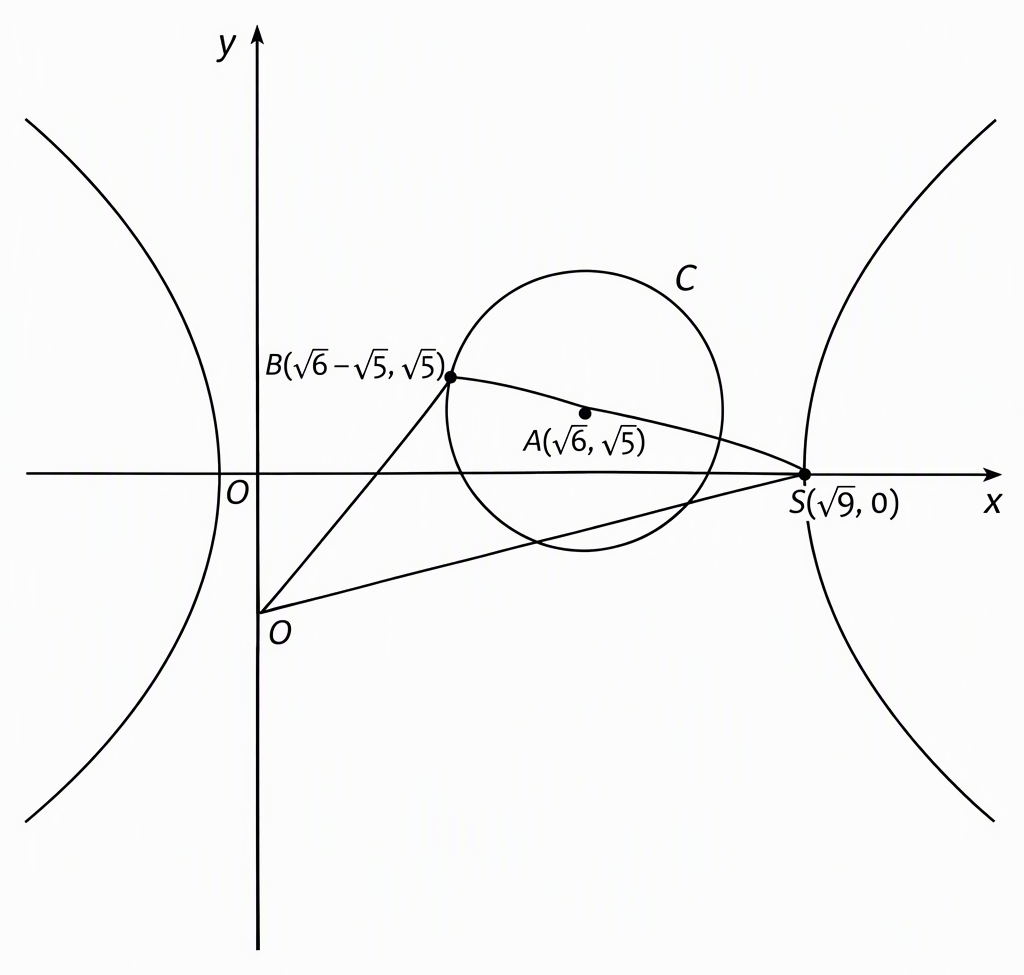
S is the right-hand focus of a horizontal hyperbola. A circle C, centred at A with coordinates square root of six and square root of five, passes through S; B is the opposite endpoint of the diameter through S and A. With O as the origin, find the square of the area of triangle OSB.
The supplied hyperbola is
This is a numerical-answer item, but neither hyperbola parameter is specified. The question bank’s “Hard” tag is a classification, not evidence that most students answer it incorrectly.
Source verification is required: the record labels the year as 2024 but gives the date 2023-01-24. The year, date and shift attribution need reconciliation before this can be published as a verified PYQ.
How do you find the focus S and the diameter endpoint B?
Find the positive focus first, then reflect it across the circle’s centre to obtain B. A is the midpoint of the diameter SB, which fixes both coordinates of B. Collinearity alone would place B on a line without fixing its position.
Step 1: Locate the focus. For this horizontal hyperbola,
so
Step 2: Use the circle’s centre. Its coordinates are
Since A bisects SB, the midpoint equations are
Step 3: Solve each coordinate separately.
Hence,
No circle equation or radius calculation is needed. The diameter gives both coordinates.
The supplied solution’s step 3 is defective: OB denotes a segment, not a point, and its asserted radius identity is not a valid general circle relation. Use the midpoint property instead.
How do you calculate the squared area of triangle OSB?
The squared area is determined algebraically, but still depends on the unspecified hyperbola parameters:
The determinant calculation below establishes this expression without assuming a numerical focus coordinate.
Step 4: Apply the triangle-area formula, including the absolute value:
For practice with this calculation, use Determinants Practice Questions JEE: 5 Solved Drills.
Substitute the three vertices:
Then
The last line uses the positive focus coordinate. Step 5: Square the area.
A’s horizontal coordinate disappears because OS lies on the x-axis. B’s vertical coordinate determines the altitude, so moving B horizontally without changing its height does not change the area.
What extra information would establish the keyed answer 36?
The missing condition must fix the sum of the squared hyperbola parameters. To establish 36, that condition is
The supplied wording gives no such condition, so keep the key separate from the derived result:
- Supplied answer key:
- Expression established from the supplied wording:
Matching the expression to the key requires or equivalently,
This is a necessary condition inferred from the key, not a fact stated in the question. It cannot be silently inserted as given data.
For any specified positive-axis focus S, a circle centred at A can pass through S by choosing AS as its radius. The circle’s existence therefore supplies no additional equation fixing the focus coordinate.
Check the original source before presenting this as a fully verified numerical PYQ solution. The supplied wording is underdetermined; that does not establish that the actual examination question was defective.
What goes wrong if you use the centre as the diameter endpoint?
Using A instead of B halves the altitude and quarters the squared area. No options were supplied for this numerical-answer item, so this is a method-error check, not a wrong-option analysis. No student response data supports calling it a common mistake.
The incorrect substitution is
It uses the height instead of
The resulting incorrect area and squared area are
The correct squared area is
Write the diameter relation before using the area formula. In coordinate-vector form,
Which two related conic-section questions should you practise?
Practise finding the focus alone, then repeat the full construction with a specified hyperbola. Both questions below are original related practice, not verified PYQs. Unlike the supplied question, each contains enough information for a numerical answer.
Question 1: Find the positive-x focus of
Add the squared semi-axis parameters to obtain the squared focus distance:
Hence,
Question 2: Consider the hyperbola
A circle centred at A passes through the positive focus S, where
Let B be opposite S on a diameter. Find the squared area of OSB.
First locate the focus, then recover B using the midpoint:
The determinant and its square give
Use this sequence on your next attempt: focus coordinate, diameter midpoint, triangle determinant, then square.
Next step: the past-paper archive on JEEnius and search every JEE Main paper from 2002 and every Advanced paper from 2007, by year, subject or chapter, each with a worked solution (free).
Frequently asked questions
How do you find the opposite endpoint of a diameter?
If S is one endpoint and A is the circle's centre, the opposite endpoint is B = 2A − S because A bisects the diameter. For A = (√6, √5) and S = (c, 0), this gives B = (2√6 − c, 2√5).
What is the squared area of triangle OSB in this question?
With O = (0, 0), S = (c, 0) and B = (2√6 − c, 2√5), the triangle has base c and height 2√5. Its area is c√5, so its squared area is 5c² = 5(a² + b²).
Why can't we get the answer 36 from the supplied question?
The squared area is 5(a² + b²), but the supplied wording does not fix a² + b². The keyed answer 36 requires a² + b² = 36/5, which is inferred from the key rather than stated in the question. A circle centred at A can pass through any specified focus S by taking AS as its radius, so its existence adds no constraint.
Is this a verified JEE 2024 conic sections PYQ?
The supplied record labels the year as 2024 but lists the date as 2023-01-24, so the attribution is not verified. The original source must be checked to reconcile the year, date and shift and confirm the complete wording. Incomplete supplied wording does not prove that the actual examination question was defective.