
What is the answer to the thermodynamics JEE 2024 two-tank question?
The numerical answer is 3 for the two-tank question in this thermodynamics JEE 2024 solution. It appeared in JEE Advanced 2024, Paper 1, Physics, in numerical-answer format. The question bank classifies it as medium; this is not an official exam difficulty rating.
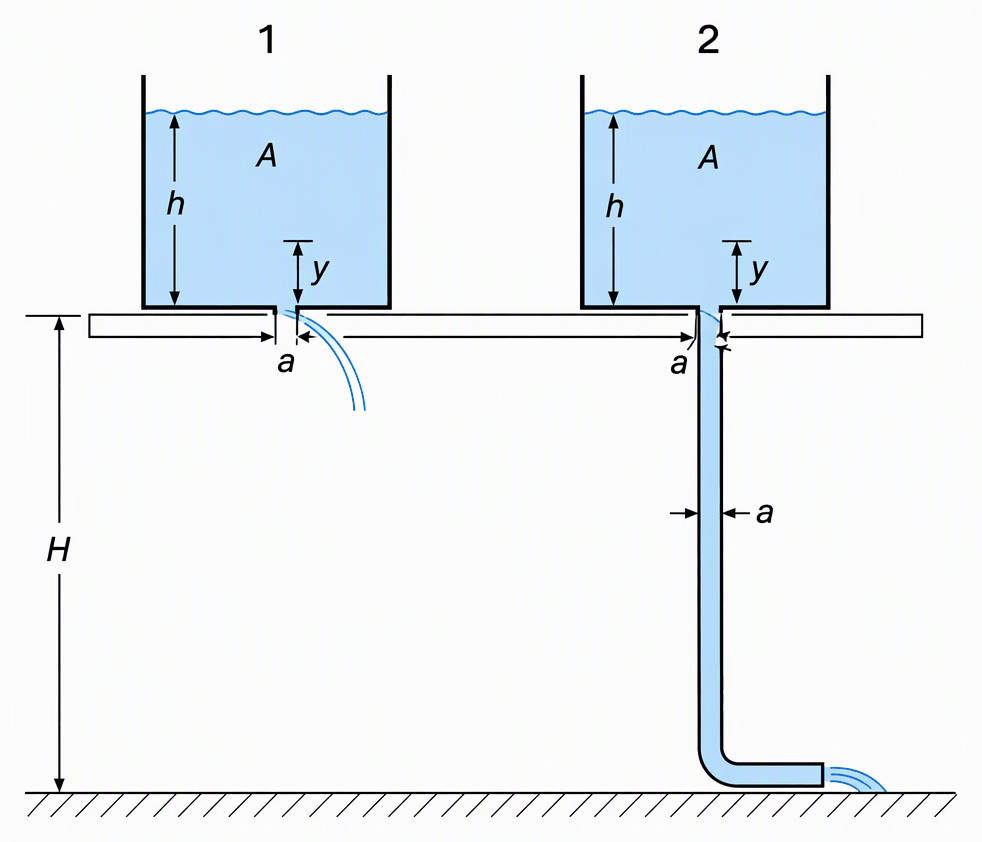
Two identical large tanks on a building initially hold equal water depths. Each has a small side opening near its bottom. Tank 1 discharges directly at roof level. Tank 2 discharges through a pipe whose internal area equals the opening area and whose open end reaches ground level.
The building height and initial water depth satisfy:
Find the ratio below, where the two times refer to emptying tanks 1 and 2, respectively:
There are no supplied answer options. The bank files this under Thermodynamics, but the required tools are Torricelli’s theorem, continuity and integration, not thermal physics.
How do you integrate the emptying time for tank 1?
Tank 1’s driving head is the instantaneous depth above its opening, so its speed falls as the level falls. Integrate the changing flow rate rather than dividing the initial water volume by the initial discharge rate.
Define the symbols:
The supplied solution assumes atmospheric pressure at the free surfaces and final outlets, negligible losses, and a much larger tank area than outlet area. Tank 2’s pipe remains water-filled during draining.
For tank 1, the free surface is above its atmospheric outlet by the instantaneous water depth. Torricelli’s theorem gives:
Continuity equates the volume leaving per second to the decrease in tank volume:
The depth derivative is negative because the level falls. The minus sign makes the outward flow rate positive.
Separate variables and integrate from the initial depth to zero:
Reversing the limits removes the minus sign. Evaluating the antiderivative gives:
Why does the ground-level pipe add to tank 2’s driving head?
Tank 2’s head is measured from its water surface to the final atmospheric outlet at ground level, not to the opening where the pipe attaches. The pipe entrance is not a free atmospheric outlet. Using the final outlet adds the building height to the driving head throughout draining.
The vertical head and pipe-outlet speed are:
The same volume flow passes through the equal-bore pipe. Applying continuity gives:
Separate variables exactly as for tank 1:
The tank again drains from the initial depth to zero. Reversing those limits produces:
The building height remains constant during integration:
The requested interval ends when the tank reaches zero water depth:
Do not add a separate interval for water remaining inside the pipe to empty afterward.
How does substituting the building height give an answer of 3?
Substitution makes the denominator one-third of the numerator, giving 3. The common area and gravity factor cancels, so no tank dimensions or numerical value of gravitational acceleration are needed.
Cancel the common factor:
This leaves:
Substitute the given height:
Thus:
The denominator becomes:
Therefore:
Enter 3 as the numerical answer. Tank 2 has greater head at every positive water depth, so it empties sooner, consistent with a ratio greater than one:
Why does comparing initial speeds give the wrong time ratio?
The initial speed ratio describes only the start of draining. Volume divided by flow rate gives the duration directly only when that flow rate stays constant. Here both heads, and therefore both discharge rates, change.
Initially:
The erroneous shortcut assigns:
This is an illustrative wrong numerical result, not a supplied wrong option. At equal instantaneous depths, the actual speed ratio is:
It depends on depth, so its initial value cannot represent the full draining process. Near the end:
Tank 1’s slow final stage matters, although its time integral remains finite. For practice with limits and antiderivatives, use Definite Integration Practice Questions JEE: 5 Solved Drills.
How do you solve two related tank-emptying practice questions?
Use the integrated ratio, not initial speeds, for both variations below. These are author-created practice variations, not additional verified JEE PYQs. They accompany the Thermodynamics entry under the same bank chapter grouping; the underlying physics remains fluid flow.
Question 1: With the same arrangement, find the emptying-time ratio when the building height equals the initial water depth.
Substitution and rationalisation give:
Question 2: With the same arrangement, what building-height to water-depth ratio makes tank 1 take twice as long?
Set:
Rationalising gives the first equation below; the original equation gives the second:
Subtract to obtain:
Check by substitution:
Before checking either practice solution, write the free-surface-to-final-outlet head for each tank. Then use continuity to set up the changing-head integral.
Next step: photograph a doubt on JEEnius and photograph any question you are stuck on and get a step-by-step solution, with a free-body diagram when the question needs one (20 free).
Frequently asked questions
What is the answer to the JEE Advanced 2024 two-tank question?
The emptying-time ratio t1/t2 is 3 when the building height H equals 16h/9, where h is the initial water depth. Tank 2, connected to the ground-level outlet by a water-filled pipe, empties faster. Enter 3 as the numerical answer.
Why is the driving head for tank 2 equal to y + H?
The driving head is the vertical distance from the free water surface to the final atmospheric outlet at ground level. That distance is y + H, where y is the instantaneous water depth above the tank opening and H is the building height. The pipe entrance is not a free atmospheric outlet.
Why can't I use the initial speed ratio to find the emptying-time ratio?
Both discharge speeds change as the water levels fall, so dividing the initial volume by the initial flow rate gives incorrect emptying times. The initial speed shortcut gives 5/3 for this question, whereas integrating the changing flow rates gives 3. Tank 1’s slow final stage cannot be ignored.
Is the JEE 2024 two-tank question thermodynamics or fluid mechanics?
The question bank groups this problem under Thermodynamics, but its underlying physics is fluid flow. The solution uses Torricelli’s theorem, continuity and integration, not thermal physics. It appeared in JEE Advanced 2024, Paper 1, Physics.