
Which definite integration practice should I start with for JEE?
Start with a skill check if choosing the method is your weakness, then move to authenticated PYQs. This page contains five original definite integration practice questions for JEE, with worked solutions. They are practice questions, not previous-year questions.
Choose authenticated PYQs when you can solve routine integrals independently. Choose full-length mocks when your topic knowledge holds up chapter-wise but fails under mixed-paper pressure. These routes serve different purposes; none is universally best.
The questions below test substitution, reflection, sign analysis and combining methods. Attempt them before collecting another giant PDF: your next practice set should target the first point where your reasoning breaks.
How do free skill drills, PYQs and full-length mocks compare?
Skill drills isolate method choices; authenticated PYQs show actual exam demands; mocks test decisions across a whole paper. Compare their purpose and feedback, not an unsupported difficulty ranking.
- Purpose: This page’s original skill-check set: diagnose method choice. Authenticated JEE PYQs: practise actual exam questions. Full-length mocks: test topic switching, pacing and question selection.
- Prerequisite readiness: This set: basic antiderivatives and substitution. Authenticated PYQs: independent routine solving. Full-length mocks: enough syllabus coverage for mixed practice.
- Definite integration coverage: This set: five selected method checks. Authenticated PYQs: depends on the papers selected. Full-length mocks: a particular paper need not contain definite integration.
- Solution feedback: This set: worked explanations and recognition cues. Authenticated PYQs: official keys verify answers; explanations depend on the source. Full-length mocks: feedback depends on the provider.
- Main/Advanced relevance: This set: foundational skills, not Advanced preparation. Authenticated PYQs: exam-specific when correctly sourced. Full-length mocks: relevant to the format they reproduce.
- Main limitation: This set: cannot establish chapter mastery. Authenticated PYQs: compilations require source checking. Full-length mocks: cannot reliably isolate a chapter weakness.
For PYQs, trace the year, paper or shift, question text and official answer key. Do not assume every compilation is accurate or freely accessible.
JEEnius includes free full-length tests: 75 questions, 300 marks, 180 minutes, with a scored per-subject breakdown. Use these for mixed-paper practice, not targeted method repair.
Which route should I pick in Class 11, Class 12 or a drop year?
Choose by demonstrated weakness, not your class label. A dropper who cannot recognise reflection needs targeted repair before another full paper. A Class 12 student who solves these questions independently should move to PYQs rather than repeat the same drill.
- Class 11, studying ahead: Check substitution, basic antiderivatives and trigonometric identities first. Harder mixed-method questions require these skills; if they still need hints, repair them before combining methods.
- Class 12, comfortable with antiderivatives but stuck at limits: Start with the reflection, symmetry and modulus questions below. Before calculating, inspect the interval and check how reflection changes the integrand.
- Any student solving all five independently: Explain why each method works, then attempt authenticated JEE Main PYQs. Recognising methods without labels is more useful now than repeating easy drills.
- Advanced aspirant with secure basics: Use authenticated Advanced PYQs for less-signposted combinations of ideas. This short diagnostic is not Advanced-level preparation.
- Dropper succeeding chapter-wise but stalling in full papers: Prioritise mixed-paper practice. Review which questions you selected, which you stayed with too long and where the mathematics failed.
A method-recognition error needs a different response from slow execution or poor question selection. Choose the route that addresses your recorded error.
Can I attempt five free definite integration questions before seeing the solutions?
All five statements appear before the worked solutions. Stop at the solution heading until you have attempted them. These are original skill-check questions, not PYQs: constructed-response practice, not a reproduction of an official paper pattern.
Record your proposed first step before doing the algebra. This separates recognising a method from carrying it out.
- Question 1: Evaluate
- Question 2: Evaluate
- Question 3: Evaluate
- Question 4: Evaluate
- Question 5: Evaluate
These questions sample method choices. They neither exhaust the chapter nor predict a JEE score.
How do I solve these five questions and recognise the right method?
Inspect the denominator, interval and sign changes before finding an antiderivative. Question 1 uses substitution, Questions 2 and 4 use reflection, and Question 3 needs a sign split. Question 5 combines reflection with substitution.
Question 1: Use substitution and transform both limits.
The numerator is proportional to the derivative of the denominator. That makes the denominator the natural new variable.
Once you change variables, use the new limits throughout. Keeping the old limits evaluates a different integral.
Question 2: Reflect to remove the variable multiplier.
Sine is unchanged when the interval is reflected. The original and reflected multipliers add to a constant.
Renaming the dummy variable and adding gives:
Integration by parts is also valid. Reflection shows directly why the multiplier disappears.
Question 3: Split where the expression inside the modulus changes sign.
The expression is negative before the midpoint and positive after it. The modulus makes both contributions non-negative.
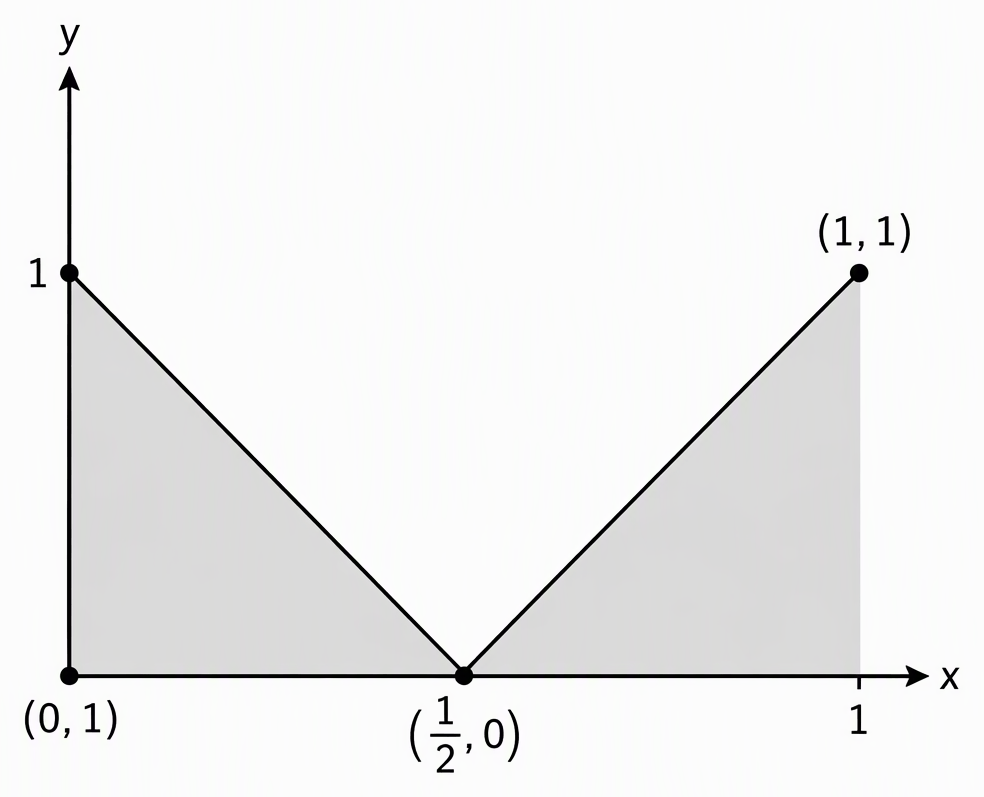
Dropping the modulus and using one signed antiderivative gives the wrong result:
That calculates cancellation between signed areas. The required integral adds their magnitudes.
Question 4: Reflect to create complementary fractions.
Reflection about the interval’s midpoint exchanges sine and cosine. The denominator stays unchanged, while the two numerators add to that denominator.
The denominator is positive throughout the interval. Both fractions are therefore defined.
Question 5: Reflect first, then substitute.
The factor multiplying the variable is unchanged by reflection: sine stays the same, as does squared cosine. Remove the variable multiplier before substituting.
Now substitute cosine. Its derivative supplies the sine factor.
Substituting before reflection leaves an unnecessary inverse-cosine factor. The order of methods matters.
What do my mistakes tell me to practise next?
Repair the first broken decision, not just the final arithmetic. Label every attempt independent, hint-assisted or incorrect, then record the first unjustified step. A correct answer after reading the method shows that you followed an explanation, not that you selected the method independently.
- Question 1 failed: Repair substitution or transformed-limit handling. Check the differential and both endpoints.
- Question 3 failed: Repair sign analysis and piecewise integration. Find the sign-change point before removing the modulus.
- Questions 2 or 4 failed: Check reflection recognition before prescribing more antiderivative practice.
- Questions 2 and 4 worked, but Question 5 failed: Practise combining methods. Identify what reflection removes and what substitution must still evaluate.
For an integrable function, reflection gives:
Use it when the transformed expression simplifies or complements the original. It is not a command to reflect every integral.
Choose your next questions by the recorded error. After a hint-assisted solution, attempt a fresh analogous problem without notes before moving on. Do not turn this five-question check into a readiness score.
How should I move from topic questions to exam practice?
Repair the failed method, attempt fresh authenticated PYQs without method labels, then test retention and question selection in a mixed paper. Keep Main and Advanced sets distinct. Check the relevant official question paper and answer key rather than trusting an unsourced difficulty label.
Main includes single-correct MCQs and numerical-answer questions. Practise obtaining an exact answer as well as checking options; option-based shortcuts alone leave a gap.
In mixed papers, review skipped questions as well as attempted ones. Separate a missing method from an execution error or a poor decision to continue with a time-consuming approach.
Advanced has two compulsory three-hour papers and a variable question and marking pattern. Never apply the Main mock format to Advanced preparation. Follow the instructions in the relevant Advanced paper, including its marking scheme.
What else should I know about free definite integration practice?
Check PYQ sources, judge progress by independent solving, and retain your substitution and antiderivative skills. Main PYQs provide a foundation, but Advanced preparation still needs Advanced-specific questions.
Where can I get free definite integration PYQs?
Start with official papers and answer keys: jeemain.nta.nic.in for Main and the official JEE Advanced website for Advanced. Check a chapter-wise compilation against the year, paper or shift, original wording and key.
How many definite integration questions should I solve?
There is no universal required count. Use independent method recognition, correct execution and success on fresh mixed questions as progress checks. Repeated errors need repair, not a larger quota.
Can definite integral properties replace indefinite integration skills?
No. Substitution and selected antiderivative skills remain necessary. In Question 5, reflection simplifies the problem; substitution and an inverse-tangent antiderivative finish it.
Are JEE Main PYQs enough for Advanced?
No. They provide useful foundations but do not replace Advanced-specific practice. Once your basics are secure, attempt authenticated Advanced questions without method labels and record the first step you cannot justify independently.
For mixed-paper practice, JEEnius free full-length mocks offer 75 questions, 300 marks and 180 minutes, with a scored per-subject breakdown. That breakdown is not a verified chapter-level diagnosis. Review your definite integration attempts yourself, including skipped questions and time spent before abandoning an approach.
Next step: full-length mock tests on JEEnius and sit a full 75-question, 300-mark, 180-minute paper and get a scored per-subject breakdown (free tests included).
If that step was the hard part, work through Sequence and Series JEE 2024: No Finite Minimum.
Frequently asked questions
Are these definite integration questions JEE PYQs?
No. These five questions are original skill checks, not previous-year questions or a reproduction of an official paper pattern. They test substitution, reflection, sign analysis and combining methods, but cannot establish chapter mastery.
How many definite integration questions should I solve for JEE?
There is no universal required count. Judge progress by independent method recognition, correct execution and success on fresh mixed questions. If an error repeats, repair that specific skill rather than increase your question quota.
Can definite integral properties replace indefinite integration skills?
No. Substitution and selected antiderivative skills remain necessary even when a definite integral property simplifies the problem. In the fifth drill, reflection removes the variable multiplier, but substitution and an inverse-tangent antiderivative finish the calculation.
Are JEE Main definite integration PYQs enough for Advanced?
No. Main PYQs provide useful foundations but do not replace Advanced-specific practice. Once your basics are secure, attempt authenticated Advanced questions without method labels and record the first step you cannot justify independently.