
Should I start with NCERT, JEE PYQs or a fresh practice set?
Choose NCERT exercises when definitions and procedures are shaky, JEE Main PYQs when those basics are secure, and JEE Advanced PYQs for Advanced-specific preparation. For coordination compounds practice questions, JEE students should choose by the mistake they need to fix, not by how difficult a question looks.
Six free original questions and worked solutions appear directly below. Use them to locate your starting point, not to replace textbook exercises or previous-year questions. They test charge balance, donor counting, isomerism and electron filling so that one error does not trigger a full chapter restart.
How do NCERT exercises, JEE PYQs and this diagnostic compare?
NCERT supports concept repair, PYQs test application in actual exam questions, and this set gives immediate worked reasoning. Main and Advanced PYQs serve different preparation goals; neither a textbook exercise nor this diagnostic establishes Advanced readiness.
- NCERT chapter exercises
- Primary purpose: Practise definitions and standard procedures.
- Prerequisite knowledge: Read the relevant explanations first.
- Exam relevance: A foundation source, not proof of Advanced readiness.
- Diagnosis: Practise foundational operations to locate recurring errors.
- Limitation: Cannot alone establish Advanced readiness.
- JEE previous-year questions
- Primary purpose: Main questions test Main application; Advanced questions test Advanced-specific demands.
- Prerequisite knowledge: Secure routine procedures before Main practice; connect electron counts, bonding and geometry before Advanced practice.
- Exam relevance: Actual exam provenance, provided the source identifies the paper correctly.
- Diagnosis: Reveal application errors, but a chapter label does not explain your mistake.
- Limitation: Answers without reasoning can leave misconceptions untouched.
- Original diagnostic on this page
- Primary purpose: Find the operation causing an error.
- Prerequisite knowledge: Recognise basic terminology and attempt without notes.
- Exam relevance: Original practice, with no past-paper provenance.
- Diagnosis: Immediate worked reasoning and named error categories.
- Limitation: Selected skills, not complete chapter coverage.
Obtain textbook material from official NCERT sources and use officially released exam papers where available. For Main, start with the official NTA site, jeemain.nta.nic.in; use the official JEE Advanced website for Advanced papers.
Which source matches the mistakes I am making?
Repair the weakest reasoning step before increasing difficulty. Miscounting donor atoms calls for NCERT work; getting routine questions right but misreading unfamiliar wording calls for PYQs. Choose by that distinction, not your class label or an invented readiness score.
- First-time learner: If ligand charge and denticity are confused, revise the relevant NCERT explanations and attempt associated exercises before timed PYQs. State each ligand’s charge and number of attached donor atoms separately.
- Main-focused student: If routine questions are correct without notes but unfamiliar wording causes errors, prioritise Main PYQs. Explain what the wording changes before doing the calculation.
- Advanced-focused student: Once oxidation states, electron counts and standard geometries are secure, move to Advanced PYQs that link concepts. Follow each question’s stated marking scheme rather than assuming every question is single-correct.
- Dropper: Use the diagnostic to isolate a gap. One linkage-isomerism error calls for repairing donor identity, not repeating every chapter exercise.
- Class 11 student studying ahead: Check bonding and electronic-configuration prerequisites. Your class label alone neither proves nor prevents readiness.
Which free coordination compounds practice questions for JEE should I try first?
Attempt these six original questions without notes, then check the solutions in the next section. This is a foundation-to-Main diagnostic, not a full Advanced test. Each MCQ has exactly one correct option; Question 4 requires a numerical answer. Keep one line of reasoning beside every response.
Question 1: Original practice, single-correct MCQ
For the compound below, identify cobalt’s oxidation state and coordination number. Here, en is neutral, bidentate ethane-1,2-diamine.
- A. Plus two; 6
- B. Plus three; 6
- C. Plus three; 4
- D. Plus three; 7
Question 2: Original practice, single-correct MCQ
Choose the correct systematic name. Potassium forms a monovalent positive ion, and each cyanido ligand has charge minus one.
- A. Potassium hexacyanidoiron(II)
- B. Potassium hexacyanidoferrate(III)
- C. Potassium hexacyanidoferrate(II)
- D. Potassium hexacyanidoferrate(IV)
Question 3: Original practice, single-correct MCQ
Identify the isomerism between these complexes, which differ only in the attachment of the nitrite ligand. In the first, nitrogen is the donor atom; in the second, oxygen is the donor atom.
- A. Linkage isomerism
- B. Ionisation isomerism
- C. Geometrical isomerism
- D. Coordination isomerism
Question 4: Original practice, numerical-answer
How many geometrical isomers does this square-planar complex have? Count only geometrical isomerism, not different orientations of the same structure.
Question 5: Original practice, single-correct MCQ
Both complexes below are octahedral. Iron has atomic number 26; water is neutral and each cyanido ligand has charge minus one. Choose the numbers of unpaired electrons in the first and second complexes, respectively.
- A. 0 and 4
- B. 4 and 4
- C. 0 and 0
- D. 4 and 0
Question 6: Original practice, single-correct MCQ
Nickel has atomic number 28. Chlorido and cyanido ligands each have charge minus one. Choose the correct comparison, in the order shown.
- A. Both tetrahedral and paramagnetic
- B. Tetrahedral and paramagnetic; square planar and diamagnetic
- C. Square planar and diamagnetic; tetrahedral and paramagnetic
- D. Both square planar and diamagnetic
How do I solve these questions and identify the wrong step?
The answer key is Q1 B, Q2 C, Q3 A, Q4 two, Q5 D and Q6 B. Check the reasoning even when your option matches. A correct guess does not show whether you counted donor atoms correctly or merely recognised a familiar formula.
Question 1: B. Error categories: charge balance and donor counting
The chloride outside the brackets makes the complex ion singly positive. Both en ligands are neutral, while the two coordinated chlorido ligands each contribute charge minus one.
Each bidentate en supplies two donor atoms, so the two en ligands contribute four. The outside chloride is a counterion, not a coordinated ligand.
Choosing 4 counts ligand units rather than donor atoms. Choosing 7 incorrectly includes the counterion.
Question 2: C. Error categories: charge balance and nomenclature
Four potassium ions require a complex charge of minus four. Balancing the six cyanido ligands gives iron’s oxidation state.
The name is potassium hexacyanidoferrate(II). An anionic iron complex takes the metal name “ferrate”; the Roman numeral records the metal oxidation state, not the complex charge.
Choosing “iron” misses the anionic-complex naming rule. Choosing (IV) confuses the magnitude of the complex charge with iron’s oxidation state.
Question 3: A. Error category: donor identity
Nitrite is ambidentate: it can attach through nitrogen or through oxygen. Switching the attached atom gives linkage isomerism.
Only one donor atom attaches in either form, so its denticity remains one here. Calling it bidentate confuses having alternative donor atoms with using two donor atoms simultaneously.
Question 4: Two. Error category: spatial arrangement
In the cis isomer, the chlorido ligands occupy adjacent positions; in the trans isomer, they occupy opposite positions. Rotating either structure does not produce another isomer.
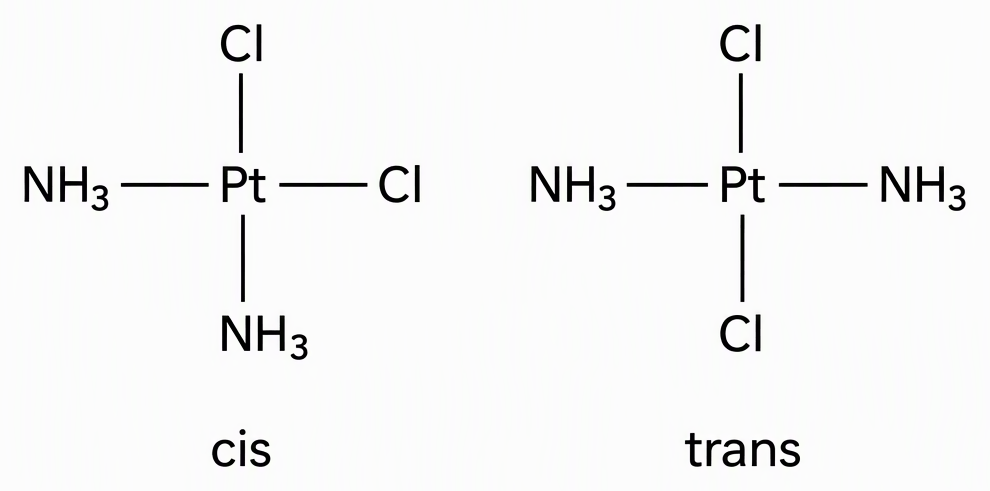
A count above two usually treats rotated drawings as different arrangements. Compare which ligands are adjacent or opposite, not where the page places them.
Question 5: D. Error category: electron filling
Both metals are iron(II), with six d electrons. The octahedral aqua complex is high spin; the cyanido complex is low spin.
\begin{aligned} [\mathrm{Fe(H_2O)_6}]^{2+}:& \quad t_{2g}^{4}e_g^{2}, \quad 4\ \text{unpaired electrons}\\ [\mathrm{Fe(CN)_6}]^{4-}:& \quad t_{2g}^{6}e_g^{0}, \quad 0\ \text{unpaired electrons} \end{aligned}For water, the lower set contains one pair and two single electrons, while the upper set contains two single electrons. For cyanido ligands, all six electrons pair in the lower set. Equal counts suggest you stopped at the metal’s electron count without applying ligand-field splitting.
Question 6: B. Error category: electron filling
Both complexes contain nickel(II), with eight d electrons. Their coordination numbers match, but their geometries do not.
The chlorido complex is tetrahedral. Its lower orbital set is filled; the upper three orbitals can hold six electrons but contain only four, leaving two unpaired electrons.
The cyanido complex is square planar and diamagnetic: its eight d electrons pair in the four lower-energy d orbitals, leaving the highest orbital empty. Treating coordination number four as automatically tetrahedral causes the wrong answer.
“Strong ligand means diamagnetic” is not a universal rule. Electron count and geometry must also be considered; ligand strength alone cannot determine the number of unpaired electrons.
What should I practise after checking my mistakes?
Use the failed step to choose your next source, not a score out of six. This set samples selected skills: it does not establish complete syllabus coverage or predict a chapter score. Repair the operation, then check it on an unseen question.
- Errors in Questions 1–2: Return to charge balance, denticity and nomenclature. Attempt fresh NCERT exercises that test those exact operations, rather than rereading every page.
- Errors in Questions 3–4: Draw the donor attachment or geometry before selecting an answer. Then use isomerism PYQs to check whether you can apply the rule to a different complex.
- Errors in Questions 5–6: Write oxidation state, d-electron count, geometry and orbital occupancy in that order. Decide magnetism only after counting unpaired electrons.
- All correct without notes: Progress to Main PYQs. Advanced aspirants should then use Advanced PYQs, not treat this short diagnostic as sufficient preparation.
Keep a three-part error record: incorrect step, corrected rule, fresh-question check. “Answer was B” records the result but repairs nothing; “counted ligand molecules instead of donor atoms” identifies a fix you can test.
Why should I finish with a mixed paper rather than another chapter test?
A mixed Chemistry section requires you to recognise which concept a question needs. Knowing in advance that every question concerns coordination compounds removes that difficulty. After targeted repair and PYQs, practise selecting the method without a chapter label.
JEE Advanced is a different exam: it has two compulsory three-hour papers, with question types and marking schemes that vary by year. Main-pattern practice does not replace those papers.
For the mixed-paper step, JEEnius offers full-length mock tests, including free tests, with 75 questions, 300 marks, 180 minutes and a scored per-subject breakdown. Use these as Main-pattern full-paper practice, not coordination-compounds-only tests. The subject breakdown does not automatically identify this chapter’s mistakes: inspect your Chemistry responses and record the first incorrect reasoning step yourself.
Next step: full-length mock tests on JEEnius and sit a full 75-question, 300-mark, 180-minute paper and get a scored per-subject breakdown (free tests included).
If that step was the hard part, work through Complex Numbers JEE 2025: Determinant and Modulus Solution.
Frequently asked questions
Should I solve NCERT or JEE PYQs first for coordination compounds?
Start with NCERT explanations and exercises if ligand charge, denticity or other standard procedures are shaky. Move to JEE Main PYQs when routine questions are correct without notes. For Advanced preparation, use Advanced PYQs once oxidation states, electron counts and standard geometries are secure.
Are these coordination compounds questions actual JEE PYQs?
No. These are six original questions with worked solutions, designed as a foundation-to-Main diagnostic. They test selected skills rather than complete chapter coverage and do not establish Advanced readiness.
How do I calculate coordination number for a complex?
Count the donor atoms attached to the central metal, not the number of ligand molecules. In [Co(en)2Cl2]Cl, the two bidentate en ligands contribute four donor atoms and the two coordinated chlorido ligands contribute two, giving a coordination number of six. The chloride outside the brackets is a counterion and is not counted.
Do strong-field ligands always make a complex diamagnetic?
No. Ligand strength alone does not determine magnetism; the metal's d-electron count and the complex's geometry also matter. Write the oxidation state, d-electron count, geometry and orbital occupancy, then count unpaired electrons.
What should I practise after solving these six questions?
Use the incorrect reasoning step to choose your next practice, rather than your score out of six. Repair charge balance, denticity and nomenclature through targeted NCERT work, or use isomerism PYQs after correcting donor-attachment and geometry errors. If all six are correct without notes, move to Main PYQs; Advanced aspirants should then practise Advanced PYQs.