
Should I start with chapter questions, PYQs or mocks?
For free carboxylic acids practice questions for JEE, start with original worked chapter questions for shaky concepts, authentic PYQs for exam calibration, and full-length mocks for timing and subject switching. This page provides a free original starter set with explanations below, not just recommendations.
A full-paper score cannot, by itself, diagnose a carboxylic acids weakness. Attempt the six questions first, then choose your next practice route from the errors you make.
Which free carboxylic acids practice route fits my problem?
Choose worked questions for concept errors, PYQs for unfamiliar exam wording, and mocks for pacing and subject switching. Compare the formats below by what they test and what they leave out.
- Chapter focus: This article’s original worked set: six targeted foundation questions. Authentic Main or Advanced PYQs: chapter-relevant questions from actual papers. Full-length mocks: whole-paper practice; carboxylic acids coverage depends on the paper and is not guaranteed.
- Explanations: Original worked set: reasoning and traps provided here. PYQs: an official answer key verifies answers but need not explain them; explanation quality depends on the accompanying source. Mocks: check the offering rather than assuming worked solutions.
- Exam authenticity: Original worked set: not past-paper questions. PYQs: authentic when their source is traceable. Mocks: simulations, not past papers.
- Timing realism: Original worked set: isolated chapter work. PYQs: chapter-only selection removes subject switching. Mocks: full-paper time pressure.
- Best use: Original worked set: diagnose basic errors. PYQs: check application against exam demands. Mocks: practise selection, pacing and subject switching.
- Principal limitation: Original worked set: not a complete chapter test. PYQs: remembered solutions can hide weak reasoning. Mocks: a subject score cannot isolate chapter weaknesses.
For a documented numerical reference, JEEnius includes free full-length tests with 75 questions, 300 marks, 180 minutes and a scored per-subject breakdown. That is a Main-format practice option, not an Advanced format.
Who should choose each practice route?
Current performance should decide your route, not your class or dropper status. If you are learning the chapter for the first time, use the worked set after studying the relevant reactions, regardless of your class.
- Class 11 student studying ahead: learn acidity, the main conversions and their conditions first. Then attempt the starter set without notes.
- Class 12 student mixing up products: begin with targeted questions. Explain each reagent’s role, such as reduction or decarboxylation, before moving to mixed practice.
- Student comfortable with familiar examples but confused by exam wording: prioritise authentic chapter-relevant PYQs. Identify the substrate, reagent and conditions before considering options.
- Dropper solving correctly untimed but losing marks across a paper: use full-length mocks alongside chapter revision driven by individual errors.
- Advanced aspirant: progress from this foundation check to authentic Advanced questions. Basic single-correct success is not proof of Advanced readiness.
Repair the chemical error before increasing the size of the test. If you confuse a reagent’s action, revise that conversion and reattempt a targeted question rather than taking another full paper.
Can I try free carboxylic acids questions before seeing the answers?
Attempt these six original single-correct MCQs without notes; the answers are in the next section. They are not PYQs and provide a foundation check, not an exhaustive Main or Advanced assessment. Record an option and one sentence of reasoning for each, including any condition that influenced your choice.
1. Which acidity order is correct in water?
Under comparable aqueous conditions, which sequence shows increasing acidity?
- A. Ethanoic acid, chloroethanoic acid, dichloroethanoic acid.
- B. Dichloroethanoic acid, chloroethanoic acid, ethanoic acid.
- C. Chloroethanoic acid, ethanoic acid, dichloroethanoic acid.
- D. Ethanoic acid, dichloroethanoic acid, chloroethanoic acid.
2. Which compound promptly releases carbon dioxide with sodium hydrogen carbonate?
Separate samples are treated with aqueous sodium hydrogen carbonate at room temperature. Which substance gives prompt carbon dioxide evolution?
- A. Phenol.
- B. Ethanol.
- C. Ethanoic acid.
- D. Ethyl ethanoate.
3. Which acid cannot undergo standard HVZ alpha bromination?
Consider the standard Hell–Volhard–Zelinsky reaction using bromine and red phosphorus, followed by hydrolysis. Which acid lacks the structural requirement for alpha bromination?
- A. Ethanoic acid.
- B. Propanoic acid.
- C. Butanoic acid.
- D. Benzoic acid.
4. What happens when water is removed during esterification?
Ethanoic acid and ethanol undergo reversible esterification with an acid catalyst at a fixed temperature. If water is selectively removed while the reacting mixture is retained, what happens?
- A. The equilibrium constant increases because water is removed.
- B. Ester formation is favoured, but the equilibrium constant remains unchanged.
- C. More ethanoic acid and ethanol form to replace the removed water.
- D. The catalyst prevents the equilibrium composition from changing.
5. Which treatment converts ethanoic acid into ethanol?
Which treatment is suitable for converting ethanoic acid to ethanol under standard preparative conditions?
- A. Sodium borohydride in ethanol under ordinary conditions.
- B. Aqueous sodium hydroxide at room temperature.
- C. Lithium aluminium hydride in dry ether, followed by a separate aqueous work-up.
- D. Acidified potassium dichromate on warming.
6. Which organic product forms from sodium benzoate and soda lime?
Dry sodium benzoate is strongly heated with soda lime, a mixture of sodium hydroxide and calcium oxide. What is the organic product?
- A. Benzene.
- B. Toluene.
- C. Benzyl alcohol.
- D. Phenol.
What are the answers, and which rules explain them?
The correct options are 1 A, 2 C, 3 D, 4 B, 5 C and 6 A. Check your written reasons, not just your total. A guessed answer can hide the same weakness as a wrong one.
Why is option A correct for the acidity order?
Chlorine stabilises the carboxylate conjugate base through its electron-withdrawing inductive effect. Acidity increases from ethanoic acid to chloroethanoic acid to dichloroethanoic acid under comparable aqueous conditions. Two chlorine substituents strengthen this effect compared with one.
The trap is B: reversing the order because chlorine attracts electrons strongly. Track how that attraction stabilises the negative charge after proton loss.
Why does ethanoic acid give the bicarbonate test?
Option C is correct because ethanoic acid reacts with hydrogen carbonate to release carbon dioxide. Phenol and ethanol do not give this prompt response under the stated conditions. Ethyl ethanoate is an ester, not a free carboxylic acid.
The trap is A: phenol is acidic, but not strong enough for this test. Sodium metal is different: it can release hydrogen with ethanol and phenol as well as carboxylic acids.
Why does benzoic acid fail the standard HVZ requirement?
Option D is correct because standard HVZ alpha halogenation requires an alpha hydrogen. Ethanoic, propanoic and butanoic acids have hydrogen on the carbon adjacent to the carboxyl carbon. Benzoic acid lacks the required alpha carbon-hydrogen bond.
The trap is A: overlooking ethanoic acid’s methyl hydrogens. Those are alpha hydrogens, so it meets the requirement.
Why does removing water favour ester formation?
Option B is correct because removing water, a product, favours further ester formation. The equilibrium composition changes, but the equilibrium constant stays unchanged at fixed temperature.
The trap is A: confusing composition with the equilibrium constant. The acid catalyst speeds the approach to equilibrium in both directions; it does not change that constant.
Why is lithium aluminium hydride the suitable reducing agent?
Option C is correct because lithium aluminium hydride reduces a simple carboxylic acid to a primary alcohol after work-up. The hydride treatment requires dry conditions; water is added afterwards. Ethanoic acid becomes ethanol without losing its carboxyl carbon.
The trap is A: treating sodium borohydride as interchangeable with lithium aluminium hydride. Sodium borohydride is not the standard reagent for reducing simple carboxylic acids under ordinary conditions.
Why does sodium benzoate give benzene rather than benzyl alcohol?
Option A is correct because soda-lime decarboxylation removes the carboxyl carbon from the organic product. The benzene ring remains, and hydrogen replaces the carboxylate group.
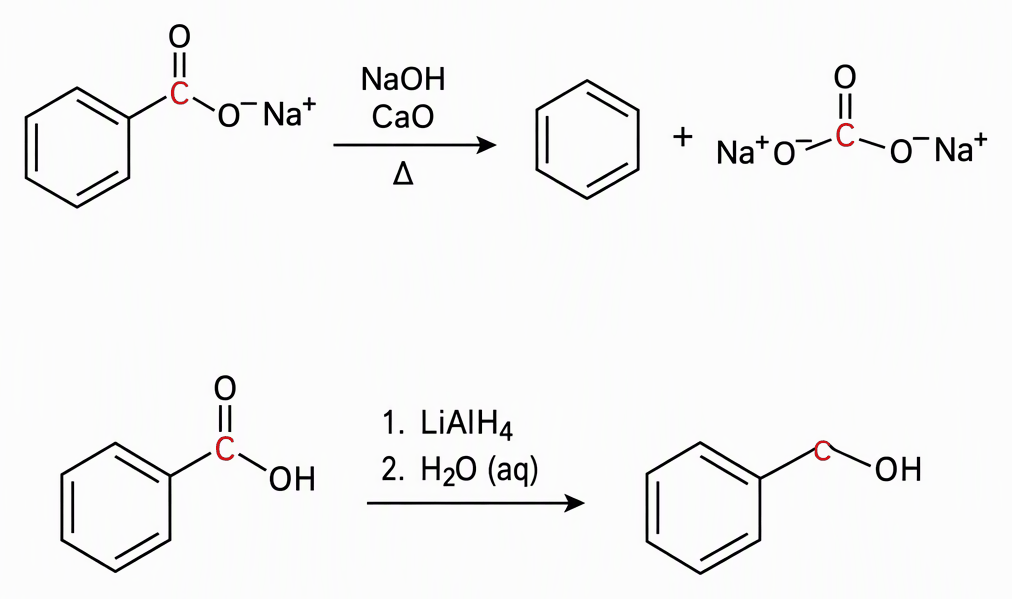
The trap is C: confusing decarboxylation with reduction. Reduction of benzoic acid to benzyl alcohol retains the carboxyl carbon; soda-lime decarboxylation does not.
How should I group my mistakes for revision?
Sort errors by the reasoning that failed, using the three buckets below. Place a question in more than one bucket if needed. Do not turn this small original set into a predicted mark, percentile or readiness cutoff.
- Acidity and conjugate-base reasoning: questions 1 and 2. Explain substituent effects and distinguish bicarbonate testing from sodium-metal reactions.
- Reagent recognition: questions 3 and 5. Identify the transformation and substrate requirement before predicting a product.
- Reaction conditions or carbon tracking: questions 4 and 6, plus the work-up in question 5. Mark what changes, what stays fixed and whether the organic product loses carbon.
When should I move to PYQs, and how do I verify them?
Move to authentic PYQs when you can explain the starter answers in your own words. Use Main PYQs to check application in Main wording and Advanced PYQs for more demanding combinations of concepts.
Carboxylic acids may appear within broader organic chemistry collections or collections titled “Aldehydes, Ketones and Carboxylic Acids.” A chapter label alone does not establish coverage or authenticity.
Before using a claimed PYQ:
- Identify the exam, year and paper or session.
- Find a traceable answer key tied to that paper.
- Check that the explanation accounts for reagents, conditions and competing pathways, rather than merely naming an option.
- Attempt the question before reading its solution.
- Revise the failed rule, then reattempt the question without the solution.
Use the official answer key to verify the answer; judge the worked explanation by its chemistry. JEE Advanced question types and marking vary by year, so follow the instructions of the paper you are using rather than Main-format assumptions.
When should I use a full mock instead of another chapter drill?
Use a full mock to test question selection and solving under whole-paper pressure. It tests pacing and subject switching, not mastery of every carboxylic acids subtopic. If a reagent rule is still unclear, choose targeted revision first.
Follow this practice loop:
- Attempt the starter set without notes.
- Diagnose errors and revise only the relevant rules.
- Attempt authentic PYQs, then reattempt your mistakes.
- Test execution in a full paper.
For that final step, JEEnius offers full-length mocks, including free tests, with 75 questions, 300 marks and 180 minutes, followed by a scored per-subject breakdown.
Review your individual organic chemistry errors as well as the Chemistry score. Before the next paper, write the corrected rule beside each error and solve it again without looking at the answer.
Next step: full-length mock tests on JEEnius and sit a full 75-question, 300-mark, 180-minute paper and get a scored per-subject breakdown (free tests included).
If that step was the hard part, work through Binomial Theorem JEE 2026: Weighted Sums by Integration.
Frequently asked questions
Should I start carboxylic acids practice with chapter questions or PYQs?
Start with worked chapter questions if your concepts or reagent rules are shaky. Move to authentic PYQs when you can explain the answers in your own words. Use full-length mocks to practise pacing, question selection and subject switching.
Are these carboxylic acids questions actual JEE PYQs?
No, these are six original single-correct MCQs with worked explanations. They check foundations, not complete Main or Advanced readiness. For authentic PYQs, verify the exam, year, paper or session and a traceable answer key.
Why does benzoic acid not undergo the standard HVZ reaction?
Standard HVZ alpha halogenation requires an alpha hydrogen. Benzoic acid lacks the required alpha carbon-hydrogen bond, whereas ethanoic, propanoic and butanoic acids meet this structural requirement.
What is the difference between carboxylic acid reduction and soda-lime decarboxylation?
Lithium aluminium hydride reduction followed by aqueous work-up converts a simple carboxylic acid to a primary alcohol while retaining the carboxyl carbon. Soda-lime decarboxylation removes that carbon from the organic product. Thus, benzoic acid gives benzyl alcohol on reduction, while sodium benzoate gives benzene on heating with soda lime.