
Which free Atomic Structure practice questions for JEE should I use first?
Use PYQs to check readiness, not to learn every missing step. For free Atomic Structure practice questions for JEE, use NCERT examples and exercises for unresolved fundamentals, JEE Main previous-year questions for exam calibration, and the original drills below to isolate mistakes. Original questions and worked solutions follow on this page.
These routes complement one another because they repair different gaps. Advanced aspirants should move to authentic Advanced PYQs after foundational work, not treat Main questions as sufficient preparation.
How do NCERT, official PYQs and these original drills compare?
NCERT builds foundations, official PYQs test exam application, and these drills isolate specific errors. Keep solution support separate from question access: a worked example explains the method, while an official answer key gives the answer without necessarily explaining it.
- Purpose
- NCERT textbook: Build concepts through explanations, worked examples and exercises.
- Official-paper questions: Check application in authentic Main or Advanced questions.
- Original drills here: Isolate a rule, proportionality or interpretation error.
- Prerequisite knowledge
- NCERT textbook: Use when basic rules still need explanation.
- Official-paper questions: Use once you can select and apply the relevant relationships.
- Original drills here: Basic formula recognition is enough to attempt them.
- Question-format exposure
- NCERT textbook: Textbook problems, not full exam-format preparation.
- Official-paper questions: Main or Advanced formats from the selected papers; keep them distinct.
- Original drills here: Open-response reasoning, without options or exam marking.
- Solution support
- NCERT textbook: Worked examples explain methods; not every exercise has a worked solution.
- Official-paper questions: Official keys give answers, not necessarily worked explanations.
- Original drills here: Worked solutions and error-specific repairs appear below.
- Access friction
- NCERT textbook: Find the Class 11 Chemistry textbook through NCERT’s official textbook portal.
- Official-paper questions: Look through NTA’s official JEE Main resources at jeemain.nta.nic.in and the official JEE Advanced website’s past-paper resources.
- Original drills here: Attempt directly on this page.
- Principal limitation
- NCERT textbook: Foundations alone do not establish exam readiness.
- Official-paper questions: Papers are organised by paper or session, so chapter questions may need manual selection.
- Original drills here: This narrow sample cannot establish whole-chapter mastery.
These access directions are not a claim of verified current availability. Do not assume an official chapter-filtered bank exists, or that questions, answer keys and worked explanations are available together.
Which route should I choose for my current mistake?
Choose by your error, not your class label, coaching enrolment or the resource’s prestige. A Class 11 student may be ready for PYQs, while a dropper may need to reconstruct a basic rule. Match your next step to the failed skill:
- Class 11, quantum numbers feel arbitrary: If you cannot explain why a combination is invalid, begin with textbook explanations and worked examples. Then attempt the quantum-number drill below without copying the allowed ranges.
- Class 12, formulas are familiar but transitions go wrong: Use the transition drill before returning to Main PYQs. Check the energy-to-wavelength conversion before assuming you have forgotten the energy-level formula.
- Dropper, PYQ answers look familiar: Hide the options and write the reasoning. Then solve an unfamiliar original drill to check whether recognition is masking a gap.
- Main aspirant, untimed answers are correct but mixed work suffers: Use chapter PYQs followed by mixed-paper practice. Do not restart the entire chapter if the problem is selecting a method under pressure.
- Advanced aspirant, basics are secure: Move to authentic Advanced PYQs. Follow each paper’s stated question types and marking scheme, because Advanced has no fixed pattern.
Can I try free Atomic Structure questions before reading the solutions?
Attempt these five original practice drills without notes, then check the worked solutions in the next section. They are a diagnostic sample, not PYQs or complete chapter coverage. Record the relationship or rule used and mark any guess. A correct guess does not count as secure understanding.
- Original practice drill: transition wavelengths
Two hydrogen-like ions undergo the same allowed downward transition, with identical initial and final principal quantum numbers. Their nuclear charges are:
Within the usual JEE hydrogen-like model, find the ratio of emitted photon wavelengths:
State how photon energy depends on nuclear charge and how wavelength depends on photon energy.
- Original practice drill: de Broglie wavelengths
Two non-relativistic particles have equal kinetic energy. Their masses are:
Find their de Broglie wavelength ratio without assuming equal speeds:
- Original practice drill: quantum numbers
Decide whether this proposed set is allowed. Name the violated condition rather than giving only a yes/no answer.
- Original practice drill: uncertainty
The position uncertainty of a particle is reduced to one-third of its initial value. Find how the lower bound on momentum uncertainty changes, and state whether this proves that the actual uncertainty changes by the same factor.
- Original practice drill: orbital counting
A subshell has azimuthal quantum number:
Find its number of orbitals and maximum electron capacity. Explain which quantum number counts the orbitals and which rule limits their occupancy.
Keep your original attempts visible when checking. Preserve incorrect reasoning so you can identify the step that needs repair.
What are the worked solutions, and what does each error mean?
The transition and de Broglie drills test proportionality; the other drills test allowed values, bounds and counting. Check each step against the stated conditions, not just the final answer. After repairing an error, reproduce the corrected method unaided before attempting a relevant PYQ.
How does nuclear charge affect the emitted wavelength?
The wavelength ratio is the inverse of the squared nuclear-charge ratio. For the same initial and final levels, photon energy scales with nuclear charge squared in the usual JEE hydrogen-like model. Wavelength varies inversely with that photon energy.
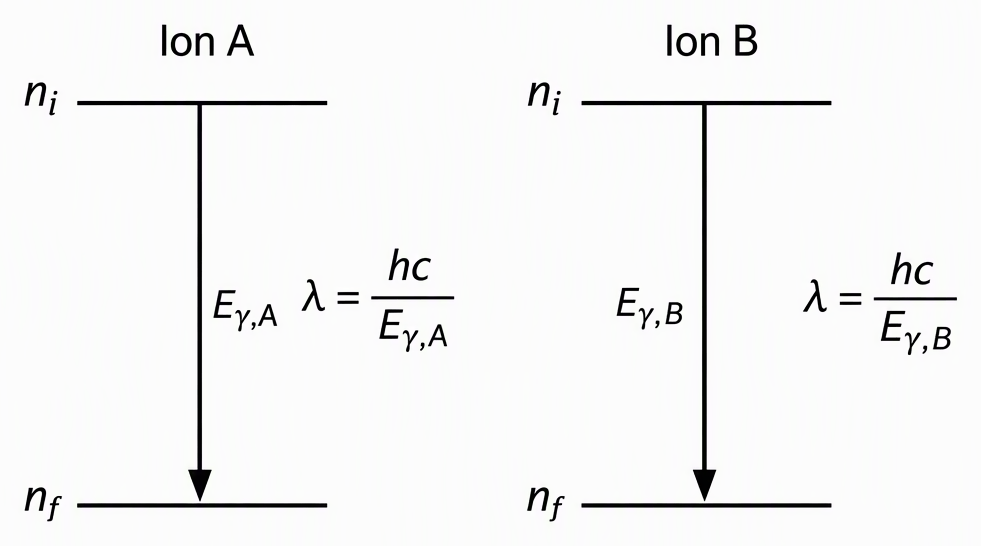
The energy constant is common to both ions in this model, so it cancels in the ratio. Connect that ratio to wavelength using the photon-energy relationship:
If you carried the energy ratio directly into the wavelength ratio, the missing link is the inverse energy-wavelength relationship, not another spectral formula. Try a fresh symbolic ratio problem, writing the photon-energy step explicitly before returning to a transition PYQ.
What changes when particles have equal kinetic energy?
The heavier particle has the shorter wavelength because its momentum is larger at equal kinetic energy. Equal kinetic energy does not mean equal speed: the heavier particle moves more slowly. Combine the momentum form of kinetic energy with the de Broglie relationship.
If you assumed equal speeds, compare symbolic problems with equal kinetic energy and equal speed. Identify what is held constant before forming either ratio, then reproduce the corrected method unaided before selecting a related PYQ.
Why is the proposed quantum-number set invalid?
The magnetic quantum number lies outside its permitted range. The principal, azimuthal and spin entries satisfy their individual constraints, but the magnetic entry does not. Check each range independently:
Repair: Return to the textbook and reconstruct the hierarchy of allowed values from memory. Explain why the magnetic entry fails before attempting a relevant PYQ.
Does reducing position uncertainty triple momentum uncertainty?
It triples the lower bound, not necessarily the actual momentum uncertainty. The uncertainty principle is an inequality, so equality cannot be assumed. Keep the calculated bound separate from the particle’s actual uncertainty.
Repair: Write “at least” when translating the inequality into words. Try another symbolic change in position uncertainty and distinguish the new bound from an actual measured spread before returning to PYQs.
How many orbitals and electrons can a subshell contain?
The orbital count is the number of allowed magnetic quantum numbers. Each orbital holds at most two electrons with opposite spins under the Pauli exclusion principle, so maximum electron capacity is twice the orbital count.
Repair: If you confused orbitals with electrons, reconstruct the textbook counting rule from the allowed magnetic values, then apply the occupancy limit. Reproduce both steps unaided before attempting a counting PYQ.
This sample does not test every area, including electronic configurations and the full range of spectra problems. Getting every answer right is not a chapter-clearance certificate.
How should I build my next practice block from these mistakes?
Build the next block around a failed skill, not your total score. Attempt without notes, check the reasoning, classify the error, repair that skill, then solve an unseen related question. Before treating a repeated question as mastered, explain why its method applies.
Keep a minimal error log with the question source, error type, failed step and repair:
- Concept error: You cannot explain a rule or its meaning. Return to the relevant textbook explanation, then state the rule without looking.
- Equation-selection error: You choose a formula with the wrong conditions. Compare two superficially similar problems, such as equal-speed and equal-energy cases.
- Algebra or unit error: The model is correct but execution fails. Show intermediate algebra and units rather than doing every step mentally.
- Guessed answer: The final answer is right but unsupported. Keep it marked as guessed until you can justify it independently.
When selecting PYQs, retain the exam identity and original marking instructions. Do not attach an invented year or shift to an unverified question, or import Main marking assumptions into Advanced.
Test the repaired method in an unseen related question. If that attempt fails, inspect the new failed step rather than restarting the whole chapter.
When should I use a free full-length mock instead of chapter practice?
Use a full mock to test execution across subjects after repairing the specific chapter misconception. An entire paper is an inefficient way to check one wavelength ratio. Mixed or full-paper practice tests whether the corrected method survives switching topics and managing time.
JEEnius offers full-length mocks, including free tests, with 75 questions, 300 marks, 180 minutes and a scored per-subject breakdown. Those specifications are the JEE Main Paper 1 format, not an Advanced format. Treat the mock as exam simulation, not as a substitute for focused Atomic Structure work.
Before your next paper, pick one failed drill, write the governing rule without notes and solve an unseen related question. Repair the identified chapter weakness first, then use mixed or full-paper practice to test whether the repair survives exam conditions.
Next step: full-length mock tests on JEEnius and sit a full 75-question, 300-mark, 180-minute paper and get a scored per-subject breakdown (free tests included).
If that step was the hard part, work through Integral Calculus JEE 2026: Floor-Function Integral.
Frequently asked questions
Should I solve NCERT or JEE PYQs first for Atomic Structure?
Start with NCERT explanations and worked examples if you cannot explain the basic rules or choose the correct relationship. Use JEE Main PYQs once you can apply those fundamentals. Advanced aspirants should then attempt authentic Advanced PYQs rather than treat Main questions as sufficient preparation.
Are these Atomic Structure practice questions actual JEE PYQs?
No, these are five original diagnostic drills with worked solutions, not previous-year questions. They test specific skills but do not cover the whole chapter. Use official Main and Advanced papers separately to check exam readiness.
Does reducing position uncertainty to one-third triple momentum uncertainty?
It triples the lower bound on momentum uncertainty, not necessarily the actual momentum uncertainty. The uncertainty principle gives an inequality, so you cannot assume that the actual uncertainty changes by the same factor.
When should I move from Atomic Structure practice to full mocks?
First repair the specific chapter error and test the corrected method on an unseen related question. Then use mixed-paper practice or a full mock to check whether the method holds up under time pressure and topic switching. A full paper is not an efficient substitute for repairing one misconception.