
Should I start with periodicity questions, PYQs or mocks?
Start with explained periodic table practice questions for JEE if trends and exceptions still confuse you. Move to previous-year questions (PYQs) when you can justify your answers. Use full-length mocks to test application across the paper, not as the first fix for a chapter misconception.
Below are six original periodic table practice questions for JEE with worked explanations, not questions claimed to have appeared in an exam. They require no payment or registration.
How do free chapter drills, official PYQs and full-length mocks compare?
Chapter drills target reasoning gaps, PYQs test that reasoning against authentic exam questions, and mocks test whole-paper execution. Choose by the problem you need to solve, not by which resource looks hardest.
- Purpose: On-page diagnostic: expose selected misconceptions. Official periodicity PYQs: check exam-question readiness. Free full-length mocks: practise applying knowledge across subjects.
- Chapter targeting: Diagnostic: entirely periodicity. PYQs: targeted once you select relevant questions. Mocks: whole-paper practice, with no promised periodicity question count.
- Explanations: Diagnostic: worked reasoning below. PYQs: an official answer key is not a worked solution. Mocks: do not assume a scored result includes worked explanations.
- Exam-format fidelity: Diagnostic: selected question formats only. PYQs: authentic wording and that paper’s marking instructions. Mocks: check which exam format the paper follows.
- Limitations: Diagnostic: cannot establish chapter mastery or reproduce an exam. PYQs: chapter selection takes work. Mocks: a subject breakdown is not evidence of chapter-level diagnosis.
- Best point of use: Diagnostic: before targeted repair. PYQs: after you can explain the concepts. Mocks: when full-paper application is the unresolved issue.
For full-paper practice, JEEnius full-length mocks offer 75 questions, 300 marks and 180 minutes, with free tests included and a scored per-subject breakdown. Use that breakdown alongside your own question-level review.
Which practice route should I choose right now?
Choose by what your answers reveal, not by your class. A Class 11 student with sound reasoning can move to PYQs, while a dropper with a sign-convention error should return to chapter drills. A full-length mock is not the first remedy for one specific misconception.
- Class 11, just finished periodicity: Attempt the diagnostic without notes. Before checking the key, explain every ordering in words. Naming an exception is weaker evidence than explaining its cause.
- Class 12, revising after a gap: Use the set to locate forgotten concepts. Repair those gaps, solve a fresh variant, then attempt relevant PYQs.
- Dropper who recognises old answers: Use unfamiliar original questions. Remembering which option was correct does not prove that you can reconstruct the argument.
- Correct in chapter practice, losing Chemistry marks in papers: Take a full-length mock. Inspect the per-subject result alongside your own question-level review for reading errors, poor selection and time pressure.
- Advanced aspirant: Secure the underlying concepts first, then add multi-statement reasoning and relevant Advanced PYQs. Evaluate each statement separately rather than judging the set by familiarity.
Can I try six free periodic table questions before seeing the answers?
Attempt all six stems below before reading the worked answers. This is original practice, not a PYQ set. Questions 1 to 4 are single-correct, Question 5 is numerical-answer, and Question 6 is an Advanced-style reasoning exercise, not an official Advanced question.
Write a reason beside each answer. An unexplained correct choice can hide a guess.
Question 1: Configuration to position
Identify the period, group and block of a neutral ground-state atom with this configuration:
- A: Period 3, group 13, p-block.
- B: Period 3, group 15, p-block.
- C: Period 2, group 15, p-block.
- D: Period 3, group 5, d-block.
Question 2: Ionic radius
Which option gives the correct decreasing order of ionic radius?
Question 3: First ionisation enthalpy
Which option correctly compares the first ionisation enthalpies in both pairs? The inequalities refer to enthalpy values, not atomic sizes.
Question 4: Electron-gain enthalpy
Which statement correctly compares the first electron-gain enthalpies of fluorine and chlorine for isolated gaseous atoms?
- A: Fluorine has the more negative value and releases more energy.
- B: Chlorine has the more negative value and releases more energy.
- C: Chlorine has the more positive value and releases more energy.
- D: Both values are equal because both atoms are halogens.
Question 5: Electron counting
How many of these species have ten electrons? Enter an integer.
Question 6: Multiple-correct reasoning
Select every correct statement independently.
- A: The second ionisation enthalpy of sodium exceeds that of magnesium.
- B: The magnesium ion with charge two positive is larger than the sodium ion with charge one positive.
- C: The first ionisation enthalpy of oxygen exceeds that of nitrogen.
- D: The first electron-gain enthalpy of chlorine is more negative than that of fluorine.
What are the correct answers and the reasoning behind them?
The answers are 1: B, 2: C, 3: A, 4: B, 5: 6, and 6: A and D. Check the explanation even when your choice matches. Identify which rule applies and why the tempting alternative fails.
1. B: Use the outer-shell configuration.
The highest occupied principal shell gives period 3. The differentiating electron enters a p subshell, and the five valence electrons place this p-block atom in group 15.
The tempting mistake is calling it group 5 from the valence-electron count, or treating the neon core as the atom’s period. Use the complete configuration.
2. C: Hold electron count constant, then compare nuclear charge.
All four ions have ten electrons. Across this isoelectronic series, increasing nuclear charge pulls the electron cloud inward, so oxide is largest and the magnesium ion is smallest.
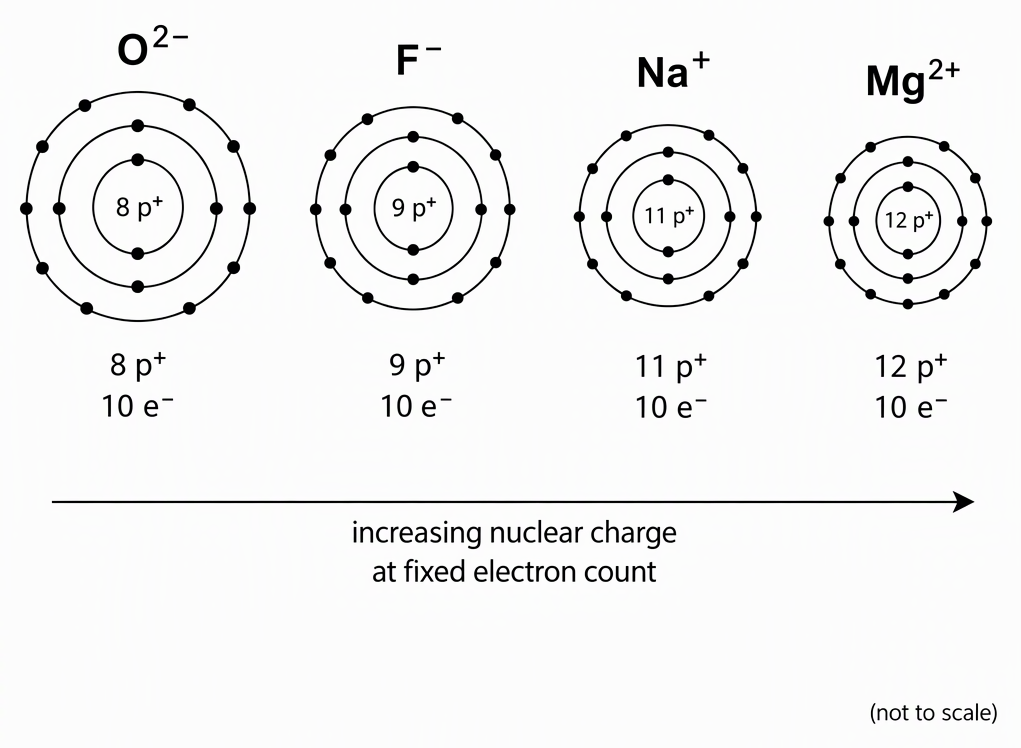
The tempting mistake is using neutral-atom trend arrows. These ions share an electron count and occupied shells; their neutral parent atoms do not.
3. A: Compare subshell energy and electron pairing.
Boron loses a higher-energy, less penetrating 2p electron more easily than beryllium loses a 2s electron. That makes beryllium’s first ionisation enthalpy greater.
Nitrogen has three singly occupied 2p orbitals; oxygen has one paired orbital. Repulsion within that pair makes removing an electron from oxygen easier, giving nitrogen the greater value.
The tempting mistake is applying “increases across a period” without examining the electron being removed. An exception mnemonic names the result but does not explain it.
4. B: Separate signed enthalpy from released-energy magnitude.
Chlorine’s value is more negative. Fluorine’s compact 2p shell creates greater electron-electron repulsion for the incoming electron than chlorine’s more spacious 3p shell.
More negative means a smaller signed value but a larger magnitude of energy release. The tempting mistakes are confusing “greater” with “more negative”, or assuming fluorine’s greater electronegativity settles this separate comparison.
5. 6: Count electrons using the charge.
Negative charge means electrons have been added; positive charge means they have been removed. Every listed species has ten electrons.
The tempting mistake is reversing the charge rule. Forming an ion changes its electron count, not its proton count.
6. A and D: Rebuild each argument separately.
For A, sodium’s second ionisation removes an electron from a neon-like core. Magnesium’s second ionisation still removes a third-shell valence electron, so A is correct.
B is false by the isoelectronic-radius argument in Question 2. C is false because pairing makes oxygen easier to ionise than nitrogen; D is correct by the electron-gain reasoning in Question 4.
The tempting mistake is accepting a familiar-looking bundle of statements. Second ionisation starts from the singly positive ion, not the neutral atom.
How should my mistakes decide what I practise next?
Use the cause of each error to choose the next source, not your total score alone. Six questions diagnose selected errors; they do not certify complete chapter coverage or predict JEE marks. A correct answer supported by faulty reasoning still needs repair.
- Errors in Questions 1 or 5: Repair configuration reading and electron counting. Then use fresh chapter drills with different atoms and charges.
- Error in Question 2: Separate neutral-atom trends from isoelectronic-ion reasoning. Count electrons first, compare nuclear charges second, and only then order radii.
- Errors in Questions 3 or 4: Revisit subshell energy, pairing or electron-gain-enthalpy signs. Write a causal explanation before attempting another variant.
- Only Question 6 causes trouble: If the individual concepts are sound, practise marking each statement true or false with its own reason. Do not select by overall familiarity.
- Answers and rejected alternatives both justified: Move to relevant PYQs.
- Knowledge holds in drills but breaks during papers: Move to mocks and review your decisions question by question.
Use this compact error log for each mistake:
- Question: Number and topic.
- My reasoning: What I actually thought.
- Missing concept: The rule I missed or misused.
- Corrected explanation: One causal sentence.
- Next practice route: Fresh drill, relevant PYQ or full mock.
How do I move to PYQs and mocks without mixing their roles?
Keep PYQs traceable and mocks matched to the exam you are practising. For every PYQ, retain the exam, year, paper or shift where available, original wording and corresponding official answer key. Do not relabel unsourced internet questions as PYQs.
For official Main material and current instructions, use jeemain.nta.nic.in. Keep a past paper’s own instructions attached rather than assuming every year used the same format.
Main Chemistry has 20 single-correct MCQs and 5 numerical-answer questions. Marking is 4 marks for a correct answer, minus 1 for a wrong answer and zero for an unattempted question; do not force a guess on every item.
Advanced consists of two compulsory three-hour papers, with question types and marking that vary by year. A fixed 75-question Main mock must not be treated as an Advanced simulation.
When full-paper application is your remaining issue, JEEnius full-length mocks include free tests with a scored per-subject breakdown. After the paper, pair that result with your error log and choose your next practice task from the cause of the error.
Next step: full-length mock tests on JEEnius and sit a full 75-question, 300-mark, 180-minute paper and get a scored per-subject breakdown (free tests included).
Keep going with Differential Equations JEE 2023: General Solution.
Frequently asked questions
Should I start periodic table practice with chapter questions or PYQs?
Start with explained chapter questions if periodic trends and exceptions still confuse you. Move to relevant PYQs once you can justify both your answers and your rejection of the alternatives. Use full-length mocks when applying that knowledge under paper conditions is the remaining problem.
Are these periodic table questions actual JEE PYQs?
No, these are six original practice questions with worked explanations, available without payment or registration. The set includes four single-correct questions, one numerical-answer question and one Advanced-style multiple-correct reasoning exercise. It diagnoses selected misconceptions rather than establishing complete chapter mastery.
How do I compare the ionic radii of isoelectronic ions?
Count electrons first to confirm that the ions are isoelectronic, then compare their nuclear charges. For O²⁻, F⁻, Na⁺ and Mg²⁺, all have ten electrons, so increasing nuclear charge gives decreasing radius: O²⁻ > F⁻ > Na⁺ > Mg²⁺. Do not apply neutral-atom trend arrows to this comparison.
Why is chlorine's electron-gain enthalpy more negative than fluorine's?
Fluorine's compact 2p shell produces greater electron-electron repulsion for an incoming electron than chlorine's more spacious 3p shell. Chlorine therefore releases more energy when an isolated gaseous atom gains its first electron. More negative means a smaller signed enthalpy value but a larger magnitude of energy release.