
Which parabola practice format should I start with?
For parabola practice questions for JEE, start with guided drills if identifying the parabola constant, choosing a parameter or forming a tangent still causes errors. Use verified previous-year questions (PYQs) once those steps are secure, and timed mixed practice when accuracy drops outside a chapter-labelled worksheet.
These are stages, not competing resources with one universal winner. Below are six original questions with worked solutions, authored practice rather than actual JEE questions.
How do guided drills, verified PYQs and timed mixed practice compare?
Guided drills repair methods, verified PYQs show actual exam demands, and timed mixed practice tests method selection. Choose by the error you need to fix, not the size of the question collection.
- Prerequisite knowledge
- Guided original questions on this page: Basic coordinate geometry and recognition of standard forms.
- Verified JEE Main or Advanced PYQs: Secure routine methods for the topic.
- Timed mixed-coordinate-geometry practice: Independent solving across the included topics.
- Main benefit
- Guided originals: Isolate one method and expose algebra errors.
- Verified PYQs: Show how the method appears in an actual examination.
- Timed mixed practice: Test topic recognition, method selection and switching.
- Feedback needed
- Guided originals: Worked steps identifying the first wrong decision.
- Verified PYQs: A verified answer key plus a reliable derivation.
- Timed mixed practice: Solution review alongside time spent and questions skipped.
- Exam authenticity
- Guided originals: Authored practice, not exam evidence.
- Verified PYQs: Preserve the original question; record exam, year and paper or shift wherever available.
- Timed mixed practice: A study format, not proof of an actual exam’s composition.
- Best use
- Guided originals: Repair a specific weakness.
- Verified PYQs: Apply secure methods to exam wording.
- Timed mixed practice: Check performance beyond a chapter worksheet.
- Principal limitation
- Guided originals: Do not establish actual exam difficulty.
- Verified PYQs: Remembered answers can hide weak reasoning.
- Timed mixed practice: A low score alone does not identify the failed method.
A final answer key tells you what is correct; a worked solution explains why. Timed mixed practice here is a study format, not a claim about a platform feature.
Which option fits Class 11, Class 12 and droppers?
Choose by observed mistakes, not your class or attempt year. Use independent method selection and correct working as evidence, rather than an arbitrary score threshold or prescribed question count.
- Class 11, confusing the two standard orientations: Begin with guided standard-form and parameter drills. Identify the opening direction before finding the focus or substituting a parameter.
- Class 12, comfortable with textbooks but lost in unfamiliar wording: Prioritise verified Main PYQs. Return to a drill only for the failed method, rather than restarting every exercise.
- Dropper, recognising previously solved answers: Use unseen questions and explain the derivation before treating timed performance as evidence of readiness. Remembering the final coordinate does not establish that you can derive it.
- Advanced aspirant, routine algebra secure: Move to verified Advanced problems linking ideas. Longer algebra alone does not make a problem Advanced-level.
- Student accurate in isolated parabola practice but weak in mixed papers: Prioritise timed mixed-coordinate-geometry practice. Check whether you can recognise the method without the chapter name giving it away.
Can I attempt six free parabola questions before seeing the solutions?
Attempt the six questions below before scrolling to the worked solutions. They move from standard-form recognition to a normal meeting the curve again. Their coverage is selective, not a complete chapter test.
Original diagnostic practice: not JEE PYQs. Mark every attempt independent, completed with a hint, or incomplete. Keep your working, including abandoned steps.
Q1. Standard form: Find the focus and directrix of the parabola.
Q2. Parameterisation: Find the point on the parabola for the stated parameter, using the given convention.
Q3. Tangent at a point: Find the tangent to the parabola at the given point.
Q4. Tangency condition: Find the constant for which the line is tangent to the parabola.
Q5. Chord from parameters: Find the line joining the points with the two stated parameters, using the same parameter convention as Q2.
Q6. Normal and second intersection: Find the normal at the given point, then find where that normal meets the parabola again.
Before checking, write the method you chose beside each attempt. “Tangent formula” or “substitute the line” is enough to identify your decision during review.
What are the worked solutions, and what does each mistake reveal?
Repair the first incorrect step, not just the final answer. Compare your working with the solutions to separate a wrong geometric condition from a substitution or algebra error. A correct answer reached with a hint still needs an independent retry.
Q1. Match the coefficient before finding the focus.
The coefficient of the unsquared coordinate is four times the parabola constant. For this orientation, the focus lies on the horizontal axis.
Repair: Using eight as the focus coordinate confuses the constant with its coefficient. Putting the focus on the vertical axis signals a standard-form orientation error.
Q2. Square the parameter only where the convention requires it.
Identify the parabola constant, then substitute into both coordinates separately. The negative parameter does not make both coordinates negative.
Repair: Practise signed substitution. The horizontal coordinate uses the squared parameter; the vertical coordinate retains its sign.
Q3. Check the point, then construct the tangent.
The supplied point lies on the parabola, as the check below confirms. Use the point-tangent formula with the correct parabola constant.
Repair: If your line misses the stated point, check the coordinate substitution. If you used the wrong coefficient, revisit standard-form identification.
Q4. Tangency requires a repeated intersection root.
Substitute the line into the parabola to obtain a quadratic. Its discriminant must vanish for the intersections to coincide.
Q3 and Q4 deliberately produce the same tangent by different routes: point-based construction versus a repeated-root condition. If Q3 worked but Q4 did not, repair discriminant reasoning rather than learning another tangent formula.
Q5. Convert the parameters to coordinates, then form the line.
A memorised chord formula is unnecessary here. Find the endpoints and calculate their slope.
Repair: Correct endpoints with a wrong final line point to coordinate line equations, not parabola theory. Check the slope, then substitute both endpoints into your answer.
Q6. Use the negative reciprocal of the tangent slope for the normal.
Differentiate to find the tangent slope at the given point. The normal passes through that point in the perpendicular direction and meets the parabola again.
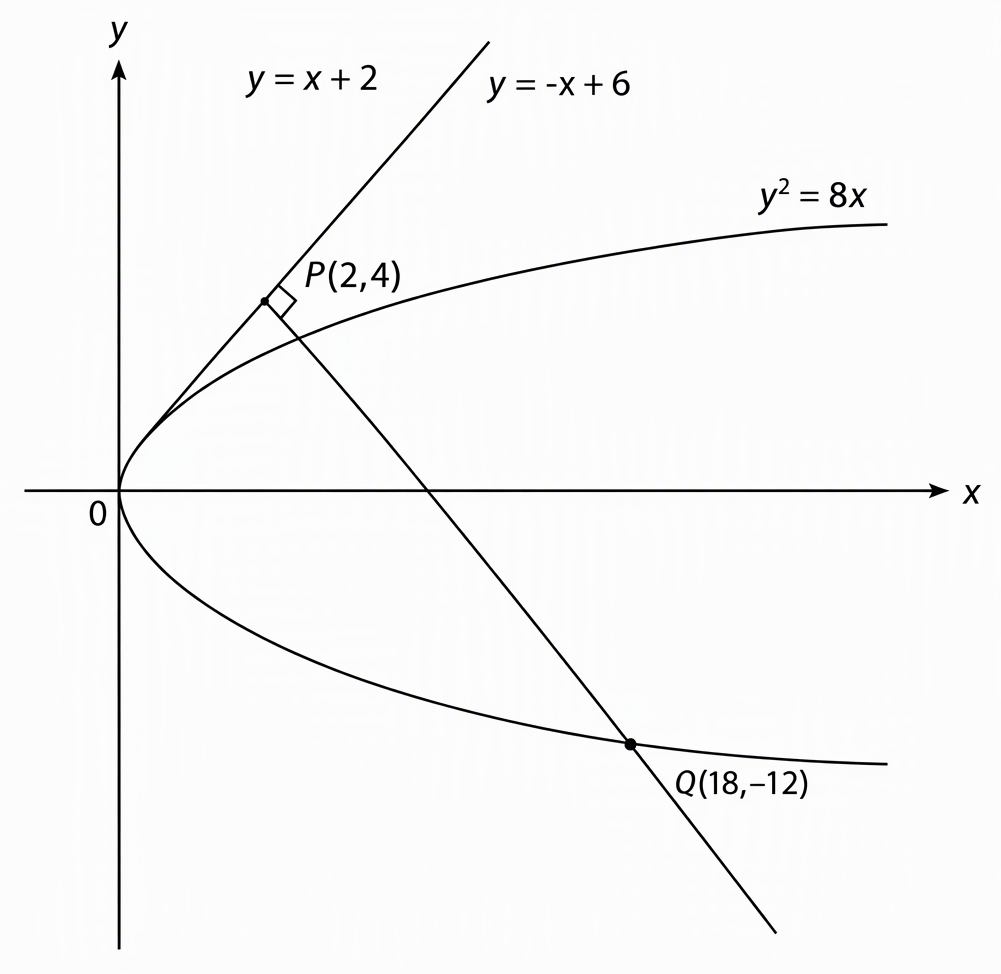
Substitute the normal into the parabola. One root gives the original point; the other gives the requested second intersection.
Repair: Reusing the tangent slope gives the wrong line. Reporting the original point means you solved the quadratic but did not finish interpreting its roots.
Should I move to Main PYQs or Advanced parabola problems next?
Choose verified Main PYQs when you can use routine methods independently; choose verified Advanced problems when you can link those methods without prompting. This authored set does not reproduce the exam’s difficulty distribution. Six questions neither cover every parabola configuration nor certify chapter completion.
- Q1 or Q2 needed help: Repair orientation, standard forms and parameterisation before collecting harder material.
- Q3 was correct but Q4 failed: Practise line–parabola intersections and discriminant reasoning. The gap is the meaning of tangency, not necessarily formula recall.
- Q5 or Q6 failed: Revisit coordinate line equations, slope relationships and substitution before looking for advanced tricks.
For Main, select verified PYQs spanning single-correct and numerical-answer practice. Preserve the original wording: a rewritten question can silently remove a condition or change the task.
For Advanced, use verified problems linking tangent, normal, chord or locus reasoning. Do not infer a fixed Advanced question pattern from this diagnostic.
Check each question’s source and answer against the original paper and official key where available. Keep the exam, year and paper or shift attached wherever available; an unsupported attribution is not verification.
Retry each missed question without viewing its solution. Then attempt a changed version, such as a different coefficient or parameter, to separate understanding from answer memory.
When should I use a full mock to check whether my learning transfers?
Use a full mock after you can solve chapter questions independently, not to learn parabola from scratch. A mixed paper tests topic recognition, question selection and performance across subjects, skills a chapter-labelled worksheet does not fully test.
JEEnius offers JEE Main-format full-length mock tests, including free tests, with 75 questions, 300 marks, 180 minutes and a scored per-subject breakdown. That breakdown can help you compare subject performance, but you should still inspect your working to identify a failed parabola method.
Do not divide the duration equally across every question and treat the result as a compulsory time limit. Allocation depends on difficulty, selection and the progress you are making.
This format is for Main. JEE Advanced has two compulsory three-hour papers, with question types and marking that vary from year to year.
Attempt the diagnostic, repair the failed method, then select your next practice format: guided drills, verified PYQs or timed mixed practice.
Next step: full-length mock tests on JEEnius and sit a full 75-question, 300-mark, 180-minute paper and get a scored per-subject breakdown (free tests included).
Keep going with Simultaneous Equations JEE 2023: Determinant Solution.
Frequently asked questions
How should I start practising parabola questions for JEE?
Start with guided drills if standard forms, parameterisation or tangent construction still cause errors. Move to verified previous-year questions once you can apply routine methods independently, then use timed mixed practice to test method selection without a chapter label.
Are these six parabola questions actual JEE PYQs?
No. These are original diagnostic questions with worked solutions, not questions taken from JEE papers. They cover selected methods from standard-form recognition to a normal meeting the parabola again, but do not establish actual exam difficulty or certify chapter completion.
When should I move to JEE Advanced parabola problems?
Move to verified Advanced problems when routine algebra is secure and you can link methods without prompting. Choose problems connecting tangent, normal, chord or locus reasoning; longer algebra alone does not make a question Advanced-level.
Why can I solve parabola worksheets but struggle in mixed tests?
A chapter-labelled worksheet tells you which topic to use, while a mixed paper requires you to recognise the topic and select the method independently. Use timed mixed-coordinate-geometry practice and review your working, time spent and skipped questions to identify where the process breaks down.