
Which Nuclei practice format should I choose for JEE?
For Nuclei practice questions for JEE, choose worked drills to repair concepts, authentic PYQs to check chapter readiness, and full-length mocks to practise whole-paper execution. You came for questions, not a shopping guide: an original free starter set with worked solutions appears below.
Choose original worked drills when formulas or mass conventions are shaky. Move to chapter-specific previous-year questions once the basics are secure. A full mock is not a substitute for targeted Nuclei practice.
These are three practice formats, not a ranking of websites whose free access has not been verified.
How do worked Nuclei drills, PYQs and full-length mocks compare?
Worked drills isolate faulty concepts. Authentic PYQs show actual exam demands, while full-length mocks test pacing and question selection across subjects. Choose the format that exposes your current problem.
Each comparison below follows the same order: original worked chapter drills; authentic JEE PYQs; full-length mocks.
- Concept repair: Drills isolate one principle; PYQs test its application; mocks mix it with unrelated demands.
- Actual exam difficulty: Drills cannot establish it; traceable PYQs show it directly; mocks approximate it according to their design.
- Chapter targeting: Drills stay focused; chapter-filtered PYQs stay focused; mocks do not guarantee Nuclei coverage.
- Solution requirements: Drills need full reasoning; PYQs need a traceable key and worked explanation; mocks need explanations as well as scores.
- Timing practice: Drills favour careful reasoning; PYQs support timed chapter work; mocks practise whole-paper pacing.
- Main limitation: Drills may not represent exam difficulty; repeated PYQs can become memory tests; mocks may miss the chapter weakness entirely.
Separate Main PYQs from Advanced PYQs. Use Main questions to check application within that exam’s demands, then Advanced questions for your Advanced preparation. PYQs show what has been asked, not what is guaranteed to recur.
If whole-paper timing is your problem, use JEEnius full-length mocks: 75 questions, 300 marks, 180 minutes, with a scored per-subject breakdown and free full-length tests included.
Which format suits Class 11, Class 12 and droppers?
Choose by what you can explain without notes, not by your class label. A dropper who confuses atomic and nuclear masses needs concept repair just as much as a Class 12 student making that mistake. Secure chapter work with poor paper pacing calls for mocks instead.
- Class 11 students studying ahead: Learn the required concepts, then begin with worked drills. Unfamiliar Nuclei content is not a useful measure of your overall JEE readiness.
- Class 12 students recalling formulas but mixing masses: Choose mass-convention drills before timed PYQs. Faster substitution does not repair an inconsistent starting expression.
- Students with secure fundamentals: If you can explain mass defect, binding energy per nucleon and nuclear-radius scaling without notes, move to authentic Main PYQs.
- Advanced aspirants: Use authentic Advanced PYQs after securing the fundamentals. Follow each paper’s instructions because Advanced has no fixed question-type or marking pattern.
- Droppers recognising remembered answers: Start from a blank page and justify every step. Use unfamiliar original drills to test application rather than recall.
- Students losing time across the paper: Choose full-length mocks when chapter work is sound but pacing or question selection is weak.
Buying another source does not repair an unanalysed mistake. Owning a paid course does not change which practice format you need next.
Can I try free Nuclei questions with worked solutions now?
Attempt the four original questions below before reading their solutions. They test scaling, mass conventions, average binding and reaction-energy signs. Every question is original practice, not a PYQ, with no Main or Advanced difficulty label assigned.
Write the starting principle and your assumptions, not just a final expression. All prompts appear before the solutions.
Question 1: Original practice, not a PYQ
Two spherical nuclei have mass numbers given below. The scale factor is positive, and both obey the same radius law.
Find the second nucleus’s radius and volume relative to the first. If nuclear mass is proportional to mass number, what does this imply about nuclear density?
Question 2: Original practice, not a PYQ
A neutral atom has the following atomic mass, atomic number and mass number. Hydrogen-atom mass and neutron mass are also supplied symbolically.
Neglect electronic binding energies. Derive its nuclear mass defect and binding energy. Explain whether proton masses can replace hydrogen-atom masses while retaining the same atomic-mass expression.
Question 3: Original practice, not a PYQ
The mass numbers and total binding energies of two nuclei are:
Assume the mass number, reference binding energy and both scale factors are positive. Find the condition for the second nucleus to have greater binding energy per nucleon. Does that comparison settle every possible radioactive decay channel?
Question 4: Original practice, not a PYQ
A balanced nuclear reaction has total initial and final rest masses:
Using consistent mass conventions, derive the reaction energy and state the condition for energy release. Does splitting a nucleus, or joining two nuclei, necessarily release energy?
How do I solve these original Nuclei questions?
Use the radius law for scaling, match particle counts for mass defect, divide total binding energy by nucleon count, and subtract final rest energy from initial rest energy for reaction energy. Check these starting steps even if your final answer matches.
Solution 1: Compare radius, then cube for volume
The same radius constant applies to both nuclei. Treating each as spherical makes volume proportional to the cube of radius, not to radius itself.
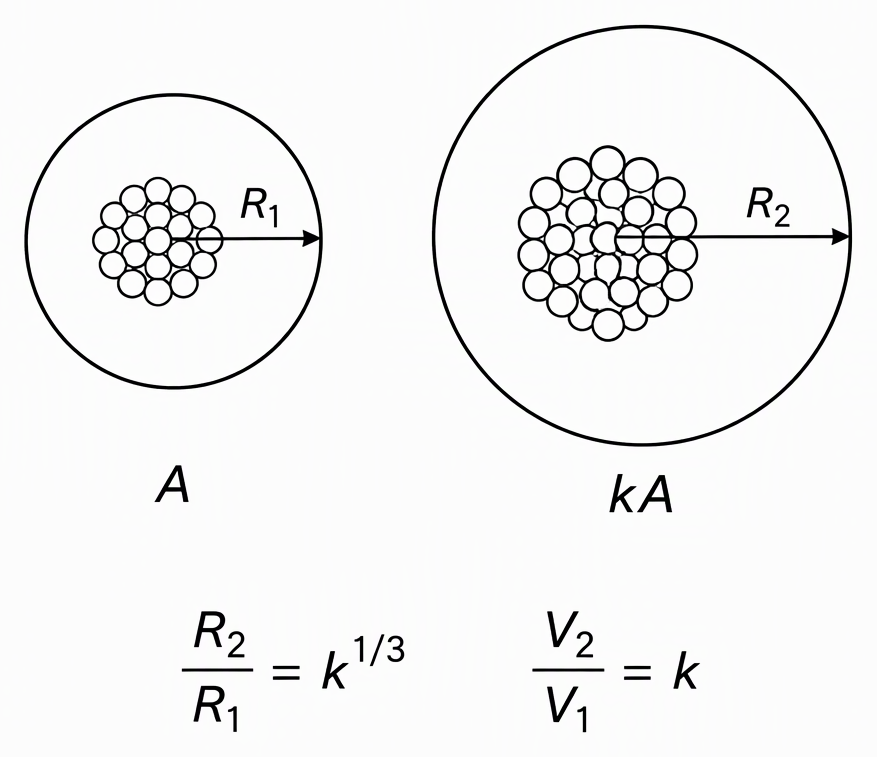
Under the stated mass approximation, mass and volume increase by the same factor. Their ratio therefore stays constant.
Nuclear density is approximately independent of mass number under these assumptions. This does not mean equal nuclear masses or equal radii.
Solution 2: Keep the electron inventory consistent
A neutral atom includes electrons, while a bare nucleus does not. Neglecting electronic binding energies gives:
Start with separated protons and neutrons, then subtract the nucleus’s mass. Substitution gives the atomic-mass form.
Hydrogen atoms supply the same electron count as the neutral atom, so electron rest masses cancel. Replacing hydrogen-atom masses with proton masses while retaining the neutral atomic mass leaves an unmatched electron contribution. Use proton masses with nuclear mass, or explicitly correct the atomic mass.
Solution 3: Divide before comparing
Total binding energy and average binding per nucleon answer different questions. Calculate the averages first.
A larger total binding energy alone is insufficient: the nucleon count may have grown by a larger factor. Binding energy per nucleon measures average binding, not immunity to every possible radioactive decay. A specific decay requires checking its allowed products and energy balance.
Solution 4: Subtract final rest mass from initial rest mass
Energy conservation makes the loss of total rest energy available to the reaction products. The reaction energy is therefore:
A positive result means energy release; a negative result means the reaction requires energy input. Fission and fusion release energy only when the particular reaction has positive reaction energy. Splitting or joining nuclei is not, by itself, an energy-release rule.
How should my mistakes choose the next Nuclei practice set?
Choose the next set from the incorrect step, not from your total score. A radius-volume mix-up needs scaling practice, not a restart of every Nuclei topic. A correct remembered answer is also insufficient evidence that you can apply the method to an unfamiliar question.
- Radius versus volume: Choose scaling drills requiring separate radius, volume and density comparisons.
- Atomic versus nuclear mass: Choose mass-convention drills. State which particles each supplied mass includes before calculating.
- Total versus per-nucleon binding: Choose binding-energy comparisons where nucleon count and total binding change by different factors.
- Wrong reaction-energy sign: Choose reaction-energy bookkeeping. Write initial and final rest-mass totals separately before subtraction.
Keep a compact error log using these fields:
- Question: Original Question 2.
- Incorrect step: Used proton masses but subtracted neutral atomic mass.
- Corrected principle: Match electron inventories on both sides of the mass difference.
- Next practice format: Worked mass-convention drills, followed by a fresh authentic PYQ.
Redo a missed question without viewing the solution. Then explain why the original method failed, not merely why the corrected answer works.
When the concept is secure but application remains uncertain, attempt a fresh PYQ. Use full-paper practice only when pacing or question selection is the actual problem.
How can I check a free source and use a mock properly?
Trust a PYQ label only when the question is traceable to the exam, year, paper or shift where applicable, and an answer key. An unattributed compilation is not official merely because its cover says “previous year”. The key confirms the marked answer but cannot replace a worked explanation.
Before relying on a free resource, check access to questions, answers and explanations. A free question page does not establish that its solution is free.
For syllabus-sensitive subtopics, check the current official syllabus for your target exam. Use jeemain.nta.nic.in for Main and the official JEE Advanced website for Advanced, rather than assuming every topic in an old worksheet remains relevant.
When whole-paper execution is the problem, JEEnius includes free full-length mocks with 75 questions, 300 marks, 180 minutes and a scored per-subject breakdown. This is a Main-style format, not an Advanced pattern; a per-subject score alone does not diagnose a Nuclei-specific weakness. After the mock, inspect the relevant questions and put the first incorrect step into your error log.
Next step: full-length mock tests on JEEnius and sit a full 75-question, 300-mark, 180-minute paper and get a scored per-subject breakdown (free tests included).
Keep going with Properties of Roots JEE 2024: Viète and AM–GM Proofs.
Frequently asked questions
How should I practise Nuclei for JEE?
Start with worked drills if formulas, mass conventions or energy signs are shaky. Once you can explain the fundamentals without notes, attempt authentic Main PYQs, followed by Advanced PYQs for Advanced preparation. Use full-length mocks when whole-paper pacing or question selection is the problem.
Are these free Nuclei questions actual JEE PYQs?
No. The four questions are original practice drills with worked solutions, not PYQs, and have no assigned Main or Advanced difficulty label. They cover nuclear-radius scaling, mass defect, binding energy per nucleon and reaction energy.
Should I use proton mass or hydrogen mass in mass defect questions?
Use hydrogen-atom masses when subtracting the neutral atomic mass, neglecting electronic binding energies. Use proton masses when subtracting nuclear mass. Mixing proton masses with an uncorrected neutral atomic mass leaves an unmatched electron contribution.
Can full-length mocks replace chapter-wise Nuclei practice?
No: a full-length mock may not expose your specific Nuclei weakness or even guarantee chapter coverage. Use targeted drills to repair concepts and fresh authentic PYQs to check application. Move to mocks when chapter work is secure but whole-paper execution needs practice.