
Should I start with mole concept drills, PYQs or mock tests?
For mole concept practice questions for JEE, start with worked chapter drills, graduate to PYQs, and use mocks to test transfer. Choose by your current errors, not whether you are in Class 11, Class 12 or a drop year.
Choose worked drills if you cannot reliably convert between mass, moles and particle counts. Choose mole concept previous-year questions, or PYQs, when those basics work without hints and you need to test how the exam combines them.
Choose full-length mocks to check whether those skills survive mixed-subject pressure, not to learn the chapter from scratch. An original free mini-set with worked solutions appears below. It is diagnostic practice, not a PYQ set or an official exam extract.
How do free chapter drills, JEE PYQs and full-length mocks compare?
Drills isolate an operation, PYQs test interpretation, and mocks test execution across subjects. Compare original worked chapter drills, questions selected from JEE past papers, and free full-length mocks by the errors they expose.
- Best use
- Drills: Repair a specific conversion or chemical relation.
- PYQs: Handle authentic exam wording and combinations.
- Mocks: Practise question selection, timing and subject-level performance.
- Control over subtopic coverage
- Drills: Easy to target one operation.
- PYQs: Depends on which questions you select.
- Mocks: Chapter coverage varies and cannot be assumed.
- Feedback to look for
- Drills: A worked explanation of setup, units and calculation.
- PYQs: Reasoning checked against the authentic question and answer key.
- Mocks: A scored subject breakdown, followed by your own error review.
- Exam relevance
- Drills: Build the operations needed inside exam questions.
- PYQs: Show how those operations appeared in an actual exam.
- Mocks: Test whether you can apply them within a mixed paper.
- Main limitation
- Drills: Repeated templates can hide weak question interpretation.
- PYQs: A selected set is not automatically a complete learning sequence.
- Mocks: A Chemistry score does not diagnose a chapter.
- When to move on
- Drills: When you can explain and adapt the setup without hints.
- PYQs: When you can explain why the method applies to unfamiliar combinations.
- Mocks: Return to targeted practice whenever review exposes a specific gap.
An answer key confirms the result; a worked solution explains the route. A subject breakdown is not chapter-level diagnosis.
For the later mock stage, JEEnius includes free full-length tests: 75 questions, 300 marks, 180 minutes and a scored per-subject breakdown.
Which practice route fits my last mistake?
Choose practice that targets your last wrong decision, not your class label. A dropper can still have a particle-counting gap; a Class 11 student with sound conversions may already benefit from unfamiliar stoichiometry.
- Class 11 beginner confusing molecules with constituent atoms: Start with worked conversion drills. Write the counted species beside every answer, such as “carbon dioxide molecules” or “oxygen atoms.” A bare particle count hides the distinction.
- Class 12 student recalling formulas but stalling at balanced equations: Repair stoichiometric setup first. Identify the given amount, required amount and coefficient ratio before attempting a mixed PYQ sequence.
- Dropper solving familiar questions from memory: Attempt unfamiliar questions without options or visible solutions. Then use PYQs to check whether the reasoning transfers beyond remembered patterns.
- Main-focused student with sound setup but arithmetic or entry errors: Practise both single-correct MCQs and numerical-answer questions. Check powers of ten, rounding instructions and the requested quantity before moving to full mocks.
- Advanced aspirant comfortable with routine conversions: Move towards multi-step stoichiometry and authentic Advanced questions. Longer arithmetic alone does not make a question Advanced-level.
Move on when you can explain the setup and units without a hint, then solve a changed version without copying the previous method. Changing which reactant is in excess tests whether you understand the coefficient ratio; larger numbers alone do not.
Can I try free mole concept questions with worked solutions now?
Attempt these four original practice questions before reading the solutions. They separate particle counting, stoichiometry, formula determination and concentration errors. The numerical-answer and single-correct formats are relevant to Main preparation, but this mini-set is not an exam-pattern replica.
Every quantity below is an authored problem input, not an exam or product statistic. Use these supplied constants:
Question 1: Original practice question, numerical answer
A sample contains 8.8 g of carbon dioxide. Its molar mass is 44 g per mole. Calculate separately the number of carbon dioxide molecules and the number of oxygen atoms.
Question 2: Original practice question, numerical answer
A vessel contains 2.0 mol of nitrogen and 3.0 mol of hydrogen. Assume the reaction proceeds completely until the limiting reactant is exhausted:
Find the moles of ammonia formed and the moles of excess reactant remaining.
Question 3: Original practice question, single-correct MCQ
A pure compound contains only carbon, hydrogen and oxygen. A 30.0 g sample contains 12.0 g carbon, 2.0 g hydrogen and 16.0 g oxygen. Its molar mass is 180 g per mole. Which is its molecular formula?
Question 4: Original practice question, numerical answer
Dissolve 5.85 g sodium chloride in 200 mL water, then add water until the final solution volume is 500 mL. Given a molar mass of 58.5 g per mole, calculate the final molarity in moles per litre.
Stop here until you have written a setup for each question. Mark any step where you needed a hint.
How do I solve the mini-set and identify my error?
Compare your chemical relation and units with the working below, not just your final answer. If your answer matches but you cannot explain the setup, attempt a changed question before moving to harder practice.
Solution 1
Mass divided by molar mass gives moles. Multiplication by Avogadro’s constant gives molecules; each carbon dioxide molecule contains two oxygen atoms.
Diagnosis: Equal answers for molecules and oxygen atoms reveal the wrong counted entity.
Solution 2
Compare available moles divided by reaction coefficients. Hydrogen gives the smaller value, so it limits ammonia formation.
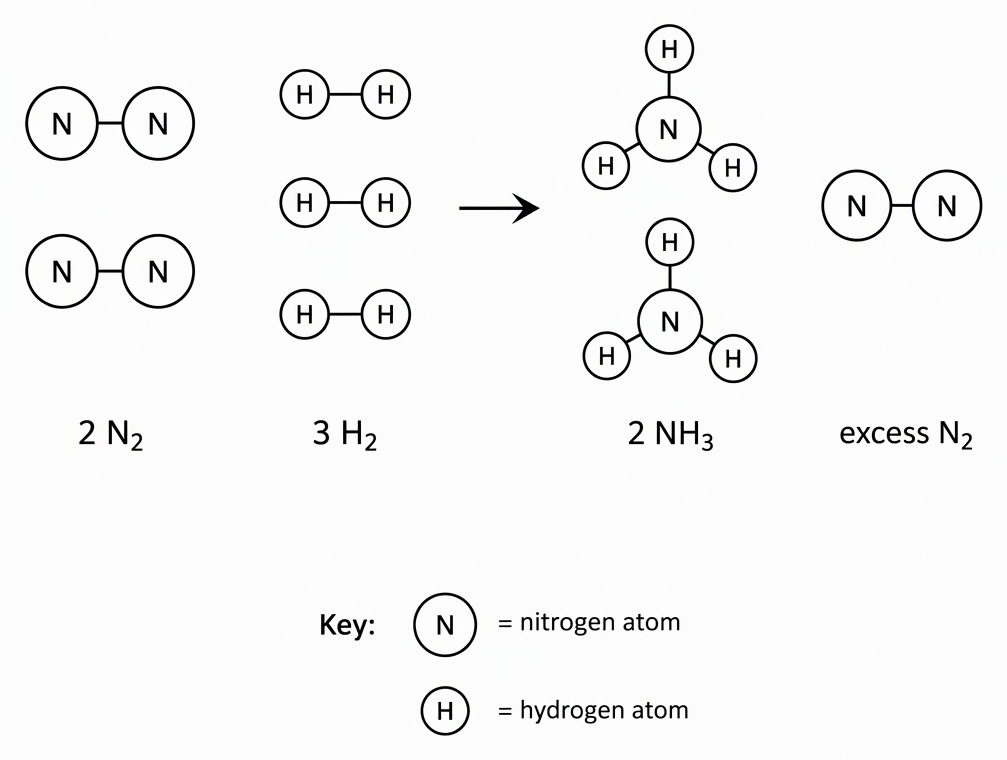
The supplied atomic masses confirm mass balance:
Diagnosis: Choosing nitrogen because its mole amount is smaller reveals a skipped coefficient ratio.
Solution 3
Convert each element’s mass to moles, then reduce to the simplest ratio. Each division uses grams divided by grams per mole.
The ratio gives the empirical formula. Divide the supplied molar mass by the empirical formula mass to find the multiplier.
Answer: C. Choosing A reveals that you mistook the empirical formula for the molecular formula.
Solution 4
Molarity uses final solution volume, not the starting solvent volume. Convert that volume to litres before dividing.
Diagnosis: Using 200 mL reveals an incorrect volume basis; using 500 without conversion mixes millilitres with litres.
How should I turn these mistakes into a PYQ practice sequence?
Repair the missed operation before selecting a mixed PYQ sequence. If the setup was wrong, revisit that concept and attempt a changed problem. If only arithmetic failed, redo the calculation without rereading the full solution.
- Particle counting missed: Return to conversion drills and label every counted species.
- Limiting reagent missed: Write the balanced equation and compare amounts through its coefficients.
- Formula determination missed: Convert composition to mole ratios, then check the supplied molar mass.
- Concentration missed: Write the final solution volume in litres before dividing.
Next, select relevant questions from authentic JEE Main or JEE Advanced past papers. Keep the exam, year, and paper or shift identification attached so you can verify the question and its answer.
An official answer key verifies the answer, but it does not replace a worked explanation. If your reasoning disagrees with the key, locate the faulty step rather than memorising the option.
Main and Advanced are different exams. Advanced has two compulsory papers of three hours each; question types and marking vary by year. Move from isolated skills to mixed stoichiometry only when you can explain why the method applies.
When is a free full-length mock worth my time?
Take a full mock when enough of your wider syllabus is prepared for mixed-paper performance to be meaningful. If you are still learning mole concept, stay with chapter practice. Leaving unrelated topics unattempted tells you little about this chapter.
For Main, each subject contains 20 single-correct MCQs and 5 numerical-answer questions. The marking is +4 for a correct answer, -1 for a wrong answer and 0 for an unattempted response. Practise choosing, calculating and entering answers, not merely recognising a familiar method.
A Chemistry score alone cannot establish mole concept mastery. Inspect the relevant attempted questions manually and classify errors as conversion, stoichiometric setup, interpretation, arithmetic or answer entry.
When you are ready, JEEnius free full-length mocks provide a scored per-subject breakdown. Use that breakdown to locate subject-level concerns, then inspect individual questions yourself; do not assume any fixed number of mole concept questions.
Repair the specific error, test it on an unfamiliar question, then assess it under mixed-paper conditions.
Next step: full-length mock tests on JEEnius and sit a full 75-question, 300-mark, 180-minute paper and get a scored per-subject breakdown (free tests included).
Keep going with Order and Degree JEE 2024: Area Question Solved.
Frequently asked questions
Should I start mole concept practice with drills or JEE PYQs?
Start with worked drills if you cannot reliably convert between mass, moles and particle counts. Move to authentic JEE PYQs when you can explain the setup and units without hints and solve a changed version. Choose by your errors, not whether you are in Class 11, Class 12 or a drop year.
Are these free mole concept questions actual JEE PYQs?
No. The four questions are original diagnostic practice covering particle counting, limiting reagents, formula determination and molarity. Each has a worked solution, but the set is neither an official exam extract nor an exam-pattern replica.
How do I identify the limiting reagent in mole concept questions?
Write the balanced equation, then divide each reactant's available moles by its reaction coefficient. The smaller value identifies the limiting reagent. Comparing mole amounts alone can give the wrong result because reactants combine in the coefficient ratio.
When should I take full-length mocks for JEE preparation?
Take full-length mocks when enough of your wider syllabus is prepared for mixed-paper performance to be meaningful. If you are still learning mole concept, use chapter practice first. A Chemistry score alone cannot diagnose this chapter; inspect relevant questions for conversion, setup, interpretation, arithmetic and answer-entry errors.