What is the correct answer to the order and degree JEE 2024 area question?
Option [4] is correct: order 2, degree 1. The order and degree JEE 2024 question requires three operations: differentiate the given area, differentiate the resulting solution family, then eliminate the constants. The exponential signs decide the equation, not the order-and-degree labels alone.
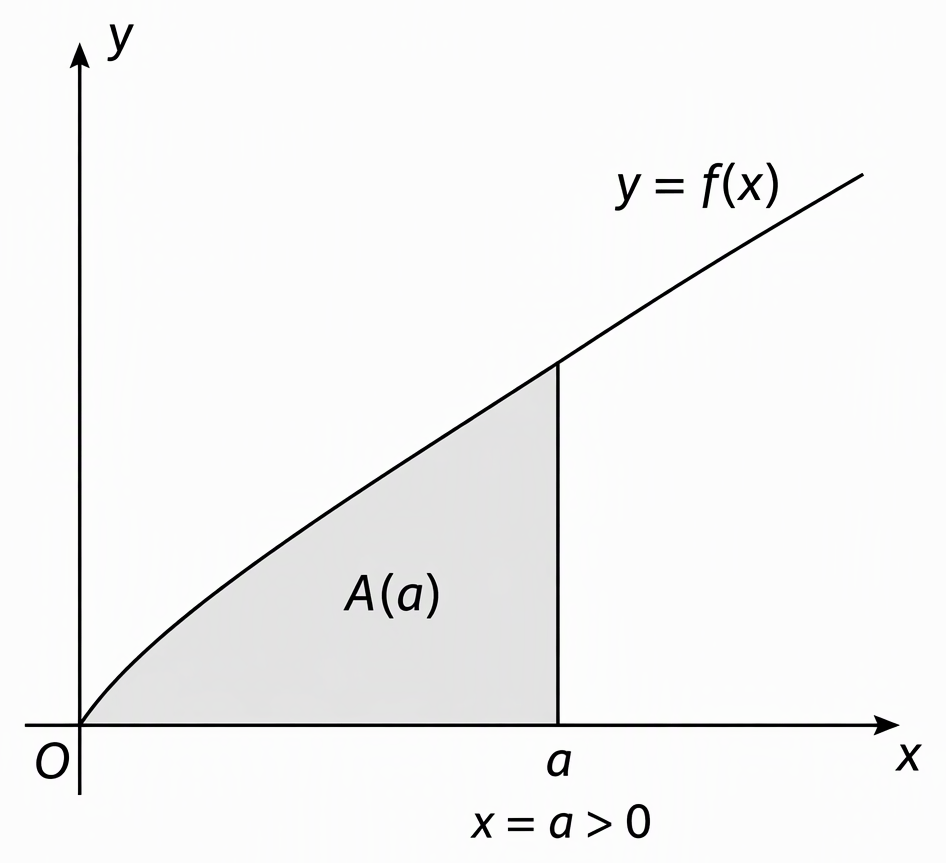
A positive curve bounds a region above the horizontal axis, from the origin to a positive endpoint. The prescribed area is the accumulated area under the curve, not its height at the endpoint. Find the differential equation generated by multiplying the curve’s function by one arbitrary constant and adding another.
Source qualification: The bank indexes the item as 2024 but supplies the date 2023-01-24, or 24 January 2023. That year/date/shift combination is not independently resolved here. The supplied solution identifies options [4] and [2], but does not supply the complete four-option text.
How do you differentiate the area to recover the function?
The derivative of the accumulated area gives the curve’s height at the moving endpoint. This is the fundamental theorem of calculus, used in the supplied solution. The area expression is an integral of the function, not the function itself.
Differentiate each term separately. Keep the exponential’s inner derivative visible to check its sign.
Combining these derivatives gives the function at the endpoint. Renaming the input then gives the form needed for the solution family:
Changing the input’s name is not another differentiation. Keep this area differentiation separate from the later derivatives of the dependent variable: it does not contribute to the order of the final differential equation.
Why must you differentiate the two-constant family twice?
The first derivative removes the additive constant, but the multiplying constant remains. A second derivative gives another relation containing that same constant, allowing elimination.
Substitute the recovered function into the family. Treat both parameters as constants:
The two negative signs in the exponential derivative give a positive term. Hence:
Differentiate again. The exponential term now has a positive sign before differentiation, so its derivative is negative.
The additive constant has disappeared, but the multiplying constant still remains. Differentiation alone has not finished the problem: the final differential equation must contain neither arbitrary constant.
How do you eliminate the constant and confirm order 2, degree 1?
Eliminating the remaining constant gives option [4], with order 2 and degree 1. Rearrange the second-derivative relation to isolate the constant:
Substitute this expression into the first derivative. Then expand the coefficient using the product of reciprocal exponentials:
Moving both derivative terms to the same side gives:
The supplied worked solution identifies this as option [4]. Read the order and degree from this equation, not from the number of differentiations performed earlier.
- Order is 2: the second derivative is the highest derivative present.
- Degree is 1: the equation is polynomial in its derivatives, and the highest derivative has power one.
The exponential is a coefficient depending on the independent variable. It is not an exponential of a derivative, so it does not make the degree undefined.
Verify by substituting both derivatives into the final equation. The terms cancel:
How does the chain-rule error lead to option [2]?
The incorrect branch starts by assigning a positive derivative to the exponential in the area formula. It misses the negative inner derivative:
That error produces the wrong recovered function. Following the same family-differentiation method then gives:
Eliminating the constant produces a different equation:
The supplied solution associates this incorrect branch with option [2]; this does not reproduce its option text verbatim. The later elimination is consistent, but the starting function is wrong.
Keep these two derivatives distinct. The leading negative sign reverses the result:
Both resulting equations have order 2 and degree 1, so classification alone cannot select the answer. Check the chain rule before comparing options.
Which three related questions should you solve next?
Use these original drills, not additional verified PYQs, to practise recovering a function from area, eliminating constants, and reading degree. Each worked answer follows its question. Attempt the equation first, then compare your elimination step.
What equation follows when the area is cubic?
Drill 1: The equation has order 2 and degree 1. Derive it from the following area, measured from the origin to the endpoint, and family on the stated domain:
Worked answer: Differentiate the area once, then the family twice. Eliminate the multiplying constant:
Order is 2; degree is 1. Check numerically:
What equation follows from an exponential family?
Drill 2: The second derivative is twice the first. Eliminate both arbitrary constants to establish the equation:
Worked answer: The additive constant vanishes immediately. Differentiate again and compare:
Order is 2; degree is 1. The exponent’s factor changes the coefficient, not the degree.
What changes when the highest derivative is squared?
Drill 3: Squaring the highest derivative changes the degree, not the order. Find both for:
Worked answer: Order is 2, and degree is 2. The main question had the same highest derivative but power one. Before assigning degree, identify the highest derivative and read its power, not the power of the independent variable.
Next step: photograph a doubt on JEEnius and photograph any question you are stuck on and get a step-by-step solution, with a free-body diagram when the question needs one (20 free).
For a worked example of the same idea, see Oxides of Nitrogen JEE 2016: Why B and D Are Correct.
Frequently asked questions
What is the answer to the order and degree JEE 2024 area question?
The supplied worked solution identifies option [4]: (8e^x + 1)y'' + y' = 0. Its order is 2 because the highest derivative is y'', and its degree is 1 because that derivative appears to the first power.
Why is the order 2 if we differentiate three times?
The first differentiation recovers the curve's function from the accumulated area; it is not a differentiation of the solution family. The family y = c₁f(x) + c₂ is then differentiated twice to eliminate its constants. Order comes from the highest derivative in the final equation, not the total number of differentiation steps.
Does an exponential term make the degree undefined?
Not when the exponential depends only on the independent variable. In (8e^x + 1)y'' + y' = 0, the exponential is part of a coefficient, and the equation is polynomial in its derivatives. The highest derivative has power one, so the degree is 1.
Why is option 2 wrong in this area question?
The supplied solution associates option [2] with incorrectly differentiating e^(-a) as +e^(-a). That error produces (8e^x - 1)y'' - y' = 0 instead of the correct equation. Both equations have order 2 and degree 1, so those labels alone cannot distinguish them.
Is this area question from JEE 2024 or 2023?
The question bank indexes the item as 2024 but supplies the date 24 January 2023. The article does not independently resolve that discrepancy, so the year and shift should not be treated as verified.