What can we verify in this integral calculus JEE 2024 question?
The supplied integral calculus JEE 2024 record supports the tangent-slope calculations, but not a verified final answer. The target integrand has lost essential mathematical grouping, and the supplied solution makes an invalid integration step.
The recoverable question concerns a thrice differentiable function on the open interval from minus five to five. At inputs one and three, its tangents make angles of pi over six and pi over four, respectively, with the positive horizontal axis.
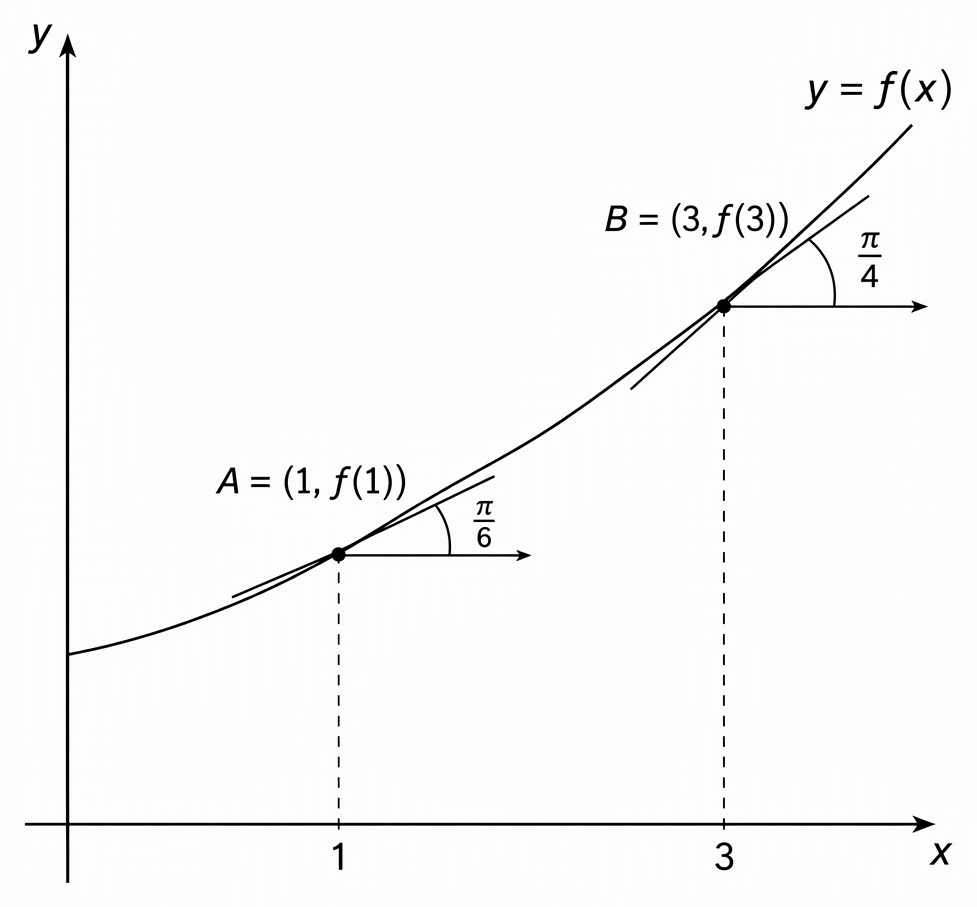
The function and domain are:
The question asks for an integer sum after expressing 27 times a definite integral, with limits one and three, in this form:
The requested result is:
The integrand cannot be unambiguously restated. Assigning brackets or derivative arguments would reconstruct mathematics that the supplied text does not establish.
- The metadata labels the year 2024, but gives the date 2023-01-24. This inconsistent record does not establish a verified paper date or shift.
- No answer options were actually supplied, despite the editorial description saying they were present.
Editorial status: hold publication. This is a source-check fallback plan, not a publishable 600–1200-word PYQ solution set. Obtain the original question image, options and matching official solution before commissioning that article.
What do the tangent angles tell us?
They determine the first derivative at the two given inputs and, by the fundamental theorem of calculus, the definite integral of the second derivative between them. This is the valid opening of the supplied solution. It does not evaluate the corrupted target integral.
For a tangent with inclination measured from the positive horizontal axis:
Therefore:
Subtracting gives:
The fundamental theorem of calculus gives:
The first derivative is an antiderivative of the second derivative. This is a separate, valid calculation, not an evaluation of the corrupted target integral.
Where does the supplied worked solution go wrong?
The supplied solution changes the transcribed integrand, then integrates derivative functions as though they were constants. Neither step is justified. Stop at the verified slope values rather than force a calculation towards an answer field.
The question transcription contains a “plus one” fragment:
That fragment is not preserved when the solution defines its auxiliary function:
The integrand therefore changes between the supplied statements. There is no basis for treating them as the same expression.
Next, the solution treats the second and third derivatives as constant coefficients during integration, but evaluates them as functions at the endpoints. Its calculation requires:
f''(1),\quad f''(3),\quad f'''(1),\quad f'''(3).
The first-derivative values at two points do not supply these four individual values. The tangent information does not justify that endpoint calculation.
The correct-answer field contains 2, while the supplied solution concludes:
Without the options, 2 could be an option index or a numerical answer. Neither field is independently verified, and inventing values for the two integer coefficients would hide the broken calculation.
Why can’t you treat a derivative function as a constant?
A derivative can vary with the integration variable. Multiplying it by a power of that variable does not make it a constant coefficient. Differentiate a proposed antiderivative before substituting the limits: the product rule exposes this error.
Consider the literal product used in the supplied solution:
The proposed partial antiderivative is:
Differentiating gives:
\frac{d}{dt}\left[\frac{t^3f''(t)}{3}\right] = t^2f''(t)+\frac{t^3f'''(t)}{3}.The extra product-rule term is:
\frac{t^3f'''(t)}{3}.It cannot simply be discarded. The ordinary power rule would work with a constant coefficient, but no such condition is given here.
Checking the entire proposed antiderivative raises another issue. If a fourth derivative exists, differentiation gives:
\frac{d}{dt} \left[ \frac{t^3f''(t)}{3} + \frac{t^2f'''(t)}{2} \right] = t^2f''(t) + \frac{t^3f'''(t)}{3} + tf'''(t) + \frac{t^2f^{(4)}(t)}{2}.This check generally introduces a fourth derivative, although the question guarantees only three derivatives. The supplied assumptions do not justify that extra differentiation.
This error cannot be linked to a supplied wrong option because the option list is missing. There is also no student-response evidence showing which answer students most often choose.
Which two practice questions build this antiderivative skill?
Practise one direct application of the fundamental theorem and one reverse-product-rule calculation. Both questions below are original practice, not JEE 2024 questions or verified past-paper questions. Their answers are separate from the unresolved source question.
How do you integrate a second derivative from endpoint slopes?
The integral equals the change in the first derivative. Suppose a function is twice continuously differentiable on the stated interval, with these endpoint values:
Evaluate:
Reverse the derivative directly, then substitute the limits:
No formula for the original function is needed. The endpoint slopes supply exactly what this integral requires.
How do you recognise a product-rule antiderivative?
Look for a derivative alone plus the variable multiplied by the next derivative. For this question, suppose the function is twice continuously differentiable on the stated interval:
Evaluate:
The integrand is a complete product-rule derivative:
Therefore:
The first question reverses a derivative directly; the second reverses the product rule. Before evaluating any limits, differentiate your proposed antiderivative and check that every term matches the integrand.
Next step: photograph a doubt on JEEnius and photograph any question you are stuck on and get a step-by-step solution, with a free-body diagram when the question needs one (20 free).
If that step was the hard part, work through Molecular Orbital Theory JEE 2016: Why A and C Are Correct.
Frequently asked questions
How do tangent angles give the values of f′(1) and f′(3)?
A tangent's slope is the tangent of its inclination measured from the positive horizontal axis. Therefore, the given angles yield f′(1) = tan(π/6) = 1/√3 and f′(3) = tan(π/4) = 1.
What is the integral of f″(t) from 1 to 3 in this question?
By the fundamental theorem of calculus, the integral equals f′(3) − f′(1) = 1 − 1/√3. This is a valid calculation from the tangent data, not an evaluation of the corrupted target integral.
Why can't I integrate t²f″(t) using the power rule alone?
The factor f″(t) is a function of the integration variable, not a given constant. Differentiating t³f″(t)/3 produces t²f″(t) plus the extra term t³f‴(t)/3. That extra term prevents the proposed expression from being a valid antiderivative in general.
Is the answer to this integral calculus JEE 2024 question 2 or 26?
Neither value is verified by the supplied record. The answer field contains 2, which could be an option index or a numerical answer, while the flawed solution concludes 26. The original question image, options and matching official solution are needed before confirming an answer.