
What is the answer to the rotational motion JEE 2018 ring-and-disc question?
The vertical height is 0.75 metres in this rotational motion JEE 2018 question, not the distance rolled along the incline. The source is JEE Advanced 2018, Paper 1, Physics. “Medium difficulty” and “120 seconds” are question-bank tags, not official exam classifications.
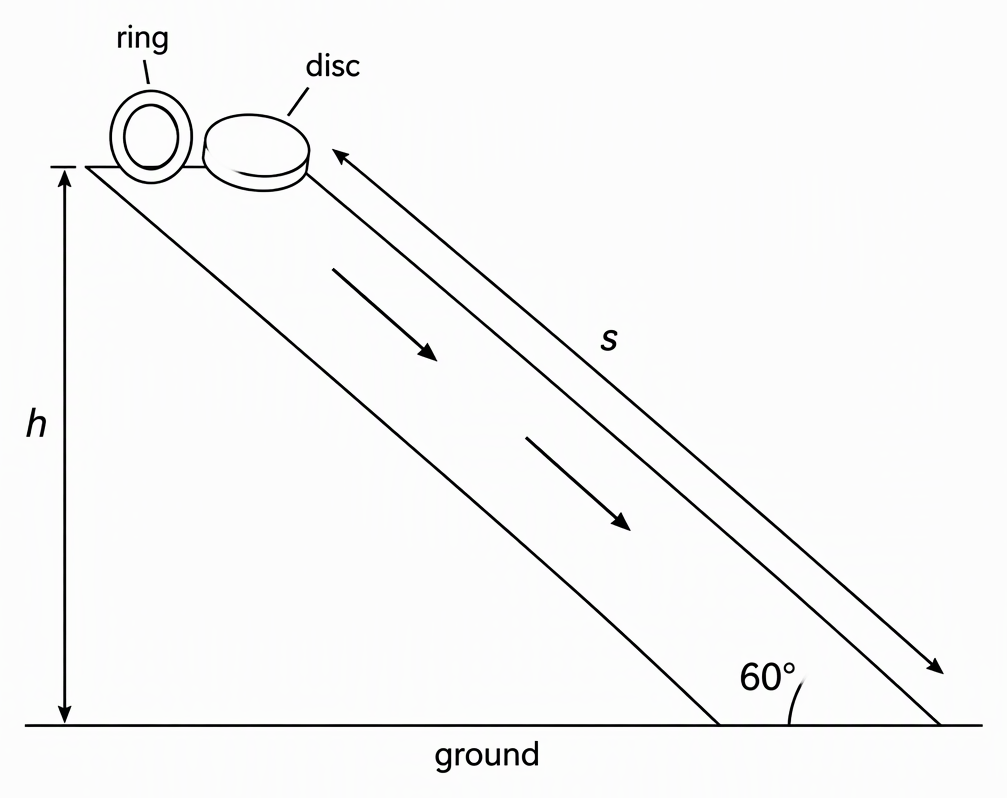
A ring and a disc begin at rest beside each other at the top of an incline making 60 degrees with the horizontal. They start together and roll without slipping along the shortest paths, straight down the slope, until they reach the ground.
Their arrival-time difference and the given gravitational acceleration are:
Find the vertical height in metres. This is a numerical-answer question; the supplied source contains no answer options.
How do you connect rolling acceleration to travel time?
Use this along-slope acceleration with the distance along the slope, not the vertical height. This follows the official acceleration-and-kinematics method.
The symbols refer to each body's own properties:
The dimensionless ratio below measures the effect of mass distribution:
The ring and disc need not have equal masses or radii. Their shape determines this ratio.
The vertical height is opposite the incline angle, while the slope length is the hypotenuse. Therefore:
Both bodies start with zero speed and have constant acceleration. The displacement in the kinematics equation is along the slope:
Substitute the slope distance and rolling acceleration:
Multiply by twice the inertia factor, then divide by the acceleration's numerator:
Take the positive root because elapsed time is positive:
One sine factor comes from slope length; the other comes from acceleration. Losing either factor changes the answer.
Why does the ring arrive later than the disc?
The ring has a larger dimensionless inertia factor, so its along-slope acceleration is smaller. Both bodies start together from rest and cover the same distance, so the ring takes longer. The difference must therefore be ring time minus disc time.
For the ring:
For the disc:
Subtract the times, not their squares. The given delay is a difference between arrival times:
Compare the dimensionless inertia factors, not the absolute moments of inertia. Dividing by each body's mass and radius squared is what makes the comparison valid.
How does the given time difference give 0.75 metres?
Cancelling the shared nonzero factor and squaring gives 0.75 m. Keep the calculation exact rather than approximating the small time difference with decimals.
Substitute the given angle and gravitational acceleration, using metres and seconds:
Cancel the nonzero common factor before squaring:
Now use the exact trigonometric value:
Numerical entry: 0.75. Physical answer: 0.75 m.
Check the result by substituting the height into both arrival-time expressions:
The ring's time is greater, as required. Their difference reproduces the given delay exactly:
Why does using height as the rolling distance give 0.866 metres?
The wrong result comes from mixing vertical displacement with along-slope acceleration. This is a wrong numerical result, not a supplied wrong option: the original question has no options.
Suppose you retain the correct rolling acceleration but incorrectly write:
That produces:
Only one sine factor remains. Subtracting the resulting ring and disc times gives the incorrect equation:
Cancelling and squaring yields:
The correction is directional: displacement and acceleration in a kinematics equation must refer to the same direction. Use the slope distance with the slope acceleration:
What are three related rolling-motion practice questions?
These exercises test the acceleration ratio, time ratio and descent time for a different rolling body. They are original related practice questions, not additional verified PYQs. Attempt each before reading its worked answer.
1. What is the disc-to-ring acceleration ratio on the same incline?
The ratio is four-thirds, so the disc accelerates faster. For rolling without slipping, substituting each inertia factor gives:
2. What is the ring-to-disc time ratio, and does height matter?
The ratio is independent of height when both start together from rest over the same slope length. Time varies inversely with the square root of acceleration:
3. How long does a solid sphere take on the original incline?
Replacing the disc with a uniform solid sphere gives the descent time below. The sphere arrives before both the disc and ring because its dimensionless inertia factor is smaller.
Substitute the original height, angle and gravitational acceleration:
Now cover the worked solution and reproduce the original height calculation. Write the slope-distance relation before substituting either body's inertia.
Next step: the past-paper archive on JEEnius and search every JEE Main paper from 2002 and every Advanced paper from 2007, by year, subject or chapter, each with a worked solution (free).
Read next: How to Study Mole Concept JEE: Conversions to Reactions.
Frequently asked questions
What is the answer to the JEE Advanced 2018 ring-and-disc question?
The vertical height is 0.75 m, so the numerical entry is 0.75. This is the height of the incline, not the distance rolled along its surface.
Why does the disc reach the bottom before the ring?
For rolling without slipping, acceleration depends on the dimensionless ratio I/(mR²), which is 1/2 for a disc and 1 for a ring. The disc therefore has greater acceleration on the same incline and covers the same slope distance in less time.
Why am I getting 0.866 m instead of 0.75 m?
The result 0.866 m comes from using vertical height in h = at²/2 while keeping the acceleration directed along the slope. Use s = h/sinθ and s = at²/2 instead, so displacement and acceleration refer to the same direction.
Do the ring and disc need equal masses and radii?
No, equal masses and radii are not required for this solution. Each body's rolling acceleration depends on its own ratio I/(mR²), which is fixed by its shape for the ring and disc considered here.