
Which options are correct in the System JEE 2018 torque question?
A and C are correct in the System JEE 2018 time-dependent force question: the torque points into the page, not out of it. This is JEE Advanced 2018, Paper 1, Physics, from System of Particles and Rotational Motion, with multiple correct options possible.
A 1.0 kg body starts at rest at the coordinate origin. Its applied force has a horizontal component that increases linearly with time and a vertical component that stays constant.
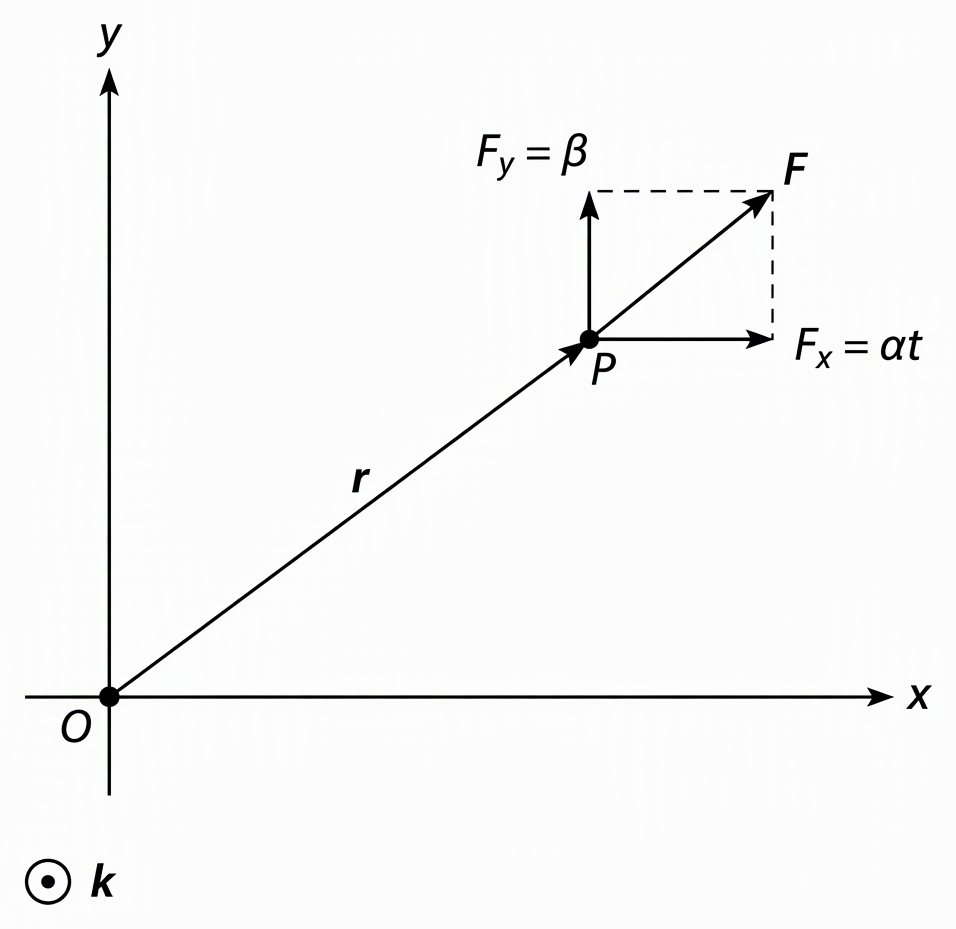
Which statements hold at 1.0 s, with torque measured about the origin?
- A: Torque magnitude:
- B: Torque direction:
- C: Velocity:
- D: Displacement magnitude:
The question bank classifies this as medium difficulty and gives an expected solving time of 120 seconds. That is a practice benchmark, not an official exam limit.
How do you integrate acceleration to check option C?
Integrating the two acceleration components gives the velocity stated in C. Start with Newton’s second law, keeping the dimensional coefficients visible rather than treating time itself as an acceleration.
Use a dummy integration variable to distinguish it from the upper time limit:
The initial rest condition fixes both velocity integration constants:
At 1.0 s, substituting the supplied values gives:
C is correct. The horizontal acceleration changes with time, so constant-acceleration shortcuts cannot be applied to that component.
How do you find the position vector needed for torque?
Integrate velocity once more to obtain the body’s position at one second. Torque needs the instantaneous position vector relative to the torque origin, not the velocity vector or the starting position.
Because the body begins at the origin, both position integration constants are zero:
At 1.0 s:
Position and displacement are the same vector here because the initial position is zero. Torque at one second uses the position just calculated, not the starting vector:
Using the starting position would incorrectly make the later torque vanish.
How do you calculate torque and check all four options?
The cross product gives torque into the page: A is true and B is false. C is already verified; checking the displacement magnitude rules out D. Evaluate the force at the same instant as the position.
For vectors in the coordinate plane:
Substitute the position components in metres and force components in newtons:
Keep magnitude and direction separate. A negative component does not mean a negative magnitude.
- A is true: The torque magnitude is:
- B is false: The torque points along:
- C is true: The first integration produced the stated velocity.
- D is false: The displacement magnitude requires both perpendicular components:
The value in D is only the horizontal displacement. It is not the displacement magnitude.
Correct options: A and C.
Why does reversing the cross product give option B?
Reversing the vector order produces B’s direction while leaving the magnitude unchanged. If your magnitude is right but the sign is wrong, check the order of the cross product.
The incorrect operation is:
Swapping the vectors reverses the direction:
Torque is defined as position crossed with force, in that order. Check the sign geometrically using the separate force contributions about O:
The rightward force produces the larger turning effect, so the net torque is clockwise. By the right-hand rule, its vector points into the page:
How does the answer change at a new time or about a new origin?
A new time requires a new position and force; a new torque origin requires a new lever-arm vector. These two original practice questions, not additional PYQs, test those changes using the same integration-and-cross-product method.
Question 1: For the same body, initial conditions and applied force, calculate the torque about O at 2.0 s.
Substitute the new time into both position components and the force:
Both position and force must be evaluated at the new time. Changing only the force is insufficient.
Question 2: At 1.0 s in the original problem, find the torque about a fixed point Q whose coordinates relative to O are:
Subtract the position of Q from the position of the body P:
Changing the torque origin changes the lever-arm vector, not the applied force. Before every cross product, write the vector from the chosen torque origin to the body.
Next step: the past-paper archive on JEEnius and search every JEE Main paper from 2002 and every Advanced paper from 2007, by year, subject or chapter, each with a worked solution (free).
Read next: How to Study Metallurgy JEE: Extraction Routes.
Frequently asked questions
Which options are correct in the System JEE 2018 torque question?
A and C are correct in this JEE Advanced 2018 Paper 1 question. At 1.0 s, the torque magnitude about the origin is 1/3 N·m and the velocity components are 0.5 m/s horizontally and 1.0 m/s vertically. B is false because the torque points into the page, and D is false because the displacement magnitude is √10/6 m.
Why does the torque point into the page?
At 1.0 s, the torque component about the origin is xF_y − yF_x = 1/6 − 1/2 = −1/3 N·m. The negative z-component means the torque points into the page. Reversing the cross product to F × r gives the wrong direction.
How do you calculate velocity when the force changes with time?
Divide each force component by the mass, then integrate each acceleration component with respect to time. For this body starting from rest, v_x = αt²/(2m) and v_y = βt/m. With the given values at 1.0 s, these become 0.5 m/s and 1.0 m/s respectively.
Why is option D wrong in the System JEE 2018 question?
At 1.0 s, the displacement components are x = 1/6 m and y = 1/2 m. The displacement magnitude is √(x² + y²) = √10/6 m, not 1/6 m. Option D gives only the horizontal component.