
How can I study Metallurgy for JEE without memorising blindly?
Study Metallurgy for JEE by choosing the process from the feed before memorising reactions. Build a compact extraction-route sheet that connects what enters each process, what leaves it and why the process works.
- Check your target syllabus separately for Main and Advanced. Use the official target-year syllabus at jeemain.nta.nic.in for Main and jeeadv.ac.in for Advanced. An old textbook chapter or previous-year question does not establish current inclusion. Do not infer a 2027 inclusion or deletion from either. Keep only verified metals and processes in your study list, without invented frequency rankings or promised marks.
- Repair only the prerequisites that support decisions here. Oxidation states identify what needs reduction; redox balancing checks electron transfer and equation coefficients. Gibbs energy helps you judge whether a proposed reducing agent is thermodynamically suitable at a stated temperature. Basic electrolysis tells you which electrode dissolves, where deposition occurs and why some impurities remain in solution.
- Build one route sheet with five columns. Use these column names: ore or feed; concentration; conversion to a suitable compound; reduction or extraction; refining. At each applicable stage, add a short “why this method?” note based on a property or reaction. This is a framework, not a compulsory sequence: keep solution-based hydrometallurgical routes distinct from thermal reduction and electrolytic extraction. Do not invent a concentration stage when the question already supplies a purified feed.
- Separate recall from reconstruction. Memorise ore identities, named refining methods and specific conditions that cannot be inferred from the question. Reconstruct carbonate versus sulphide treatment, electron balance and thermodynamic feasibility from principles. For an exception, record the exact stage where the usual rule fails and the property responsible, rather than adding another isolated reaction.
- Read, close the book and rebuild one route. Read only the relevant textbook material, then reproduce the route with balanced equations and conditions. Compare your attempt against the source and mark omissions: missing air, wrong carbon product, absent electrolyte or forgotten condensation. Repair those entries instead of rereading the whole chapter.
- Solve and classify the error. Label each mistake as factual recall, process selection, reaction or condition, or thermodynamic reasoning. Revise the matching part of the sheet, then solve another question requiring that decision. A wrong roasting choice needs classification practice, not repeated copying of the equation.
Once these decisions are familiar, JEEnius daily practice problems provide a fresh ten-question topic set every day, with free sets daily. Choose a topic that fits your verified syllabus.
How do I choose between calcination and roasting for zinc feeds?
A carbonate feed suggests calcination; a sulphide feed suggests oxidative roasting. Oxygen is a reactant in sulphide roasting, but carbonate decomposition does not require it.
Original illustrative problem, not a JEE previous-year question: Convert zinc carbonate and zinc sulphide into zinc oxide before reduction. Choose the treatments, write the reactions and explain why the same treatment does not suit both.
Classify the feeds first. Calcine the carbonate in the absence of air or with limited air:
Roast the sulphide in air:
Heating alone does not supply the oxygen consumed in roasting. The carbonate already contains the oxygen needed for its decomposition products.
Complete the illustrative route with reduction at high temperature. The zinc vapour must subsequently be condensed to recover the metal.
Numerical check: Calculate the oxide obtained by complete calcination of 25 g of pure zinc carbonate. Use the supplied molar masses:
The equation gives a one-to-one mole ratio, not equal masses. Learn the feed-to-process rule first, then attach equations and conditions instead of memorising two unrelated reaction lists.
How do I read an Ellingham comparison without reversing the answer?
Subtract the metal-oxidation value from the carbon-oxidation value, using the same oxygen basis and temperature. A negative result means reduction is thermodynamically favourable under standard-state conditions, not necessarily fast.
Original symbolic problem: At the temperature marked in the figure, the standard Gibbs energy for carbon oxidation to carbon monoxide lies below that for oxidation of the metal. Both reference reactions use one mole of oxygen.
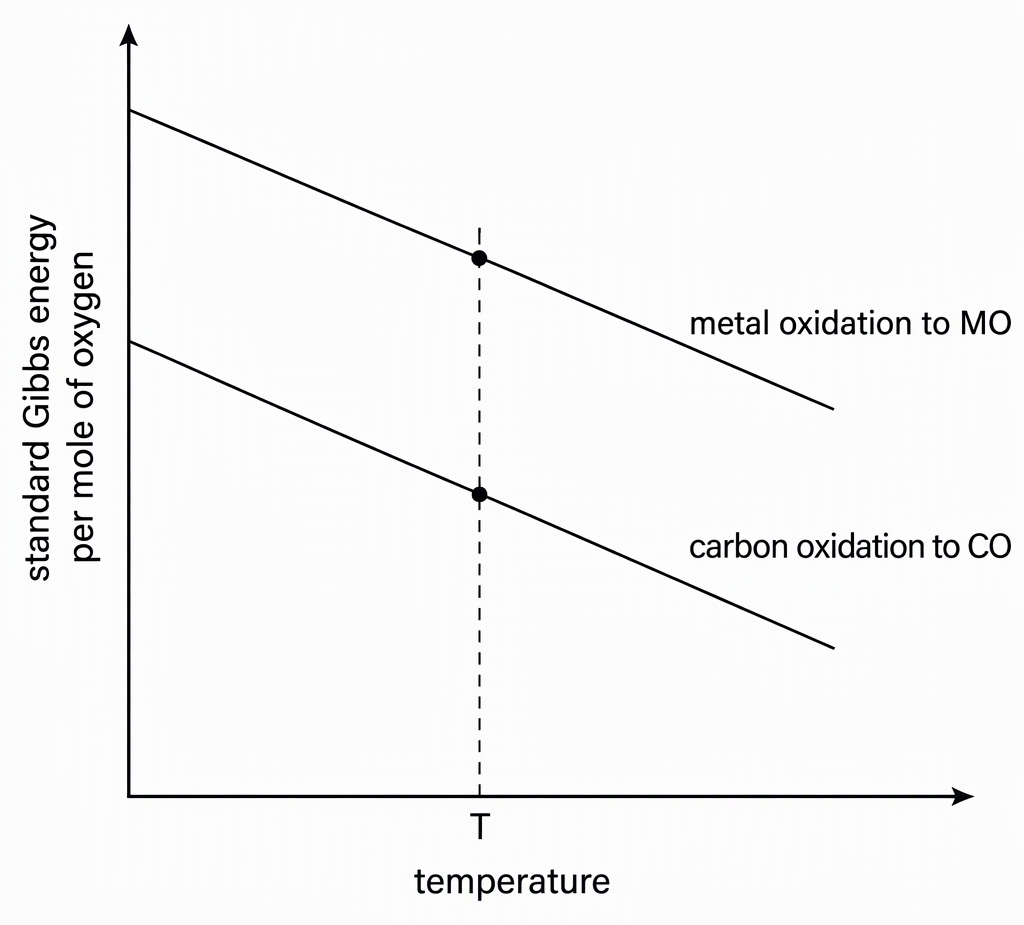
Write the reference reactions:
Reverse metal oxidation, then add carbon oxidation:
Therefore:
Reduction is thermodynamically favourable under standard-state conditions at that temperature. It is not necessarily fast or industrially suitable; actual gas pressures and activities can change the Gibbs energy:
Check four traps before choosing an answer:
- Unequal oxygen basis: normalise before comparing.
- Wrong carbon product: use the specified carbon monoxide or carbon dioxide reaction.
- Ignored temperature: compare at the stated temperature.
- Misread crossing: a line crossing does not guarantee practical extraction.
A standard Ellingham diagram alone does not settle every operating condition. Close the explanation, redraw the two symbolic lines and derive the sign from the reactions.
How do I distinguish copper extraction from copper electrorefining?
An impure copper slab is already metallic copper, so this problem belongs in the refining column. You are separating impurities from copper, not concentrating an ore or reducing an oxide.
Original problem: An impure copper slab is refined using acidified copper sulphate electrolyte. Identify the electrodes, write the principal reactions and explain what happens to silver and zinc impurities.
Use impure copper as the positive anode and a thin sheet of pure copper as the negative cathode. The electrolyte carries ions between the electrodes.
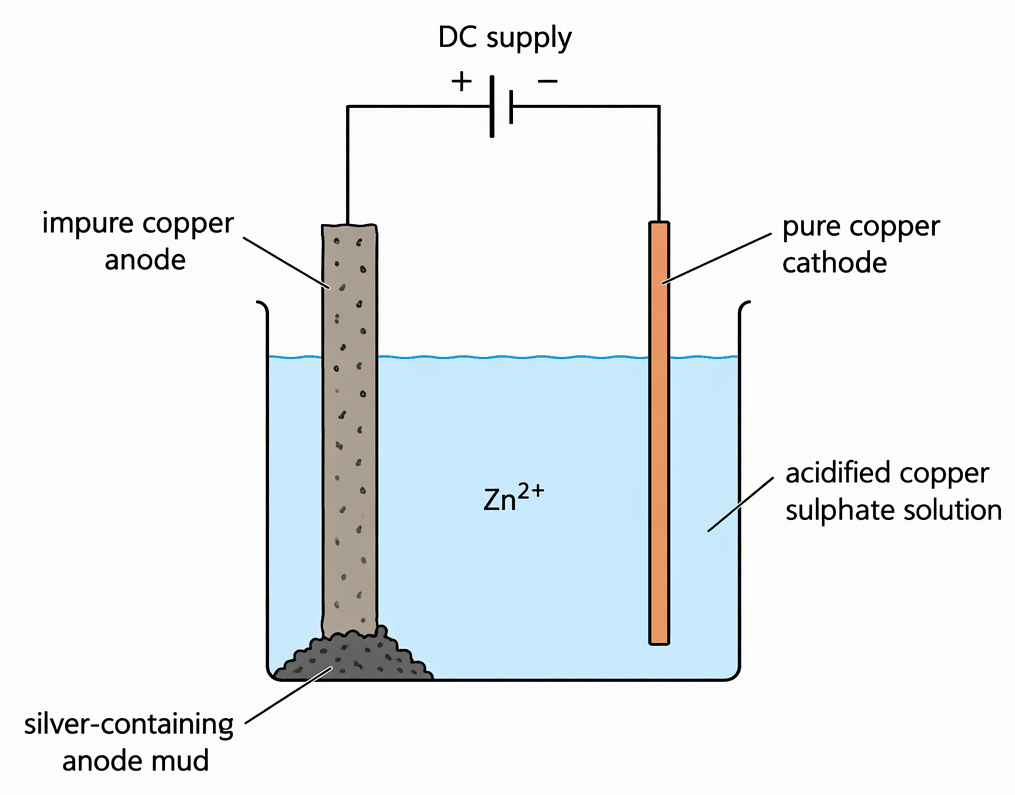
At the anode:
At the cathode:
Silver is typically collected in anode mud. Zinc dissolves and normally remains in solution under copper-refining conditions.
Neither “every impurity becomes mud” nor “every dissolved metal plates out” is correct. Selective dissolution and deposition control the separation, so attach each refining method to its separation principle, not merely a metal–method pair.
What should I practise after learning the extraction routes?
Start with feed classification, then balanced routes, Ellingham reasoning and refining before attempting mixed statements. Keep every category conditional on your verified syllabus; practise individual decisions first so you can identify the source of an error.
- Feed to treatment: choose the process and state why.
- Balanced routes: supply equations, conditions and recovery steps.
- Ellingham reasoning: normalise reactions, combine them and determine the sign.
- Refining and mixed statements: identify the stage, separation principle and misleading claim.
Then attempt relevant PYQs. Check the examination, year and current syllabus fit rather than assuming every old Metallurgy question remains relevant.
For each wrong answer, record the decisive missed fact or reasoning step. Reconstruct that part of the route sheet from memory before checking it.
Use a mastery check, not a guaranteed completion time: explain the process choice, balance the reaction and state the important condition without notes. Repeat the closed-book reconstruction later to check retention.
Finish with a fresh mixed set, since recognising repeated answers can conceal gaps. JEEnius practice mode offers topic sets that skip questions already seen, with free sets included; use an eligible topic to test whether your reasoning survives a new question.
Next step: practice mode on JEEnius and practise a topic in sets that skip questions you have already seen (free sets included).
Related on JEEnius: Limits Practice Questions JEE: 6 Drills With Solutions.
Frequently asked questions
How do I study Metallurgy for JEE without memorising everything?
Build a five-column sheet covering ore or feed, concentration, conversion to a suitable compound, reduction or extraction, and refining. Add a reason for each applicable process rather than forcing every route through all five stages. Memorise ore identities, named refining methods and specific conditions; reconstruct process choices, electron balance and thermodynamic feasibility from principles. Close the book and rebuild each route to expose gaps.
Is Metallurgy included in the JEE Main and Advanced syllabus?
Check the official syllabus for your target year separately at jeemain.nta.nic.in and jeeadv.ac.in. An old textbook chapter or previous-year question does not establish current inclusion. Keep only verified metals and processes in your study list.
What is the difference between calcination and roasting for zinc ores?
Zinc carbonate is calcined in the absence of air or with limited air to form zinc oxide and carbon dioxide. Zinc sulphide is roasted in air to form zinc oxide and sulphur dioxide. Oxygen is a reactant in sulphide roasting, whereas carbonate decomposition does not require it.
How do I use an Ellingham diagram to check carbon reduction?
Compare the carbon-oxidation and metal-oxidation Gibbs energies at the same temperature and on the same oxygen basis. Subtract the metal-oxidation value from the carbon-oxidation value to obtain the standard Gibbs energy of reduction. A negative result means thermodynamic favourability under standard-state conditions, not necessarily fast or industrially suitable extraction.
What happens to silver and zinc during copper electrorefining?
In copper electrorefining with acidified copper sulphate electrolyte, impure copper forms the positive anode and a thin pure copper sheet forms the negative cathode. Copper dissolves at the anode and deposits at the cathode. Silver typically collects in anode mud, while zinc dissolves and normally remains in solution under copper-refining conditions.