
In what order should I study Matrices for JEE?
For Matrices for JEE, study dimensions first, then structure, properties, inverse tools and question types. Learn to choose a valid operation before trying to calculate faster. Use these five steps and apply the same solving checklist to every question.
- Fix the prerequisites.
Know matrix order, equality, addition and multiplication before touching inverses. Equality requires matching dimensions and equal corresponding entries. Addition also requires matching dimensions.
For multiplication, the inner dimensions must match. The result takes the outer dimensions:
Check this before calculating an entry. Reversing the factors may produce a different-sized matrix or make the product undefined.
- Learn structure before calculation.
A zero matrix has every entry zero. An identity matrix is square, with diagonal entries one and other entries zero. A diagonal matrix is square, with every off-diagonal entry zero.
For real square matrices, symmetry and skew-symmetry mean:
Every diagonal entry of a real skew-symmetric matrix is zero. Use these restrictions before calculating individual entries.
- Build a small property sheet with conditions.
Record the order-sensitive rules with their conditions. For products with compatible dimensions:
Cancellation needs an invertible factor on the correct side. Left factors are removed by left multiplication; right factors by right multiplication.
For square matrices of the same order, check factorisation rather than assuming ordinary algebra applies:
The difference-of-squares shortcut works only when the extra term vanishes, meaning the matrices commute:
- Learn the determinant and inverse tools you need.
For a square matrix, the invertibility test is:
Learn the small-matrix determinant and inverse calculations needed for equations. Do not postpone all matrix practice until you finish the entire Determinants chapter.
- Sort questions by the decision they require.
Use these groups:
- Direct operations.
- Matrix equations.
- Powers or polynomial identities.
- Parameter-dependent systems.
Study one worked solution, close it, then attempt an unseen question of the same type. Build accuracy on direct operations first, then progress to questions combining several properties. Do not assume a fixed Main-versus-Advanced split.
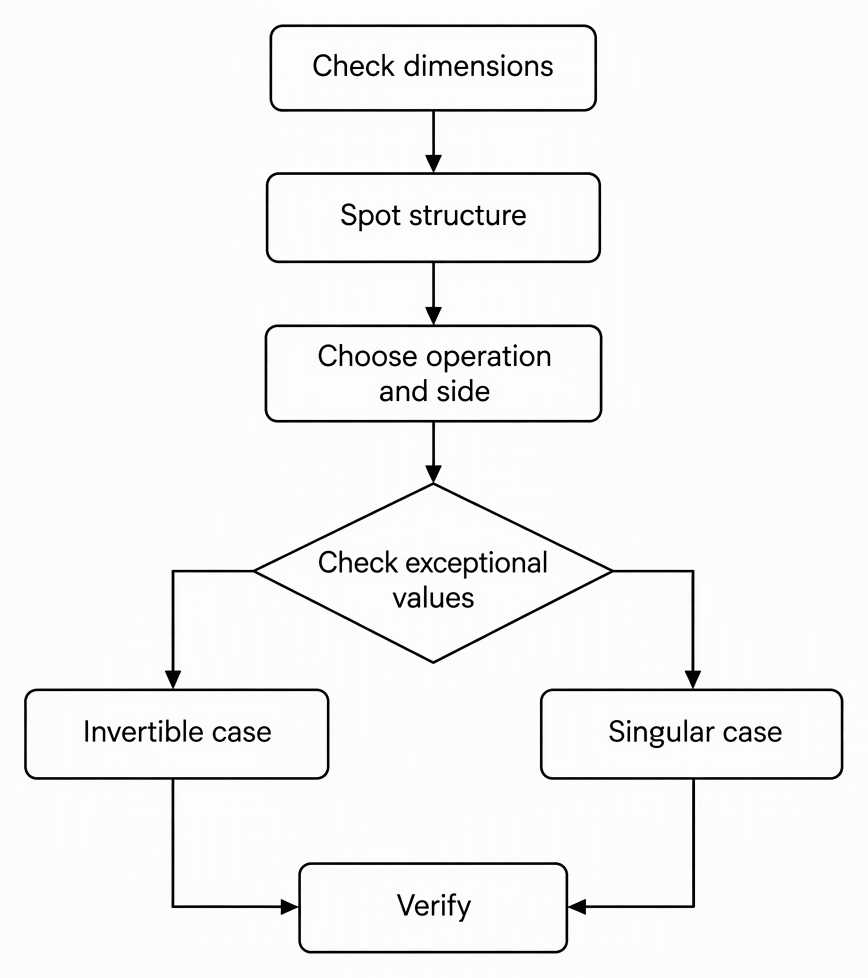
Use this checklist every time: check dimensions → spot structure → choose the operation and its side → check exceptional parameter values → verify by substitution or a low power.
How do you solve a matrix equation without reversing the order?
Remove the coefficient matrix from the side where it appears. An inverse cannot move freely across a product. The two equations below use identical matrices, but their solutions differ because left multiplication and right multiplication are different operations.
Take this teaching example:
Both matrices are two by two, so both multiplication orders are defined. The coefficient matrix is upper triangular and invertible:
First equation: multiply on the left.
Verify by putting the answer into the original equation:
Second equation: multiply on the right.
The different upper-right entries come from multiplication order, not an arithmetic mistake. Both answers are correct for their respective equations.
Writing the following is not valid matrix algebra:
There is no ordinary matrix division operation that chooses the correct side. Replace “divide” with an explicit instruction to left-multiply or right-multiply by the inverse, and apply it to both sides.
If you chose the wrong side, practise equation isolation, not more inverse calculations. Calculate another inverse only if that calculation was the source of your error.
How can a short identity replace repeated matrix multiplication?
Calculate the square once, then check whether it can be written using the original matrix and the identity matrix. For this example, a verified relation reduces every higher power to those two matrices. The same relation also establishes the inverse.
Find the fifth power and inverse of:
The matrix is square and symmetric. Calculate its square, then verify the proposed relation directly:
Thus:
Multiply by the original matrix, then immediately replace every square using this relation:
Only now substitute the entries:
An optional compact way to organise the same arithmetic is:
Start from the verified square relation. Each new pair of coefficients follows from the previous pair, avoiding repeated full matrix multiplication.
For the inverse, rearrange the identity. This establishes invertibility rather than assuming it:
Avoid two errors: replacing the scalar multiple of the identity with a bare scalar, and using a polynomial relation without verifying it for the given matrix. The constant term here is a matrix, not a number:
For continuing topic practice, JEEnius daily practice problems provide a fresh ten-question set on a topic every day, with free sets daily.
No eigenvalue method or named theorem was needed. When a low-degree identity is given or easy to verify, reduce powers before doing repeated matrix multiplication.
What should you do when a parameter makes the matrix singular?
Find the determinant and split the parameter cases before introducing any denominator. A zero determinant blocks the inverse method, but it does not decide whether the equations have no solution or infinitely many. Check consistency using the original equations.
Consider this system with real parameters:
The dimensions are compatible. For the coefficient matrix:
Its two rows become identical at the exceptional value, so split immediately.
Case one: the determinant is nonzero.
Write the two scalar equations and subtract the first from the second:
Division is now justified:
This solution is unique. To verify it, the first equation gives:
Adding the subtraction equation recovers the second original equation.
Case two: the determinant is zero.
- When the right-hand constants match, there are infinitely many solutions:
- When they differ, there is no solution:
Singular does not mean no solution. It means the inverse route is unavailable, so consistency must be checked.
Row subtraction is shorter than calculating an adjugate here because the first-column coefficients already match. Matrix notation does not oblige you to use an inverse. A missed exceptional value calls for parameter-case drills, not another formula revision.
What should I practise after these examples?
Move from isolated operations to mixed questions, using errors to choose what to revise. Before calculating, write one first-step decision: “left-multiply by the inverse”, “reduce the square”, or “split where the determinant is zero”. Use this practice order:
- NCERT definitions and basic exercises.
- Matrix-equation drills.
- Powers and identity problems.
- Singular-parameter systems.
- Mixed JEE Main and JEE Advanced previous-year questions.
These three worked problems are teaching examples, not PYQs or an exhaustive chapter checklist. Include entrywise equality, transpose identities and symmetric/skew-symmetric decomposition in subsequent practice. For a real square matrix, the terms below are symmetric and skew-symmetric, respectively:
For your first ten-question diagnostic, use this suggested practice mix, not exam weightage or a guaranteed product-set composition:
- Two on dimensions and multiplication.
- Two on transpose or symmetry.
- Two on matrix equations.
- Two on powers and identities.
- Two on parameter-dependent systems.
Classify each mistake before revising:
- Dimension: return to the prerequisite checks.
- Order/property: revisit the first or second example.
- Arithmetic: locate and redo the first incorrect calculation.
- Missed case: revisit the third example.
Then solve an unseen variant. You are ready for mixed work when you can justify the operation, preserve multiplication order, handle singular cases and verify the result without checking a solution.
Use JEEnius practice mode for topic sets that skip questions you have already seen, with free sets included. Write your first-step decision before starting the calculation.
Next step: daily practice problems on JEEnius and get a fresh ten-question set on a topic every day (free sets daily).
Related on JEEnius: Laws of Motion Practice Questions JEE: 5 Solved Drills.
Frequently asked questions
In what order should I study matrices for JEE?
Start with matrix dimensions, equality, addition and multiplication. Then study matrix types, transpose rules and order-sensitive properties before learning determinant and inverse tools. Progress from direct operations to matrix equations, powers and parameter-dependent systems.
Should I finish determinants before starting matrices?
No. Begin matrix practice with dimensions, operations and structure, then learn the small-matrix determinant and inverse calculations needed for equations. You do not need to finish the entire Determinants chapter before practising matrices.
How do I solve AX = B and XA = B?
If A is invertible, solve AX = B by multiplying both sides on the left by A's inverse. Solve XA = B by multiplying both sides on the right by A's inverse. Preserve this order and verify the result in the original equation; ordinary division by a matrix is not valid.
Does a zero determinant mean a system has no solution?
No. A zero determinant means the coefficient matrix is singular, so the inverse method is unavailable. Check the original equations for consistency: a singular square linear system can have no solution or infinitely many solutions.
What should I practise after learning matrix formulas?
Start with NCERT definitions and basic exercises, then practise matrix equations, powers and identities, and singular-parameter systems. Follow these with mixed JEE Main and JEE Advanced previous-year questions. Classify each error as a dimension, order/property, arithmetic or missed-case error, revise that skill, and solve an unseen variant.