
What six steps should I follow before choosing a kinematics formula?
- Repair only the prerequisites you need. To study kinematics for JEE, choose the representation before the formula. Repair vector components, basic trigonometry, quadratic equations, graph slopes and areas, and the meanings of differentiation and integration. Do not postpone kinematics until you have completed all of calculus.
Follow this learning order: position/displacement and speed/velocity → one-dimensional constant-acceleration motion → motion graphs → projectile motion → relative motion. After each subtopic, close the solution and reproduce the setup yourself. Recognising a worked solution is not the same as solving it.
- Set the coordinates and clock. Sketch the situation, choose an origin and positive axes, and define the starting instant:
Write initial position, initial velocity and acceleration with signs and units. “Slowing down” means acceleration opposes velocity, not that acceleration is negative. Its sign depends on your chosen axis.
- Identify the event and valid interval. Decide whether the question concerns landing, meeting, turning or closest approach. Note when the model begins and ends. Split the motion when acceleration changes, and give a later-starting object its own elapsed time.
- Choose the representation. Constant acceleration permits SUVAT equations, which connect displacement, initial and final velocity, acceleration and time. Position–time slope gives velocity; velocity–time signed area gives displacement. Use components for projectiles and relative position and velocity for two-body comparisons.
For variable acceleration, start from derivatives, not constant-acceleration formulas. Integration reverses these operations, but requires initial conditions:
- Translate the event into an equation. Landing means reaching the actual landing height. Meeting means equal positions at the same global time. A turning point requires velocity to change sign, not merely become zero for an instant. Write this condition before substituting numbers.
- Check the answer physically. Check units, signs, admissible roots and the stated interval. Displacement is signed change in position; distance counts the entire path. Velocity includes direction; speed is its magnitude. Reject a negative root if it lies outside the motion being modelled, not simply because it is negative.
How do I find distance when a velocity graph crosses zero?
Use signed areas for displacement and absolute areas for distance. When velocity changes sign, split the interval at the crossing before adding areas. This illustrative teaching example, not a JEE previous-year question, shows why graph reasoning is safer than blind substitution.
Problem: Find displacement and total distance for:
Steps 1 and 2: Use line slopes and triangle areas. Choose the initial velocity as positive, the starting position as origin, and the given clock:
Steps 3 and 4: Choose the velocity graph and locate the turning event. Velocity changes from positive to negative at this root within the interval:
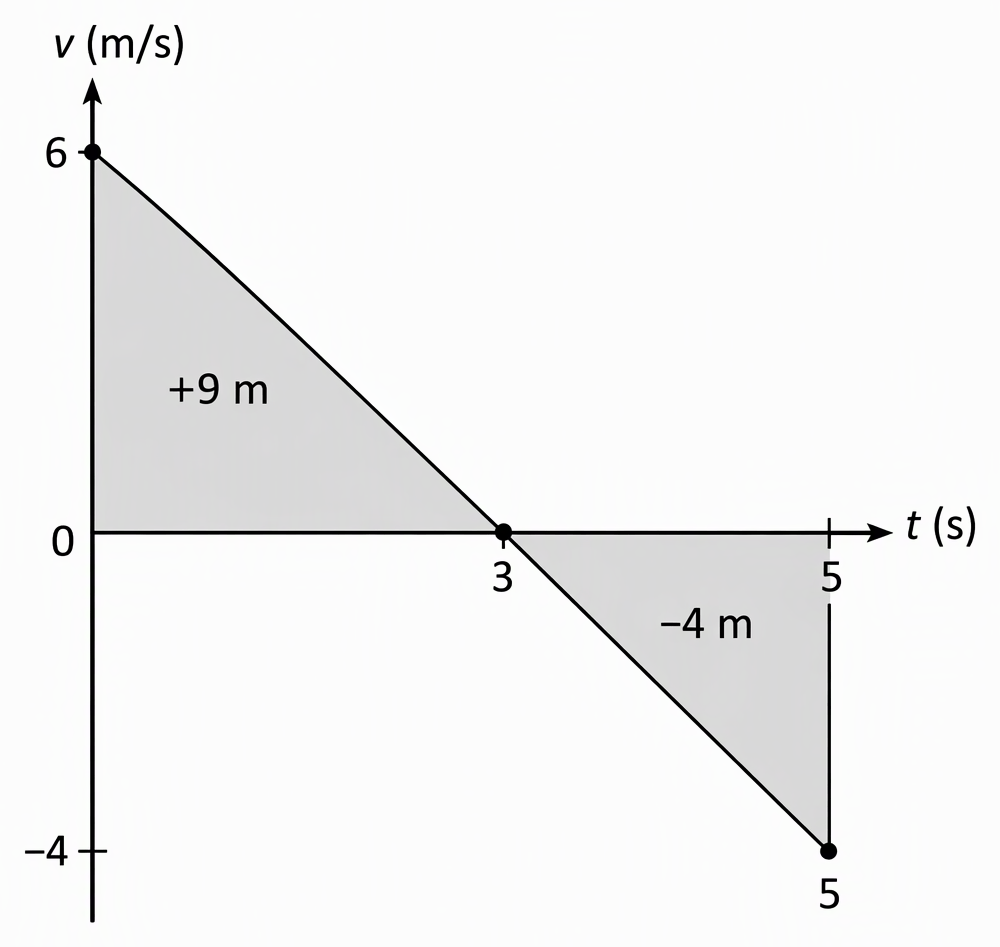
Step 5: Split the interval and calculate:
Step 6: Cross-check displacement using constant acceleration:
Diagnostic mistake: Taking the absolute value of net displacement does not give distance after reversal. The reusable sequence is graph → sign change → split interval → signed or unsigned areas.
JEEnius daily practice problems provide a fresh ten-question topic set every day, with free sets daily. Use a set to practise identifying the representation before calculating.
How do I solve a projectile that lands below its launch point?
Write the vertical position equation and impose the actual landing height. The equal-height flight-time formula gives the time to return to launch height, not to reach the ground below.
Illustrative teaching example, not a JEE previous-year question: A projectile leaves a 25 m platform with horizontal and upward velocity components of 15 m/s and 20 m/s. Find flight time, horizontal displacement and impact speed.
Steps 1 and 2: Resolve the motion into components. Neglect air resistance and use:
Choose ground level as the vertical origin, upward and the horizontal launch direction as positive, and launch as time zero:
Steps 3 and 4: The valid flight runs from launch to ground contact. Both components share the same time, despite different accelerations:
Step 5: Landing gives:
Step 6: Reject the negative root because this flight begins at launch, not before it. Use the positive root for horizontal displacement and both impact components:
The equal-height expression gives:
That describes return to launch height, not landing below it. Write the actual landing-height condition before using a memorised flight-time or range formula.
How do I find closest approach when two objects do not collide?
Minimise the squared relative separation, not one coordinate difference. At an interior minimum with nonzero relative velocity, relative position is perpendicular to relative velocity. Matching horizontal coordinates alone cannot establish a collision.
Illustrative teaching example, not a JEE previous-year question: Find the minimum separation for future motion:
Steps 1 and 2: Use vector subtraction, the given origin, rightward and upward positive axes, and the common starting clock.
Steps 3 and 4: The event is minimum separation. Define B relative to A consistently:
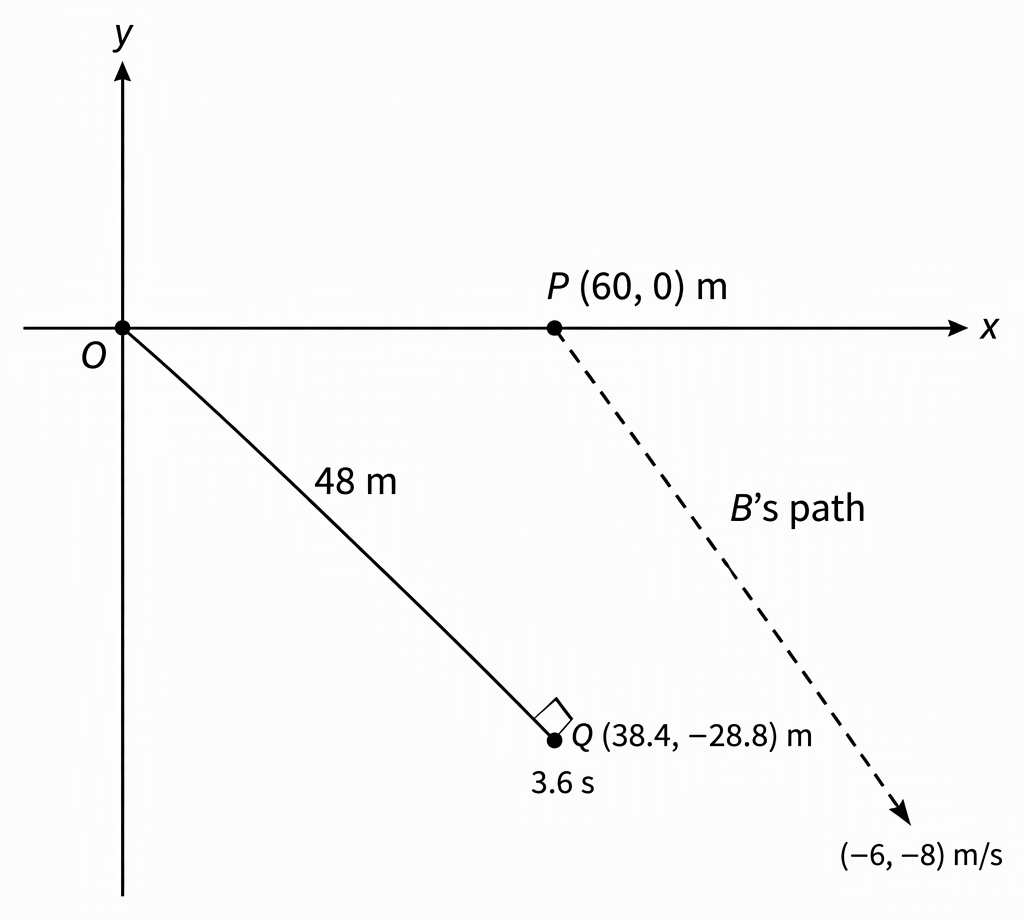
Step 5: Minimise separation squared by completing the square:
Alternatively, set the derivative of separation squared to zero. The zero dot product expresses the perpendicular condition:
Step 6: Check the domain. If the unconstrained minimum time is negative, the future minimum for constant relative velocity occurs at time zero.
Matching horizontal coordinates instead gives:
Diagnostic mistake: A collision requires both coordinates to match at the same time. Equal horizontal positions with nonzero vertical separation are not a collision.
What should I practise next if I keep making the same mistakes?
Choose questions by the first incorrect step, not by how difficult the final answer looks. Isolate the failure, practise that setup, then change one condition instead of watching another full lecture.
Use this progression:
- Single-stage one-dimensional motion.
- Turning and piecewise motion.
- Position–time, velocity–time and acceleration–time graphs.
- Unequal-height projectiles.
- Relative motion.
- Mixed questions and variable acceleration.
For each new type, study one worked setup, solve a similar question without looking, then solve a changed version. Alter the sign, initial position, landing height or starting time.
Match practice to the error:
- Wrong distance: velocity sign-change questions.
- Wrong projectile time: unequal-height landing questions.
- False collision: two-dimensional position matching.
- Wrong formula: acceleration classification and graph interpretation.
Keep an error log with four labels: representation, sign/time origin, algebra and physical check. Record the first incorrect step, not the entire solution.
Make delayed starts your next challenge. Distinguish global time from the later object’s elapsed time:
For constant acceleration after its start, use:
Do not extend this equation before its start time. Model the earlier motion separately.
Once basic setups are reliable, attempt topic-wise JEE Main PYQs, then selected JEE Advanced problems combining graphs, components, constraints or multiple stages. Do not assume a fixed JEE Advanced question pattern.
Readiness means choosing and justifying a representation on an unseen question, solving without a hint, and rejecting an invalid root or sign. Reciting formulas is not enough.
JEEnius practice mode offers topic sets that skip questions already seen, with free sets included. Use unseen questions to test transfer, but separately re-solve previously incorrect questions to check repair. Start with the first wrong setup in your error log.
Next step: practice mode on JEEnius and practise a topic in sets that skip questions you have already seen (free sets included).
If that step was the hard part, work through Free JEE Maths Mock Test: Choose the Right Format.
Frequently asked questions
What should I learn before starting kinematics for JEE?
Revise vector components, basic trigonometry, quadratic equations, graph slopes and areas, and the meanings of differentiation and integration. You do not need to finish all of calculus before starting kinematics. Begin with position, displacement, speed and velocity, then move to constant-acceleration motion, graphs, projectiles and relative motion.
How do I find distance when a velocity-time graph crosses zero?
Split the interval wherever velocity changes sign and add the magnitudes of the areas between the graph and the time axis. Signed areas give displacement, while absolute areas give distance. Taking the absolute value of net displacement does not give total distance after a reversal.
How do I find flight time when a projectile lands below its launch point?
Choose a vertical origin, write the vertical position equation and set the final position equal to the actual landing height. Solve for time and retain the root within the modelled flight interval. The equal-height flight-time formula gives the return time to launch height, not the time to land below it.
How do I find the minimum distance between two moving objects?
Write their relative position at a common time and minimise its squared magnitude over the allowed interval. At an interior minimum with nonzero relative velocity, relative position is perpendicular to relative velocity. For constant relative velocity, if the unconstrained minimum time is negative, the minimum over future motion occurs at time zero.
How should I practise kinematics if I keep making mistakes?
Record the first incorrect step under representation, sign/time origin, algebra or physical check, then choose questions targeting that error. Study one worked setup, solve a similar question without looking and then change one condition, such as landing height or starting time. Once basic setups are reliable, attempt topic-wise JEE Main PYQs followed by selected JEE Advanced problems.