
How should I study Hydrocarbons for JEE in six steps?
To study Hydrocarbons for JEE, test every reaction forwards and backwards, with its conditions attached. Make decisions about the substrate, reagent and pathway instead of repeatedly reading a reaction chart.
- Check only the prerequisites you need. Test bond-line structures, nomenclature, structural and geometrical isomerism, resonance, inductive effect, hyperconjugation, electrophiles and nucleophiles, and carbocation and radical stability. You should be able to recognise equivalent positions and compare plausible intermediates. If secondary carbocation stability is unclear, revise that specific gap rather than restarting all of GOC.
- Study alkanes, then alkenes, alkynes and aromatic hydrocarbons. Use NCERT for the first pass and the current official syllabus as your boundary. Check jeemain.nta.nic.in for Main’s syllabus and the official JEE Advanced website for Advanced’s; do not assume every subsection deserves equal attention. Give each family a concrete target:
- Alkanes: radical substitution and equivalent hydrogen positions.
- Alkenes: addition, orientation and oxidation.
- Alkynes: addition, reduction and terminal-hydrogen acidity.
- Aromatic hydrocarbons: electrophilic substitution, directing effects and side-chain reactions.
- Build a reaction sheet that records decisions. Give every entry five fields: substrate, reagent and conditions, reaction family, product, and an answer-changing condition or exception. Include preparation routes as well as reactions. For each preparation, record the starting functional group and whether the carbon skeleton changes. Keep these contrasts together:
- HBr without peroxide versus peroxide-initiated HBr addition.
- Cold dilute alkaline potassium permanganate, giving alkene dihydroxylation, versus vigorous oxidative conditions that can cleave the double bond.
- Toluene with chlorine and ferric chloride, giving ring substitution, versus chlorine under light, giving side-chain substitution.
- Use the same solving procedure every time. Identify the reactive site; read every reagent and condition; choose the pathway or intermediate; draw the product; check carbon count, valency, regioselectivity and relevant stereochemistry. If cleavage occurs, count carbons across all fragments. Do not force a carbocation mechanism onto a radical or concerted reaction. In a sequence, restart this procedure after every arrow.
- Close the notes and test both directions. First predict a product from its substrate, then recover a possible substrate or reagent from the product. Learn mechanisms where they explain orientation, rearrangement or selectivity. Explicitly memorise conditions and exceptions that mechanisms alone do not supply.
- Progress from single-family questions to mixed conversions and actual PYQs. Label each mistake: prerequisite gap, reagent confusion, wrong reactive site, intermediate error or product-counting error. Correct the cause, then redo the question without its solution. Keep wrong questions separate from fresh practice so recognition does not masquerade as recall.
The three worked examples below are illustrative teaching problems, not attributed previous-year questions.
Why does propene give different products with HBr and peroxide?
Propene gives 2-bromopropane without peroxide and 1-bromopropane under peroxide-initiated radical conditions. Learn these as a controlled pair: the substrate stays unchanged, but the conditions select different pathways.
Problem: Predict the major product of propene with HBr under ordinary conditions without peroxide, then under peroxide-initiated radical conditions.
- Without peroxide: The reactive site is the double bond. Ordinary HBr addition follows an ionic pathway: protonation favours the more stable secondary carbocation, which bromide attacks.
The product is 2-bromopropane. Check that the three-carbon skeleton remains intact, each carbon has valid valency, and bromine occupies the middle carbon.
- With peroxide: The reactive site is still the double bond, but peroxide initiates a radical chain pathway. A bromine radical adds to the terminal carbon, leaving the more stable secondary carbon radical. That radical abstracts hydrogen from HBr.
The product is 1-bromopropane. Again, check three carbons and valid valencies, but now bromine occupies an end carbon.
The trap: the standard peroxide effect applies to HBr, not HCl or HI. It is not a universal reversal rule for hydrogen halides.
Retain this reaction-sheet entry: the same substrate can give a different major product because conditions change the reaction pathway.
How do I reconstruct an alkene from ozonolysis products?
Reconnect the two carbonyl carbons with a double bond after removing their oxygens on paper. Ethanal and propanal therefore reconstruct pent-2-ene connectivity, but they do not identify its geometrical isomer.
Problem: An acyclic monoalkene gives ethanal and propanal after ozonolysis followed by reductive work-up with zinc and water. Identify its connectivity.
In each fragment, the carbon of the aldehyde group is the carbonyl carbon. Those are the two carbons that originally formed the double bond.
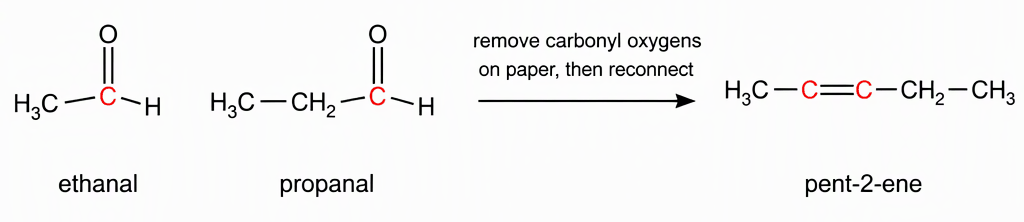
- Mark the carbonyl carbon in each fragment.
- Remove the two carbonyl oxygens on paper.
- Join the marked carbons with a double bond, keeping their attached groups unchanged.
Check carbon conservation: the two-carbon and three-carbon fragments reconstruct a five-carbon alkene.
Reductive work-up matters: retain the aldehydes stated in the problem. Do not silently replace them with the carboxylic acids associated with oxidative work-up.
The fragments cannot distinguish E-pent-2-ene from Z-pent-2-ene. After solving, cover the fragments and predict them again from the reconstructed alkene.
For fresh recall practice, JEEnius daily practice problems provide a fresh ten-question set on a topic every day, with free daily sets.
Why does reversing oxidation and nitration change the aromatic product?
Oxidising toluene first gives predominantly m-nitrobenzoic acid after nitration; nitrating first gives mainly ortho- and para-nitrobenzoic acids after oxidation. The group attached to the ring at the nitration step determines the orientation. Reassess the substrate at every arrow.
Problem: Compare side-chain oxidation followed by nitration with nitration followed by side-chain oxidation, starting from toluene.
Use hot alkaline potassium permanganate followed by acidification for oxidation. Use concentrated nitric acid and concentrated sulfuric acid for nitration.
Route A: oxidise, then nitrate.
At the first arrow, choose the benzylic side chain as the reactive site. Standard side-chain oxidation requires at least one benzylic hydrogen; toluene has three. Oxidation gives benzoic acid, whose carboxyl group is deactivating and meta-directing, so nitration gives predominantly m-nitrobenzoic acid.
Route B: nitrate, then oxidise.
At the first arrow, methyl directs ring nitration mainly ortho and para. Toluene nitration therefore gives mainly an ortho/para nitrotoluene mixture, not one unique isomer. At the second arrow, oxidise each methyl side chain without relocating the nitro group.
The principal products are the corresponding ortho- and para-nitrobenzoic acids. Carbon count is unchanged through both routes, but substituent positions differ.
Practise conversions in opposite orders. Explain whether the first transformation changes the reactive site or directing group for the second.
What should I practise after these Hydrocarbons examples?
Start with isolated decisions, then move to reverse questions and mixed sequences. Use a skill-based readiness check: explain the product, identify the decisive condition and reject a plausible wrong answer without notes.
- Alkanes: count distinct monochlorination products after checking symmetry.
- Alkenes: keep the substrate fixed and change addition or oxidation conditions.
- Alkynes: compare terminal-hydrogen acidity with internal alkynes, which lack that hydrogen.
- Aromatics: identify the directing group and distinguish ring from side-chain attack.
Numerical drill: Count distinct constitutional monochlorination products of propane. Its two end carbons are equivalent, while its middle carbon is different, giving 1-chloropropane or 2-chloropropane.
For an internal alkyne, contrast hydrogen with Lindlar catalyst, giving a cis alkene, against sodium in liquid ammonia, giving a trans alkene. Practise hydration with mercuric sulfate and sulfuric acid through enol–carbonyl tautomerism. Terminal alkynes usually give methyl ketones; ethyne gives ethanal.
Next attempt reverse ozonolysis and mixed conversions. Include Main single-correct and numerical-answer PYQs. For Advanced, use its own PYQs and read each question’s instructions rather than assuming a fixed pattern.
Apply substrate-and-reagent reasoning next in How to Study Haloalkanes JEE: Mechanisms and Practice. It is a next application, not a prerequisite.
Revisit wrong questions separately. For fresh questions, JEEnius practice mode offers topic sets that skip previously seen questions, with free sets included.
Frequently asked questions
What should I revise before studying Hydrocarbons for JEE?
Check bond-line structures, nomenclature, structural and geometrical isomerism, resonance, inductive effect, hyperconjugation, electrophiles and nucleophiles, and carbocation and radical stability. You should also recognise equivalent positions and compare plausible intermediates. Revise specific gaps rather than restarting all of GOC.
How do I memorise Hydrocarbons reactions for JEE?
Make a reaction sheet with five fields: substrate, reagent and conditions, reaction family, product, and an answer-changing condition or exception. Close your notes and practise both predicting products and recovering possible substrates or reagents. Use mechanisms to explain orientation, rearrangement and selectivity, but explicitly memorise conditions and exceptions.
How do I find an alkene from its ozonolysis products?
For an acyclic monoalkene, identify the carbonyl carbon in each fragment, remove the carbonyl oxygens on paper, and reconnect those carbons with a double bond. Keep their attached groups unchanged and check the total carbon count. Ethanal and propanal reconstruct pent-2-ene connectivity, but do not distinguish its E and Z isomers.
What questions should I practise after learning Hydrocarbons reactions?
Start with single-family questions on alkane product counting, alkene reaction conditions, alkyne acidity and aromatic directing effects. Then attempt reverse ozonolysis, mixed conversions and actual JEE PYQs. Label each mistake by its cause and redo wrong questions separately from fresh practice.