
What order should I follow to study equilibrium for JEE?
- Step 1: Study equilibrium for JEE by deciding what is present before choosing a formula. Start with chemical equilibrium, then move to ionic equilibrium, where reactions may occur before the equilibrium calculation begins. Check prerequisites through tasks: calculate molarity after mixing, convert moles into concentration, evaluate logarithms for pH, and solve a quadratic.
If a task fails, repair that skill before attempting coupled ionic problems. Follow this study order:
- Reversible reactions and concentration-based and pressure-based equilibrium constants.
- Reaction quotient and equilibrium shifts.
- Acid–base equilibria and the ionic product of water.
- Neutralisation, buffers and salt hydrolysis.
- Solubility product and common-ion problems.
- Step 2: List the species actually present in the vessel. Calculate their moles and the final solution volume. When strong-acid/strong-base neutralisation or another proton transfer is effectively complete, finish that mole calculation first.
Stoichiometry changes the mole inventory; equilibrium describes the remaining adjustment in concentrations. Convert the surviving moles into concentrations using the final volume before writing the equilibrium equation.
Never insert the original bottle concentrations into a post-mixing equilibrium expression. Account for both dilution and reaction.
How do I choose the equilibrium equation and check my answer?
- Step 3: Write the balanced reaction, then its equilibrium expression. Use the species remaining after Step 2. Omit pure solids and pure liquids from the expression, but retain dissolved ions. Compare the reaction quotient and equilibrium constant using the same reaction and concentration or pressure convention.
For precipitation, compare the ionic product with the solubility product. Track changing concentrations in an initial–change–equilibrium table, shown as separate rows below for phone reading.
Use material balance and charge balance when a coupled ionic system cannot be reduced to one dissociation equation. For ideal gases:
For a specified reaction, the equilibrium constant changes with temperature, not merely because concentration or pressure changes.
- Step 4: Solve the equation before accepting a shortcut. For a monoprotic acid initially without its conjugate base, define the initial and dissociated concentrations:
Neglecting water autoionisation, the reaction gives:
Replacing the denominator by the initial concentration needs a check:
This 5% rule is a screening convention, not a universal guarantee of answer accuracy. Use the full quadratic when it fails, and check water autoionisation in very dilute solutions.
- Step 5: Audit the result. Reject negative concentrations and changes beyond stoichiometric limits, then substitute back into the equilibrium expression. The pH relation below applies at 25°C:
Use a buffer equation only when appreciable amounts of both conjugate partners remain after neutralisation. For salt hydrolysis, identify which ion reacts with water before choosing an equation.
How do I solve chemical equilibrium without assuming a small change?
Use the balanced coefficients to build the concentration changes, then solve the equation exactly. This and the next two examples are constructed teaching problems, not claimed JEE previous-year questions. Here, the physically allowed root is easy to obtain, so a small-change assumption saves nothing.
At a fixed temperature, consider:
The constant uses the concentration convention specified in this problem. Initially:
The reaction proceeds forward. Define the unknown as the concentration of dinitrogen tetroxide dissociated; the entries below list dinitrogen tetroxide first and nitrogen dioxide second.
Substitution gives:
Reject the negative root because it gives negative nitrogen dioxide concentration. Therefore:
Audit both the constant and degree of dissociation:
The coefficient two changes both the concentration entry and the power in the equilibrium expression. Calling a change small does not justify neglecting it.
For direct setup practice, JEEnius daily practice problems provide a fresh ten-question set on a topic every day, with free sets daily. Write the concentration changes before calculating.
When does the weak-acid pH shortcut fail?
Reject the shortcut when the calculated dissociation is too large to neglect against the initial acid concentration. In this constructed teaching problem, it gives 31.6% dissociation, failing the small-change check. Find the pH of this monoprotic acid at 25°C, treating the dilute solution as ideal:
Initially neglect water autoionisation. The reaction and governing equation are:
The usual shortcut gives:
The small-dissociation assumption fails. Retain the full denominator and solve:
For the ideal solution:
The shortcut gives pH 4.50 instead. “Weak” describes the acid’s ionisation equilibrium, not a promise of small percentage dissociation at every concentration.
Check the assumption about water:
This is negligible compared with the hydrogen-ion concentration, so neglecting water autoionisation was justified. Test the assumption using the calculated dissociation, not the label “weak acid”.
How do I test for precipitation after mixing solutions?
Calculate diluted ion concentrations first, then compare their product with the solubility product. That comparison tests precipitation onset, not the final dissolved concentrations. This constructed teaching problem assumes additive volumes, ideal dilute-solution behaviour, and no competing equilibria or complex formation.
Mix equal volumes of silver nitrate and sodium chloride solutions:
Take the stated solubility product at the problem’s fixed temperature.
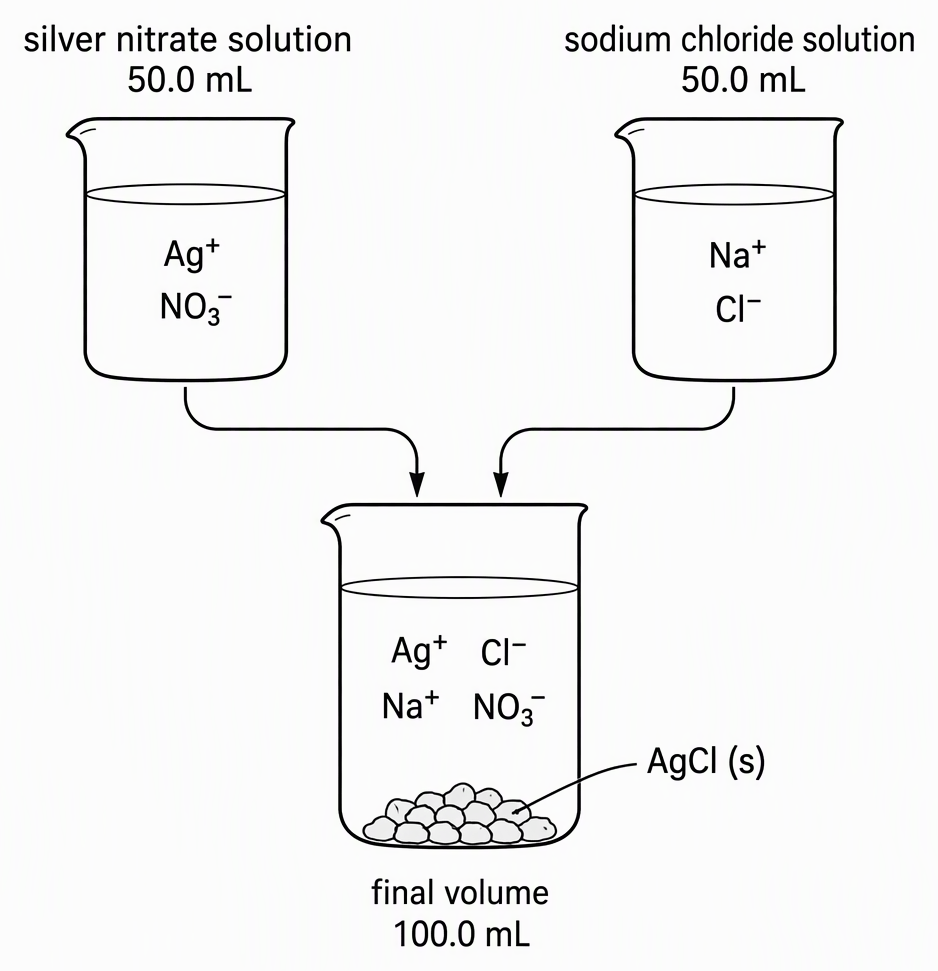
Each relevant ion supplies:
Before precipitation, the final volume gives:
Silver chloride precipitates under the stated model. Using unmixed concentrations would give the wrong ionic product.
Equal initial ion amounts and equal removal leave equal final concentrations. With solid present:
The precipitated amount and final-product check are:
With unequal starting amounts, an excess ion remains. The final concentrations are then unequal, so the square-root shortcut does not automatically apply.
What should I practise when equilibrium solutions keep going wrong?
Choose the next problem from your setup error, not an arbitrary question quota. Write the species, governing equation and assumption before looking at a solution. Recognising a worked solution is not the same as setting it up independently.
First practise isolated setups:
- Equilibrium expressions and reaction manipulation.
- Conversion between concentration-based and pressure-based equilibrium constants.
- Reaction-quotient comparisons.
- Initial–change–equilibrium entries.
Then tackle weak acids and bases, neutralisation followed by equilibrium, buffers, hydrolysis, and solubility products. For each family, follow a direct problem with a contrast problem:
- Valid versus invalid approximation.
- Before versus after mixing.
- Equal ion amounts versus an excess common ion.
Keep an error log whose labels determine the next task:
- Species error: rebuild the species list after reaction.
- Stoichiometry error: redo the mole calculation before using concentrations.
- Wrong equilibrium expression: check coefficients, powers and omitted phases.
- Invalid approximation: solve exactly and compare.
- Algebra/logarithm error: practise that calculation separately.
Use JEE Main previous-year questions for direct setup and answer-entry accuracy, then JEE Advanced questions with coupled constraints. Do not assume a fixed Advanced pattern; practise choosing equations rather than predicting question formats.
JEEnius practice mode offers topic sets that skip questions already seen, with free sets included. Use unseen questions to test transfer, but keep deliberate reattempts separate: close your notes and solve each logged error again from the species list onward.
Next step: daily practice problems on JEEnius and get a fresh ten-question set on a topic every day (free sets daily).
If that step was the hard part, work through Haloalkanes Practice Questions JEE: 5 Solved Drills.
Frequently asked questions
In what order should I study equilibrium for JEE?
Start with reversible reactions, equilibrium constants, reaction quotient and equilibrium shifts. Then study acid–base equilibria and the ionic product of water, followed by neutralisation, buffers, salt hydrolysis, solubility product and common-ion problems. Before attempting coupled ionic problems, check that you can calculate concentrations after mixing, evaluate logarithms and solve quadratics.
When does the weak-acid pH shortcut fail?
For a monoprotic acid initially without its conjugate base, calculate the dissociation using x ≈ √(KaC), then check x/C. If it exceeds 0.05, retain the full denominator in Ka = x²/(C − x) and solve the quadratic. The 5% rule is only a screening convention; water autoionisation also needs checking in very dilute solutions.
How do I check whether a precipitate forms after mixing solutions?
Calculate the ion concentrations using their moles and the final solution volume, then compare the ionic product with Ksp. An ionic product greater than Ksp indicates precipitation under the stated equilibrium model. This comparison tests precipitation onset, not the final dissolved concentrations, which require a separate equilibrium calculation.
What should I practise if I keep getting equilibrium questions wrong?
Choose practice problems from your setup errors: species identification, stoichiometry, equilibrium expressions, approximations or algebra and logarithms. Practise isolated setups first, then contrast cases such as valid versus invalid approximations and equal ion amounts versus an excess common ion. Use JEE Main previous-year questions for direct setup and answer-entry accuracy, then JEE Advanced questions for coupled constraints, and reattempt logged errors with your notes closed.