
How should I study Electromagnetic Waves for JEE in the right order?
- Check only the prerequisites you need. Electromagnetic Waves for JEE does not require finishing all of electromagnetism first. Revise electric flux, capacitance, magnetic field around a current, cross products and the travelling-wave form:
Recognise amplitude and phase, and know how a cross product fixes direction. Patch these gaps before proceeding.
- Start with the charging capacitor. Conduction current flows in the wires, but charges do not conduct across the vacuum gap. Between the plates, changing electric flux supplies the displacement-current term needed for a consistent magnetic-field description.
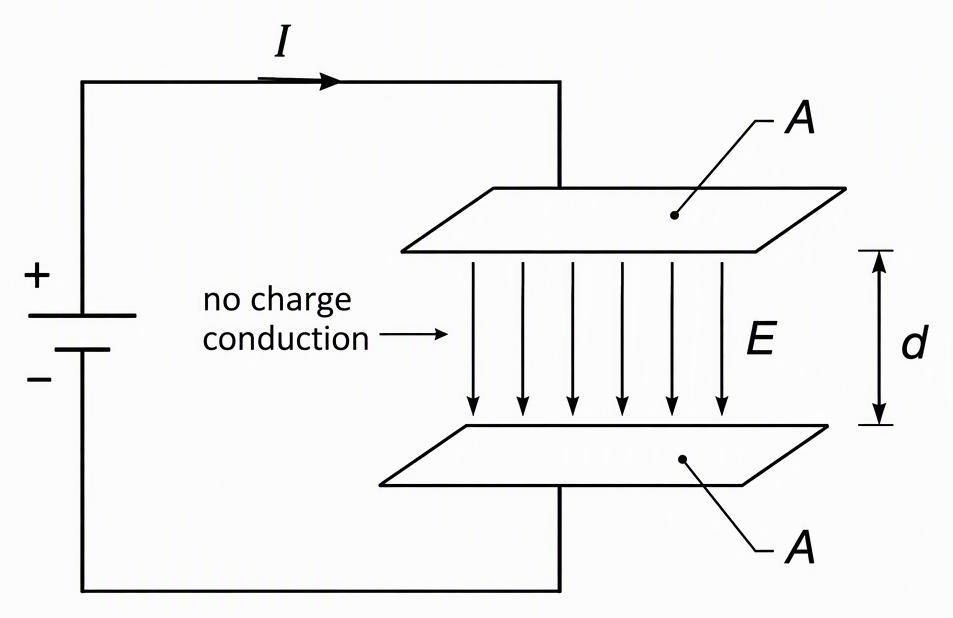
For vacuum, displacement current is:
- Study wave properties, then the spectrum. Electric and magnetic fields are mutually perpendicular and perpendicular to propagation: electromagnetic waves are transverse. They need no material medium, and accelerated charges can generate radiation.
Maxwell’s equations explain how changing electric and magnetic fields support wave propagation. Understand that conceptual role; a full differential-equation derivation is not needed for the problems below.
If changing magnetic flux and induced electric fields are unclear, use the Electromagnetic Induction study order. Induction concerns fields and emf produced by changing magnetic flux; electromagnetic waves concern propagating fields carrying energy.
What should my Electromagnetic Waves JEE revision sheet contain?
- Divide one sheet into formulas, physical statements and spectrum facts. Derive the capacitor-current relation once, understand travelling-wave relations, and recall spectrum associations. Do not copy the chapter: these are different revision tasks.
Formula block: keep the vacuum relations together.
For travelling-wave phase data, use:
The field-amplitude ratio equals the speed of light for a plane travelling electromagnetic wave in vacuum. Do not apply that vacuum result to an arbitrary medium.
For a sinusoidal plane wave in vacuum, average intensity is:
The half applies when using peak electric-field amplitude, not RMS amplitude. With RMS amplitude:
Physical-statements block: record transverse fields, propagation without a material medium, radiation from accelerated charges, and in-phase electric and magnetic fields for a plane travelling wave in vacuum.
Spectrum block: memorise this order:
- Radio → microwave → infrared → visible → ultraviolet → X-ray → gamma.
- Frequency increases along this order; vacuum wavelength decreases.
- Within visible light, the same direction runs from red to violet.
Use these NCERT-based source or use associations:
- Radio: radio communication.
- Microwaves: radar.
- Infrared: radiation from hot bodies.
- Visible: human vision.
- Ultraviolet: germicidal lamps.
- X-rays: medical radiography.
- Gamma rays: nuclear transitions.
Adjacent bands do not have universally sharp boundaries. X-rays and gamma rays can overlap in wavelength; their production mechanisms matter too.
- Classify before calculating. Label the question as changing flux/current, travelling-wave data or spectrum recall. Then identify the medium, convert units and check propagation using:
For classification practice, JEEnius practice mode offers topic sets that skip questions already seen, with free sets included.
How do I find displacement current without calculating the electric field?
Use capacitance and the rate of voltage change, not voltage alone. Illustrative problem, not a previous-year question: find the displacement current between the plates of an ideal vacuum parallel-plate capacitor with:
Start with the defining relation. Neglect edge effects, so the field between the plates is uniform:
For fixed plate area and separation:
Recognise the capacitance:
Substitute in SI units:
Check: this equals the conduction current charging the capacitor:
The traps are inserting voltage instead of its rate of change, and claiming electrons cross the vacuum gap. Displacement current here comes from changing electric flux, not charge conduction between the plates.
How do I read frequency, wavelength and magnetic field from a wave equation?
Read the amplitude and phase coefficients first, then determine propagation from constant phase. Constructed example: the electric field below describes a vacuum wave, with position in metres and time in seconds. Find its frequency, wavelength and magnetic field.
Before calculating, identify:
Convert angular quantities to frequency and wavelength:
Check consistency with vacuum propagation:
For direction, follow a point of constant phase rather than guessing from the minus sign:
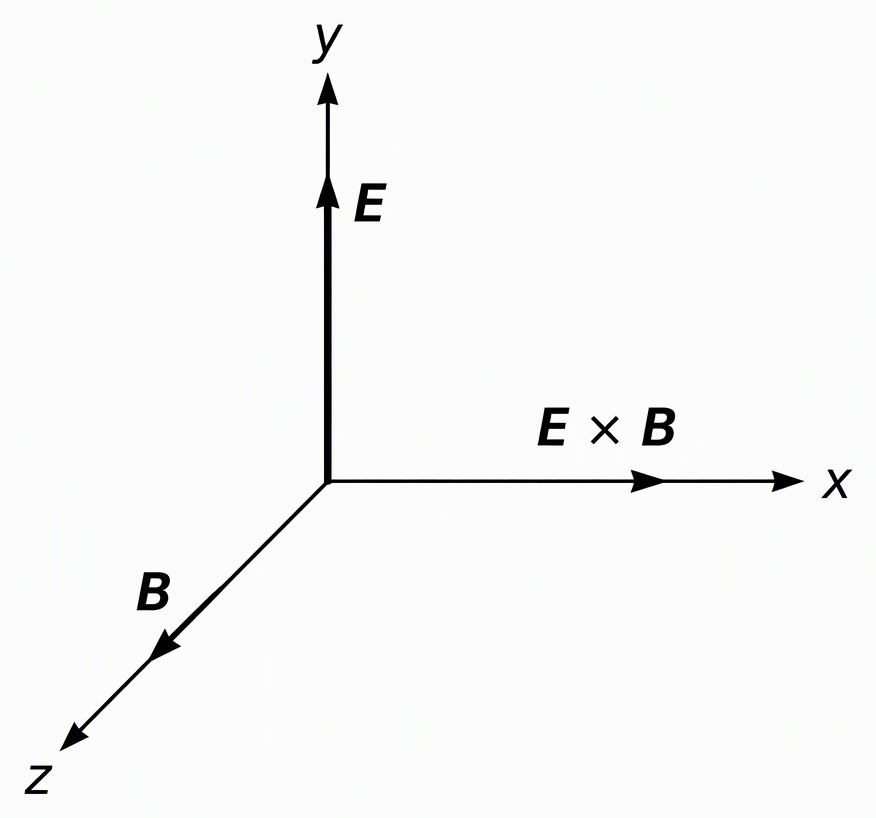
Propagation is along the positive x-axis. The electric field lies along the y-axis, so the magnetic field must have the orientation that gives positive x-directed energy flow.
The magnetic-field amplitude is:
Therefore:
The direction check is:
The fields are in phase: their maxima and zero crossings occur together. Do not mistake angular frequency for frequency, treat wave number as inverse wavelength without the full-cycle factor, or choose magnetic-field direction independently of propagation.
How do I classify radiation when its wavelength changes in a medium?
Use the vacuum wavelength or frequency to identify the spectrum band, not the wavelength inside a medium. Constructed question: radiation has a vacuum wavelength of 600 nanometres. Identify its band, calculate its frequency and find its wavelength in a transparent medium whose refractive index at that frequency is 1.5.
Convert the given wavelength:
The incident radiation is visible. Its frequency is:
Inside the medium, the speed becomes:
Frequency remains unchanged at a stationary interface. The transmitted oscillation must match the incident oscillation’s time dependence at the boundary, so wavelength adjusts instead:
The reduced wavelength does not put the radiation into a different vacuum-spectrum category. The trap is classifying it from the in-medium wavelength using a vacuum-wavelength spectrum chart.
Recall check: infrared has lower frequency than this visible radiation, while ultraviolet has higher frequency.
What should I practise next for Electromagnetic Waves JEE questions?
Start with NCERT statements and spectrum recall, then practise displacement current, wave equations and mixed questions. I would use this order rather than random difficulty because each stage adds a specific demand: recall, calculation, interpretation, then formula conditions.
- NCERT statements and spectrum recall: explain each statement and recall one source or use per band.
- Direct displacement current: calculate from changing flux or a capacitor’s voltage-change rate.
- Wave-equation extraction: identify amplitude, angular frequency, wave number and propagation.
- Mixed questions: combine directions, media or intensity, including peak versus RMS amplitude.
Before mixed practice, explain three checks without notes:
- Why does capacitor-gap displacement current match charging current?
- Why does the electric-field cross magnetic-field direction fix propagation?
- Why does frequency remain unchanged at a stationary interface?
Keep an error log with four labels: recall, units, direction and formula conditions. Reread only the concept responsible for the error, then solve another question testing it.
Use topic-wise previous-year questions for the exam you are targeting. For Advanced preparation, add multi-step combinations with fields, energy flow or wave ideas where relevant to the current syllabus.
Finishing a set is not the endpoint. Explain the governing relation and its conditions before moving to mixed practice. For the next topic set, JEEnius daily practice problems provide a fresh ten-question set every day, with free sets daily; classify each question before writing its first equation.
Next step: daily practice problems on JEEnius and get a fresh ten-question set on a topic every day (free sets daily).
Frequently asked questions
What should I study before Electromagnetic Waves for JEE?
Revise electric flux, capacitance, the magnetic field around a current, cross products and the travelling-wave form. You do not need to finish all of electromagnetism first. Then study the charging capacitor and displacement current, followed by wave properties and the electromagnetic spectrum.
How do I calculate displacement current in a capacitor?
For an ideal vacuum parallel-plate capacitor with fixed geometry, use Id = C(dV/dt). This follows from Id = ε₀(dΦE/dt) and equals the conduction current charging the capacitor. Use the rate of voltage change, not voltage alone; charges do not conduct across the vacuum gap.
How do I find frequency and magnetic field from an EM wave equation?
Read the electric-field amplitude E₀, angular frequency ω and wave number k from the equation, then use f = ω/(2π) and λ = 2π/k. For a plane travelling wave in vacuum, B₀ = E₀/c and the fields are in phase. Determine propagation from constant phase, then choose the magnetic-field direction so that E × B points along propagation.
Does an electromagnetic wave change its spectrum band in a medium?
Classify radiation using its frequency or vacuum wavelength, not its wavelength inside a medium. Frequency remains unchanged at a stationary interface, while speed and wavelength change. A shorter wavelength inside the medium does not place the radiation in a different vacuum-spectrum category.