
What order should I follow to study Electrochemistry for JEE?
- Check prerequisites before mixing formulas. To study Electrochemistry for JEE, first test four skills: balancing redox reactions, counting transferred electrons, calculating molarity and handling base-10 logarithms. Repair the specific missing skill before attempting mixed problems. A logarithm mistake does not require rereading the whole chapter.
- Build the chapter in dependency order. Study galvanic cells and electrode potentials first, followed by Nernst and thermodynamic links. Then study conductance and Kohlrausch’s law, followed by electrolysis and Faraday’s laws. This connects reactions to potential before introducing charge transport and externally driven reactions.
- Make a decision sheet organised by the quantity asked. Use three branches:
- Potential or equilibrium: electrode potentials, Nernst, Gibbs energy and equilibrium constants.
- Resistance or conductivity: conductance, cell constant, molar conductivity and limiting ionic contributions.
- Deposited mass or charge: current, time, electron moles and current efficiency.
Use NCERT for definitions, cell conventions, batteries, fuel cells and corrosion. Numerical practice cannot replace that reading. Keep descriptive recall separate from your calculation checklist.
Fix electrode names before memorising signs: oxidation always occurs at the anode; reduction always occurs at the cathode. In a galvanic cell, the anode is negative and the cathode positive. In an electrolytic cell, those polarities reverse, but the reaction definitions do not.
How do I choose the right Electrochemistry equation?
- Identify the physical process before substituting numbers. For reaction-based questions, balance the reaction first. For conductance, write the quantity-and-unit chain.
For cell potential, use tabulated reduction potentials in this order. Never multiply an electrode potential by a stoichiometric coefficient.
For non-standard composition, start with the general Nernst equation. The electron count must come from the balanced reaction.
Use the base-10 form below only at approximately 298 K, with potential in volts. At other temperatures, use the general equation.
For standard Gibbs energy or an equilibrium constant, use these thermodynamic links. The reaction quotient describes the current composition; the equilibrium constant describes equilibrium.
For conductance questions, convert resistance to conductance before applying the cell constant. Use the molar-conductivity formula below only with the stated units.
For electrolysis, distinguish lowercase electrical charge from uppercase reaction quotient. The efficiency fraction accounts for current producing the specified deposit.
- Check sign, dimensions and trend. Check the answer against the reaction direction, stated units and expected physical change.
- Revise the mistake, not the entire chapter. Label it concept, equation choice, electron count, unit conversion or arithmetic. Re-solve without notes before attempting a fresh variant.
For fresh variants, JEEnius daily practice problems provide a ten-question topic set every day, with free sets daily. Use them after correcting the original error.
How do I solve a Nernst problem without reversing the reaction quotient?
Balance the cell reaction before building the quotient. This fixes the electron count and which species belong in the numerator. This and the next two examples are author-created practice problems, not previous-year questions or reported exam data.
The constructed cell is at 298 K. Assume ideal dilute-solution behaviour:
Zinc undergoes oxidation and copper ions undergo reduction. Electrons move through the external connection from zinc to copper.
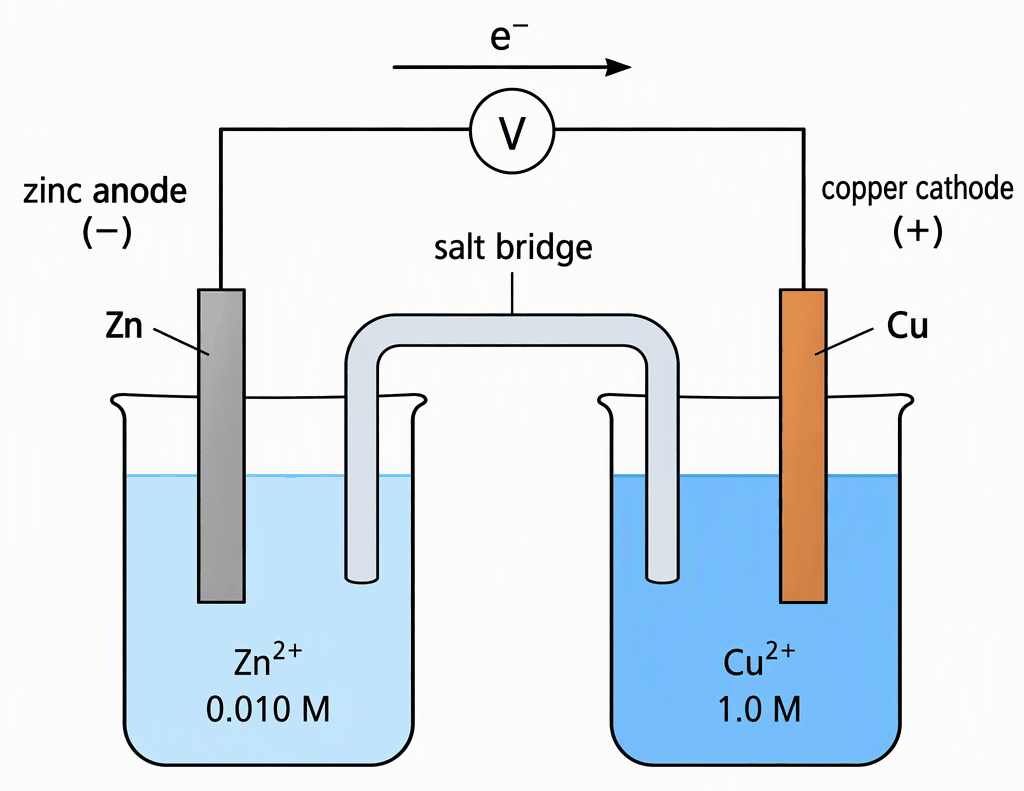
Each zinc atom loses two electrons, and each copper ion gains two. The balanced reaction therefore gives:
The quotient is dimensionless because it uses activities. Pure solids have unit activity and are omitted; the concentration ratio approximates the ionic activity ratio here.
The quotient is below one, so its logarithm is negative. Subtracting that negative correction makes the potential greater than the standard value.
Wrong turn: reversing only the quotient gives 100 and produces approximately 1.041 V. The concentration correction is wrong because the reaction was not reversed.
Transfer prompt: predict the direction of the potential change if zinc-ion concentration increases while copper-ion concentration stays fixed. Use the change in the quotient to justify your answer.
How do I keep conductivity and molar conductivity separate?
Convert resistance to conductance, apply the cell constant, then account for concentration. Keep the unit at every step: these quantities are not interchangeable. In this author-created problem, the givens are:
The factor 1000 belongs to this combination of centimetre-based conductivity and concentration per litre. It is not a universal multiplier. With conductivity in siemens per metre and concentration in moles per cubic metre, divide directly.
Now compare an illustrative diluted solution at the same temperature. Apply the same unit convention:
Conductivity fell while molar conductivity rose. These observations are compatible: dilution reduces ions per unit volume, while conduction per mole can improve.
For strong electrolytes, reduced interionic interactions explain the usual rise in molar conductivity. Weak electrolytes also show increased ionisation. Move to Kohlrausch’s law when the question supplies limiting ionic contributions or asks for a weak electrolyte’s limiting molar conductivity.
How do I calculate deposited mass through electron moles?
Convert charge to electron moles before calculating product moles. This is safer than blindly substituting into a mass formula because the half-reaction shows the required electron count. For this author-created problem, sufficient copper ions are present and current efficiency is 100%.
The governing process is cathodic deposition. Write the half-reaction before calculating charge, electron amount, copper amount and mass.
Cross-check with the direct formula. Use the electron count from the copper deposition half-reaction, not the charge of an unrelated ion.
Below 100% efficiency, multiply this theoretical mass by the corresponding efficiency fraction. Cells in series receive the same charge, but need not deposit the same mass: molar masses and electron requirements can differ.
Separate calculating a specified product’s amount from predicting which product forms when electrode reactions compete. The mass formula answers only the first task.
What should I practise next, and how do I know I am ready?
Move to mixed questions when you can choose the relation and explain your setup without answer options. Use this practice ladder rather than a fixed chapter-completion deadline.
- Practise setup without lengthy arithmetic. Identify electrodes, interpret cell notation, balance electron transfer and construct reaction quotients. State the reaction direction each time.
- Separate the three numerical families. Practise Nernst calculations, resistance-to-molar-conductivity conversions and charge-to-mass calculations in separate sets. Write the governing relation before inserting values.
- Add connected applications. Include standard-potential, Gibbs-energy and equilibrium-constant conversions; concentration cells; Kohlrausch’s law; weak-electrolyte applications; and electrolysis with efficiency or shared charge.
- Run a separate NCERT recall check. Explain the working principles and relevant reactions of batteries and fuel cells, then the electrochemical basis of corrosion. Numerical fluency does not complete descriptive preparation.
- Use actual previous-year questions. Start with chapter-wise JEE Main questions to test coverage. Follow with JEE Advanced questions that combine concepts.
Before moving ahead, check that you can explain the electron count, retain units throughout and reproduce a corrected solution without looking. Use errors to choose the next drill:
- Sign errors: reaction-direction and electrode-convention drills.
- Conductivity errors: quantity-and-unit chains.
- Electrolysis errors: charge-to-electron-to-product accounting.
JEEnius practice mode offers topic sets that skip questions already seen, with free sets included. Use unseen questions to test transfer, but deliberately re-solve previously missed questions without notes before moving on.
Next step: daily practice problems on JEEnius and get a fresh ten-question set on a topic every day (free sets daily).
If that step was the hard part, work through Electrostatics Practice Questions JEE: 5 Solved Drills.
Frequently asked questions
What order should I study Electrochemistry in for JEE?
First check redox balancing, electron counting, molarity and base-10 logarithms. Study galvanic cells and electrode potentials, then Nernst and thermodynamic links. Follow with conductance and Kohlrausch’s law, then electrolysis and Faraday’s laws.
Is NCERT enough for Electrochemistry in JEE?
Use NCERT for definitions, cell conventions, batteries, fuel cells and corrosion, but do not treat that reading as complete preparation. Add numerical practice in potential, conductivity and electrolysis, followed by chapter-wise JEE Main questions and JEE Advanced questions that combine concepts.
How do I write the reaction quotient in a Nernst equation problem?
Balance the cell reaction first, then place product activities in the numerator and reactant activities in the denominator, raised to their stoichiometric powers. Omit pure solids because their activities are one. For ideal dilute solutions, concentration ratios can approximate ionic activity ratios; take the electron count from the same balanced reaction.
Why does conductivity decrease but molar conductivity increase on dilution?
Dilution reduces the number of ions per unit volume, so conductivity usually falls. Molar conductivity can rise because reduced interionic interactions improve conduction per mole. Weak electrolytes also show increased ionisation on dilution.
How do I calculate deposited mass in electrolysis questions?
Calculate charge as current multiplied by time, then divide by the Faraday constant to obtain electron moles. Use the deposition half-reaction to convert electron moles into product moles, then multiply by the molar mass. If current efficiency is below 100%, multiply the theoretical mass by the efficiency fraction.