
How should I study d-block for JEE through questions?
Study d-block for JEE by separating calculation from recall: derive configurations and electron transfers, but retrieve colours, exceptions and reaction products from memory. Do not use one stability rule to explain every fact.
- Set the scope before opening your notes. Check the current official syllabus for the exam you are attempting, then select the relevant NCERT material. Use jeemain.nta.nic.in for JEE Main and the official JEE Advanced website for Advanced. Keep this exercise centred on d-block chemistry, using scandium through zinc as the working series. Do not add f-block or the whole coordination-compounds chapter.
- Repair electronic configuration first. Write neutral-atom configurations from memory, including the two familiar exceptions:
When forming cations, remove electrons from the 4s subshell before the 3d subshell. Practise this removal explicitly rather than jumping straight to an answer. One wrong removal changes the d-electron count and can spoil the classification and magnetic-moment answers that follow.
- Build a two-column revision sheet labelled “derive” and “recall”. Keep entries short enough to reconstruct without the textbook. Use these contents:
- Derive: ionic configurations, d-electron counts, simple unpaired-electron counts when occupancy is known, and redox coefficients.
- Recall: characteristic colours, common oxidation states, NCERT-stated exceptions and medium-dependent reaction products.
Attach each exception to its property. Put chromium’s configuration beside configurations, not in a disconnected “exceptions” list. For a colour, record the exact species and conditions where relevant. For an oxidation state, distinguish “commonly observed” from “most stable in this particular environment”.
- Classify the question before solving. Choose configuration/transition-element definition, property statement, or reaction. For a property, identify the exact atom, ion or compound. For a reaction, identify the medium before balancing anything.
A d-electron count alone does not determine every complex’s spin state. Empty or filled d subshells rule out d–d transitions, not every source of colour. Half-filled-shell arguments alone do not explain oxidation-state stability, which also depends on the energy changes involved in forming the species in its environment.
- Close the book and test the sheet. Reconstruct it, answer questions, then tag each error as configuration, missed condition, recall or balancing. Repair that specific gap instead of rereading the entire chapter. Keep definition errors explicitly marked beside classification questions.
NCERT reading supplies facts; closed-book recall and question solving test whether those facts are usable. For fresh questions after correction, JEEnius practice mode offers topic sets that skip questions already seen, with free sets included.
Why is chromium a transition element but zinc is not?
Chromium meets the incomplete-d-subshell definition; zinc does not, although both belong to the d-block. First write the configuration, then apply the definition. Neither the element’s position alone nor the presence of any d electrons settles its classification.
Original practice question: Write the configurations of chromium(III) and zinc(II) ions, and explain why chromium is a transition element but zinc is not.
A transition element has an incompletely filled d subshell in its atom or can form cations with an incompletely filled d subshell. Chromium satisfies this definition in both the neutral atom and the ion shown.
Zinc’s atom and characteristic divalent ion both have filled d subshells. Zinc therefore belongs to the d-block but is not classed as a transition element.
Error diagnosis: Removing 3d electrons before 4s is a configuration error; calling every d-block element a transition element is a definition error.
How do I calculate the magnetic moments of manganese(II) and iron(III)?
Both ions have the same spin-only magnetic moment when each has five singly occupied d orbitals. Use this order: configuration, orbital occupancy, unpaired-electron count, then formula. Do not insert the total number of d electrons into the magnetic formula unless you have established that each is unpaired.
Original practice question: Calculate the spin-only magnetic moments of the following ions, assuming five singly occupied d orbitals in each case.
Remove the 4s electrons first. For iron, then remove one 3d electron:
Under the stated assumption, each ion has one electron in each of its five d orbitals. There are no paired electrons in those orbitals.
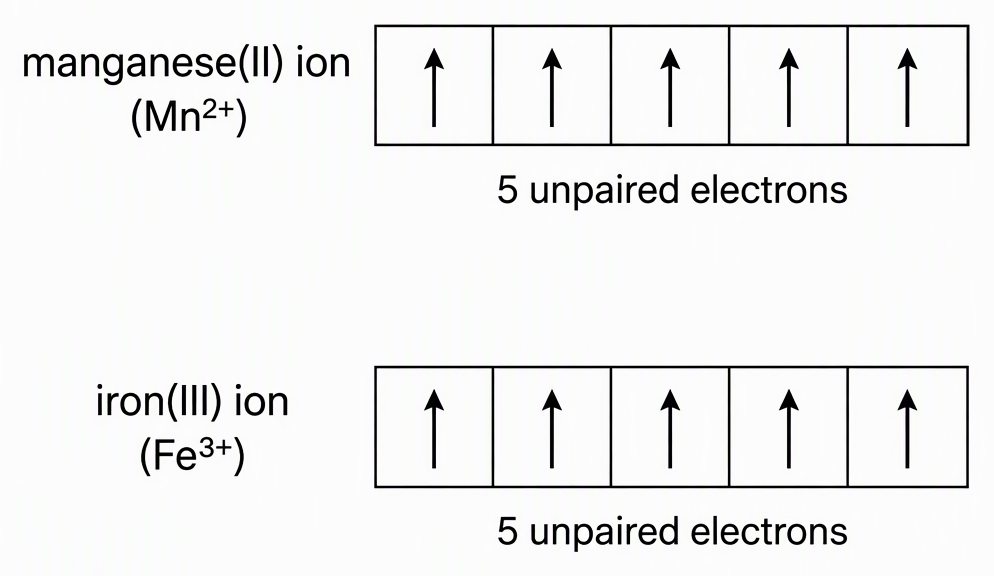
This is the spin-only prediction for each ion, not a universal exact measured value. Different starting atoms and different charges can leave the same d-electron count and occupancy.
A specified coordination complex requires attention to ligand field and spin state. Do not transfer this answer to every iron(III) complex. Identical d counts do not imply identical colours, and five d electrons do not mean colourless.
How do I balance acidic permanganate oxidation of iron(II)?
One mole of permanganate oxidises five moles of iron(II) ions in acidic medium. Recall the manganese product first, then derive the electron transfer and coefficients. Do not start with a memorised ratio: changing the medium can change the product and the number of electrons accepted.
Original practice question: In acidic medium, how many moles of iron(II) ions are oxidised by one mole of permanganate, and what is the balanced ionic equation?
The recalled acidic reduction product is manganese(II). Manganese therefore gains five electrons:
Balance oxygen with water, hydrogen with hydrogen ions, and charge with electrons:
Each iron(II) ion loses one electron:
Multiply this oxidation half-equation by five, add the equations and cancel electrons:
The coefficients give five moles of iron(II) ions per mole of permanganate. Check four oxygen atoms and eight hydrogen atoms on each side, then check charge:
Compare the common reductions by medium:
- Acidic: manganese(II), a five-electron reduction.
- Neutral or weakly alkaline: manganese dioxide, a three-electron reduction.
- Strongly alkaline: manganate, a one-electron reduction.
The acidic ratio is not universal. The medium-dependent product was recalled; the electron transfer, coefficients and mole ratio were derived. A wrong product is a recall error, not a balancing error.
What should I practise after the first d-block revision?
Use three practice passes: configurations and classification, properties and trends, then reactions with their conditions stated. Keep errors separated by pass so you can repair the failed step instead of rereading the whole chapter.
- Configurations and classification: Write neutral and ionic configurations, then decide whether the element meets the transition-element definition. Explain the decision in one sentence. Include chromium, copper and zinc so that exceptions and definitions are tested together.
- Properties and trends: Practise oxidation states, magnetism, colours, atomic size, ionisation enthalpy and oxidation-state stability. Separate broad trends from NCERT-stated exceptions; do not impose a smooth trend across the entire series. For every wrong statement, rewrite it correctly and label the error as species, condition or recalled fact.
- Reactions: Practise permanganate and dichromate with the medium stated. Include acidic dichromate reduction to chromium(III). Contrast it with chromate–dichromate interconversion: identify the reduction as redox and the interconversion as a change in speciation while chromium remains in oxidation state six.
After the first closed-book recall pass, use relevant, syllabus-matched JEE Main and JEE Advanced previous-year questions. Identify direct recall demands separately from multi-concept reasoning; do not assume that the exam label alone tells you the method.
Cross-topic application: Use Qualitative Analysis JEE 2019: Zinc Reactions Solved to apply zinc chemistry, not as a substitute for d-block practice.
Readiness means reconstructing the sheet unaided, explaining each worked example and solving an unfamiliar variant without repeating the same conceptual mistake. For the next recall check, daily practice problems provide a fresh ten-question set on a topic every day, with free sets daily.
Frequently asked questions
How should I revise d-block for JEE?
Make a two-column sheet labelled “derive” and “recall”, using syllabus-relevant NCERT material. Derive ionic configurations, d-electron counts and redox coefficients; recall characteristic colours, common oxidation states, exceptions and medium-dependent products. Reconstruct the sheet closed-book, solve questions and repair each error rather than rereading the entire chapter.
Why is zinc not a transition element?
A transition element has an incompletely filled d subshell in its atom or can form cations with an incompletely filled d subshell. Zinc's atom and characteristic Zn²⁺ ion both have filled 3d subshells. Zinc therefore belongs to the d-block but is not classed as a transition element.
Do Mn²⁺ and Fe³⁺ have the same magnetic moment?
Both ions have a 3d⁵ configuration after removing 4s electrons first. Assuming five singly occupied d orbitals, each has five unpaired electrons and a spin-only magnetic moment of √35 μB, approximately 5.92 μB. This result must not be applied to every coordination complex without checking its ligand field and spin state.
How many moles of Fe²⁺ does one mole of permanganate oxidise?
In acidic medium, one mole of permanganate oxidises five moles of Fe²⁺ to Fe³⁺. Manganese is reduced from oxidation state +7 to +2, accepting five electrons, while each Fe²⁺ loses one electron. The ratio is not universal because the permanganate reduction product depends on the medium.