
What five steps should I follow to study Complex Numbers for JEE?
- Choose the representation before calculating when studying Complex Numbers for JEE. Start with a prerequisite checklist: solve a quadratic, recall basic trigonometric values, identify quadrants and calculate Cartesian distance. Repair only the skill that fails, rather than revising three entire chapters.
- Study in this order: arithmetic and conjugates, then modulus and argument, then polar form and powers/roots, and finally geometric interpretation and loci. Revisit complex quadratic roots after polar form to connect their algebraic values with their angles and symmetry.
Build a compact working sheet around these representations and identities:
Multiply out the conjugate product yourself. The cancellation explains why it produces a real, nonnegative number and why conjugates help with division.
- Match the trigger to the first move. Use this lookup list before doing algebra:
- Real/imaginary-part conditions: choose Cartesian form and compare parts.
- Reciprocals or conjugates: try identities or clear denominators first.
- High powers and roots: use polar form.
- Distances or equal moduli: interpret the condition on an Argand plane, then introduce coordinates if needed.
- Write restrictions and the chosen representation first. After calculating, substitute into the original condition and check that every solution has been found. A transformed equation is not enough if you divided by zero or lost an angle branch.
The reciprocal shortcut has a condition:
The argument of zero is undefined. Use the principal-argument convention stated in the problem and check the quadrant; do not blindly apply:
That expression also needs special handling when the real part is zero.
- Practise one family, then mix families. Family-wise work tests the technique; mixed work also tests whether you can select it. Label every error as concept, representation choice, algebra, or restriction/branch handling.
The three examples below are illustrative, not authenticated previous-year questions. Each uses the same sequence: trigger → first move → calculation → check. Keep that sequence visible in your notebook.
How do I solve an equation containing a complex number and its reciprocal?
Clear the denominator before splitting into real and imaginary parts. Here the reciprocal turns the problem into a quadratic. Do not assume unit modulus: the question has not given it.
Find all complex solutions of:
Trigger: a reciprocal appears.
First move: record the restriction, then multiply the original equation by the unknown:
Calculation:
Check: both roots are nonzero, and their moduli satisfy:
Only now may we replace the reciprocal by the conjugate:
Both roots satisfy the original equation. Clearing the denominator was reversible on the stated domain, and the quadratic has exactly these two roots, so the solution set is complete.
Unit modulus follows from the roots; assuming it at the start would make the reasoning circular. The longer Cartesian route creates two real equations and a denominator involving the sum of two squares, without adding insight.
Transfer cue: for this form, check the denominator restriction and look for a quadratic first:
How do I turn a modulus ratio into a circle?
Read the moduli as distances, then use coordinates to find the circle. The multiplier makes this a fixed distance-ratio condition, not an equal-distance condition. Do not answer “perpendicular bisector” without checking that multiplier.
Identify the locus:
Trigger: the numerator and denominator measure distances from the fixed points one and minus one on the real axis.
First move: preserve the domain restriction and rewrite:
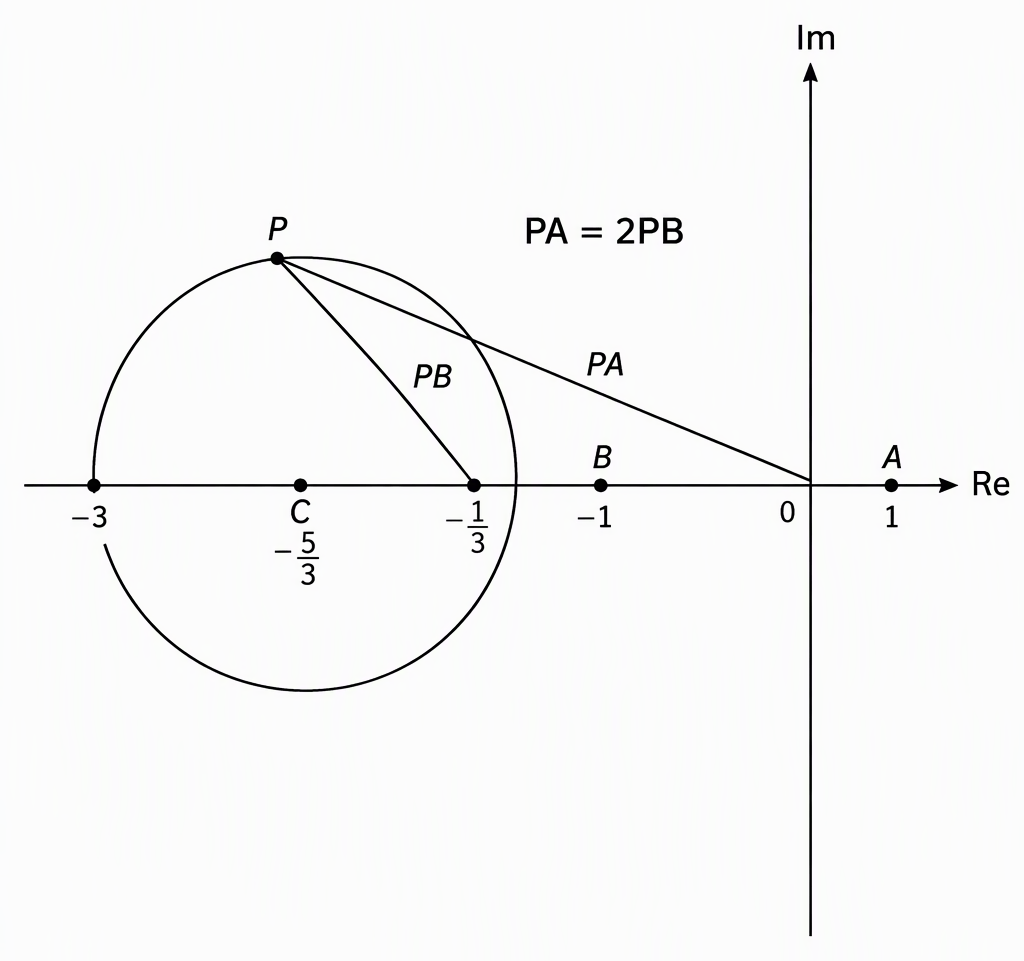
Calculation: choose Cartesian form and square the nonnegative sides:
Thus the centre and radius are:
Check: the excluded point is not on this circle:
No point needs removal. Squaring introduced no extra solutions because both sides were nonnegative.
Contrast this with equal distances:
That locus is the perpendicular bisector: the multiplier changes the geometry. For more coordinate practice, use How to Study Circles JEE: A Six-Step Plan.
For family-wise repetition, JEEnius daily practice problems provide a fresh ten-question set on a topic every day, with free sets daily.
How do I find every cube root of a negative real number?
Use polar form to separate modulus from angle, retaining full rotations before dividing the angle. Expanding a Cartesian cube creates coupled equations. Polar form gives the root size and positions directly, but you must enumerate every distinct angle.
Find all roots and locate them on the Argand plane:
Trigger: a power equation.
First move: write the right-hand side with all possible arguments:
Calculation: each root has modulus two:
The angular separation is:
They form an equilateral triangle centred at the origin on:
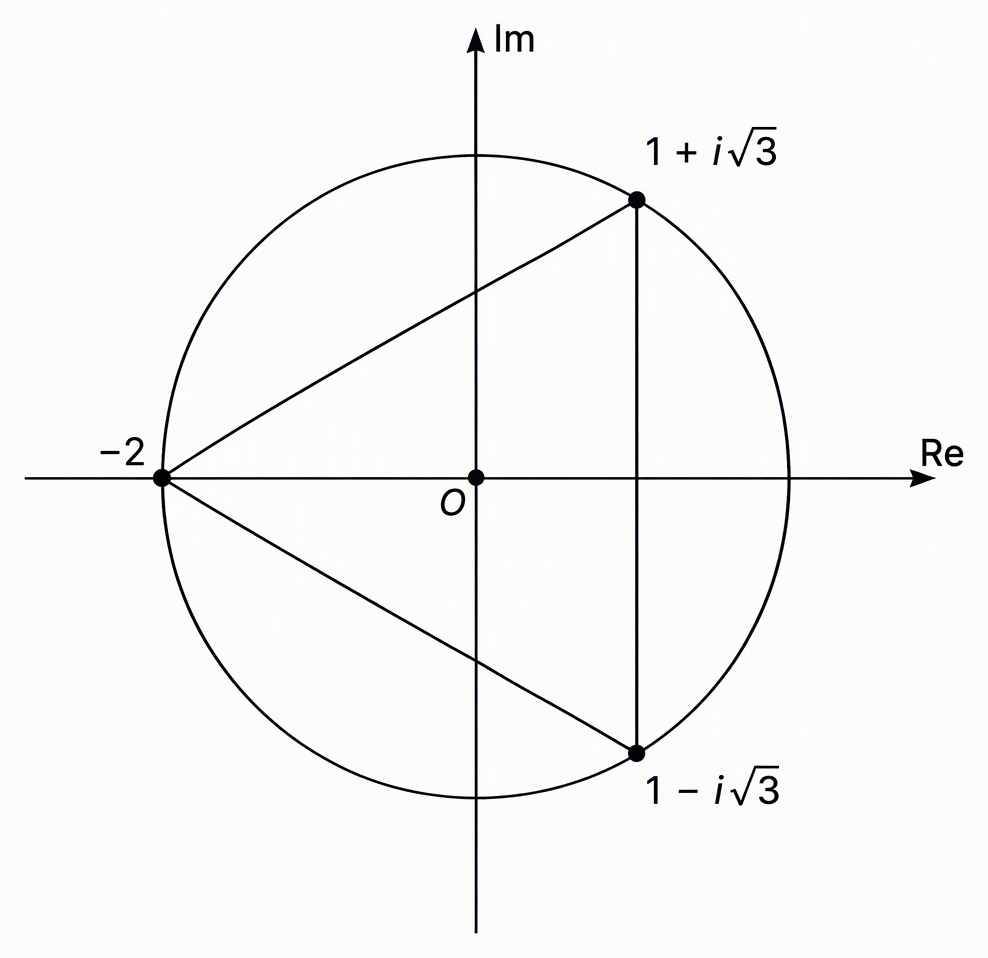
Check: cubing any listed root cubes its modulus and triples its angle, giving the original value. The next index repeats the first root, and further integer values give no new roots:
A principal argument selects one angle for a number; solving a power equation requires all distinct roots. Keeping only the first angle misses two answers.
For a positive integer power, the general rule is:
What should I practise next before attempting mixed Complex Numbers questions?
Move on when you can explain the first move, finish without a hint and verify the answer in the original condition. Use these checks, not days spent on the chapter, to decide whether to progress.
Practise in this order:
- Operations, conjugates, reciprocals and modulus identities.
- Quadratics and real/imaginary-part conditions.
- Arguments, powers and roots.
- Distance loci and mixed algebra–geometry questions.
For JEE Main, consolidate standard forms with relevant previous-year questions. For JEE Advanced, extend to combinations of constraints, loci, roots and parameter cases. A standard question solved with an unjustified assumption still needs repair.
Keep an error log with four fields:
- Trigger missed: what should have suggested the method?
- Incorrect step: where did the reasoning first fail?
- Corrected rule: what condition or identity fixes it?
- Later unaided retry: did you solve it correctly without the solution?
Re-solving matters more than rereading. After family-wise practice, attempt a mixed unseen set and write the intended representation before each solution. This separates recognition failures from calculation errors.
After the fundamentals, use Complex Numbers JEE 2025: Determinant and Modulus Solution as an optional mixed-topic follow-up.
JEEnius practice mode offers topic sets that skip questions already seen, with free sets included. Use unseen practice to test recognition; keep incorrect questions separately for retries, which test whether the repair has held.
Start now: attempt the three examples without looking, identify which first move was unclear, and practise that family next.
Next step: practice mode on JEEnius and practise a topic in sets that skip questions you have already seen (free sets included).
Frequently asked questions
In what order should I study Complex Numbers for JEE?
Start with arithmetic and conjugates, then study modulus and argument, polar form and powers or roots, and finally geometric interpretation and loci. Revisit complex quadratic roots after polar form to connect their algebraic values with angles and symmetry.
When should I use Cartesian or polar form in complex numbers?
Use Cartesian form for conditions involving real and imaginary parts, and polar form for high powers and roots. For reciprocals or conjugates, try identities or clear denominators first. For distances or equal moduli, interpret the geometry on the Argand plane before introducing coordinates.
Can I replace 1/z with the conjugate of z?
Only when |z| = 1; the general identity is 1/z = conjugate(z)/|z|² for z ≠ 0. Establish unit modulus from the given conditions or calculated solutions before using the shortcut.
When should I start mixed Complex Numbers questions?
Start mixed questions when you can explain the first move, solve family-wise questions without hints and verify answers in the original conditions. In a mixed unseen set, write your intended representation before each solution. Log errors and retry incorrect questions without the solution to check whether the correction has held.