
How should I study carboxylic acids and solve their JEE questions?
To study carboxylic acids for JEE, check acid–base chemistry before predicting a product. Organise the chapter around three decisions: does neutralisation happen first, where does the reagent act, and does the organic product gain or lose carbon?
- Repair only the prerequisites you need.
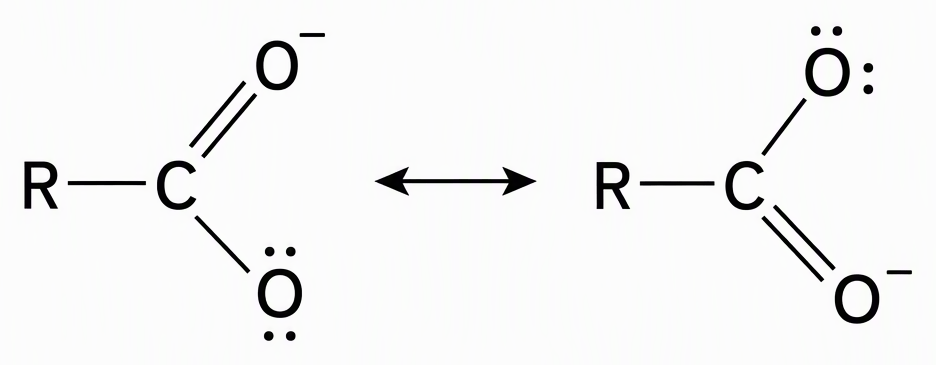
Revise resonance, inductive effect, conjugate-base stability, nucleophile and electrophile recognition, and alpha-carbon identification. The alpha carbon is the carbon directly attached to the carboxyl carbon. Draw both equivalent resonance contributors of a carboxylate ion yourself, keeping atom positions fixed and moving only electrons.
- Make a compact NCERT foundation sheet.
Extract nomenclature, preparation routes, hydrogen bonding, boiling-point comparisons and water-solubility trends. Compare boiling points using similar molar masses: carboxylic acids associate through intermolecular hydrogen bonding. Their smaller members interact well with water, while solubility generally falls as the nonpolar carbon chain grows.
Keep two explanations separate: intermolecular association explains physical behaviour; conjugate-base stability explains acidity. “Strong hydrogen bonding” is not a sufficient acidity-order argument.
- Solve acidity orders through conjugate bases.
Remove the acidic proton from each candidate, then compare the resulting anions. Check electron-withdrawing or electron-donating effects, their distance from the carboxylate group, and whether resonance connectivity actually exists.
Greater stabilisation of the conjugate base generally means a stronger acid in the stated medium. Do not assign a resonance effect merely because a double bond appears somewhere in the molecule.
- Build a reaction map with fixed fields.
Use these fields in every row: substrate form; reagent and conditions; reaction site; product; carbon-count change. Distinguish the free acid from its carboxylate salt before choosing a reaction.
Use these representative entries:
- Nitrile: aqueous acid, heat; nitrile group; carboxylic acid; nitrile carbon retained.
- Grignard reagent: carbon dioxide under dry conditions, then acidic workup; nucleophilic carbon attacks carbon dioxide; carboxylic acid; one carbon added to the alkyl group.
- Free acid: alcohol, acid catalyst, heat; carboxyl group; ester; acid skeleton retained, alcohol supplies its own carbons.
- Free acid: lithium aluminium hydride in dry ether, then aqueous workup; carboxyl group; primary alcohol; carbon count unchanged.
- Free acid with an alpha hydrogen: bromine/red phosphorus, then hydrolysis; alpha carbon; alpha-bromo acid; carbon count unchanged.
- Sodium carboxylate: soda lime, heat; carboxyl group; alkane; organic product loses one carbon.
- Run the product checkpoint before drawing bonds.
Check neutralisation first, then the reactive site, required structural features and workup. A carboxylic acid proton quenches a Grignard reagent before familiar carbonyl-addition logic applies. Conditions and substrate form are part of the question, not optional annotations.
- Rebuild, solve and diagnose.
Rebuild the map from memory, solve without notes, and classify each mistake: acidity-effect, substrate-form, reagent-condition or carbon-count error. Revise the failed rule rather than restarting the chapter.
This is an organising method, not an exhaustive reaction list. Check the current syllabus at jeemain.nta.nic.in and your prescribed NCERT coverage before deciding the map is complete.
How do I rank carboxylic acids without guessing from their formulas?
Compare the conjugate bases, not the apparent complexity of the acids. In this constructed practice question, the acid with two alpha-chlorine atoms is strongest in aqueous solution. Chlorine’s electron-withdrawing inductive effect decides the order, because all three conjugate bases share carboxylate resonance.
Practice example, not a PYQ: arrange these acids in decreasing acidity in aqueous solution.
Remove the acidic proton to obtain:
Each ion delocalises its negative charge across two oxygen atoms. Counting resonance contributors therefore cannot distinguish them.
Chlorine withdraws electron density through sigma bonds and stabilises the anion. With the chlorine atoms at the same position relative to the carboxylate group, two chlorine atoms produce a stronger withdrawing effect than one. Hence:
Transfer check: 2-chlorobutanoic acid is more acidic than 4-chlorobutanoic acid. The chlorine atom is closer to the carboxylate group in the former, and the inductive effect weakens with distance.
The trap is treating chlorine count as a universal shortcut when position or other structural features change. Give the conjugate-base explanation, not just the memorised order.
Why does a Grignard reagent not simply add to a carboxylic acid?
The acidic oxygen–hydrogen proton consumes the Grignard reagent first. Carbon dioxide, by contrast, has no such proton and accepts attack by the Grignard reagent. These constructed practice reactions show the difference.
Reaction A: treat propanoic acid with one equivalent of methylmagnesium bromide under otherwise anhydrous conditions.
This uses the conventional magnesium-carboxylate representation. The methyl group becomes methane; it does not extend the acid’s carbon skeleton. Acidic workup protonates the salt and regenerates propanoic acid.
Worked numerical: suppose each reactant starts at 0.020 mol and proton transfer is complete. The equation gives a one-to-one mole ratio:
No methylmagnesium bromide remains for a proposed addition step.
Reaction B: treat ethylmagnesium bromide with carbon dioxide, then perform acidic workup. The intermediate is magnesium propanoate:
The carbon ledger is explicit:
Adding acid before carboxylation would quench the Grignard reagent instead. The trap is recognising a carbonyl group without checking for an acidic proton.
For regular retrieval practice, JEEnius daily practice problems provide a fresh ten-question set on a topic every day, with free sets daily. Explain the first chemical event before choosing any product.
Why does propanoic acid give different products with HVZ reagents and soda lime?
HVZ bromination changes the alpha carbon; soda-lime decarboxylation removes the carboxyl carbon from the organic product. The starting forms also differ: the first constructed pathway uses propanoic acid, while the second uses sodium propanoate. Treating both as “the same three-carbon compound” hides the deciding information.
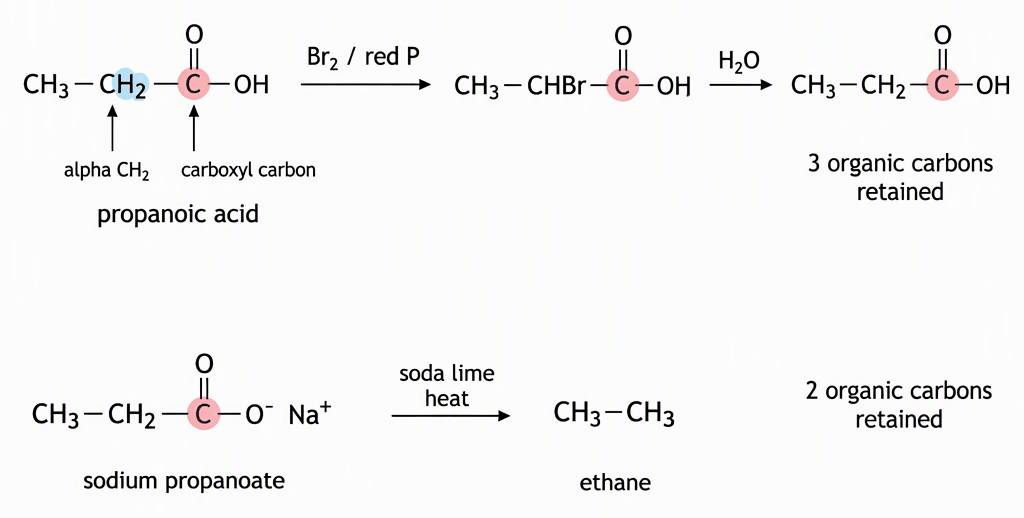
For the Hell–Volhard–Zelinsky reaction, the alpha carbon of propanoic acid is the middle carbon. It carries two hydrogen atoms, so the required alpha hydrogen is present.
Bromine replaces an alpha hydrogen, retaining all three carbons. It does not replace the hydroxyl group in the final acid product.
For soda-lime decarboxylation, heat sodium propanoate with sodium hydroxide and calcium oxide:
The carboxyl carbon enters the carbonate product. The remaining two-carbon organic fragment gives ethane, not propane; “decarboxylation” does not mean that carbon disappears from the balanced equation.
Boundary check: benzoic acid has no alpha hydrogen and does not undergo the usual HVZ alpha-halogenation. Merely possessing a carboxyl group is insufficient.
Use the same distinction every time: check acid versus salt, identify the reaction site, then verify the product’s carbon count.
What should I practise after building the reaction map?
Begin with single-skill questions and move to mixed questions only when you can explain the deciding rule without notes. Start with acidity comparisons, alpha-hydrogen identification and reagent-to-product recognition.
Make the next practice set cover:
- Inductive-effect distance and Grignard quenching.
- Carbon dioxide carboxylation and nitrile hydrolysis.
- Esterification and reduction.
- HVZ bromination and soda-lime decarboxylation.
For every reaction answer, write substrate form, reagent conditions, product and carbon count. For every acidity answer, give a conjugate-base argument instead of a remembered order. This exposes an incorrect method even when a guessed answer happens to be right.
Next, use chapterwise JEE Main PYQs for direct application, followed by JEE Advanced PYQs for linked reasoning. Keep author-created practice examples labelled separately from past-paper questions.
When an answer fails, rewrite only the failed map row or governing principle. Then test it on an unseen question rather than rereading the whole chapter.
JEEnius practice mode provides topic sets that skip questions you have already seen, with free sets included. Use the next unseen question to check whether you corrected the rule, not merely remembered the previous answer.
Next step: daily practice problems on JEEnius and get a fresh ten-question set on a topic every day (free sets daily).
For a worked example of the same idea, see Circles Practice Questions JEE: 5 Worked Examples.
Frequently asked questions
How should I study carboxylic acids for JEE?
Revise resonance, inductive effect, conjugate-base stability and alpha-carbon identification, then make a compact NCERT foundation sheet. Build a reaction map recording substrate form, reagent conditions, reaction site, product and carbon-count change. Rebuild it from memory, solve single-skill questions before mixed PYQs, and revise the specific rule behind each mistake.
How do I compare the acidity of carboxylic acids?
Remove the acidic proton and compare the stability of the resulting carboxylate ions. Check electron-withdrawing and electron-donating effects, their distance from the carboxylate group and whether resonance connectivity exists. In aqueous solution, dichloroacetic acid is stronger than chloroacetic acid, which is stronger than acetic acid, because chlorine stabilises the conjugate base through its inductive effect.
What happens when a carboxylic acid reacts with a Grignard reagent?
The acidic oxygen–hydrogen proton quenches the Grignard reagent before carbonyl addition can occur. Propanoic acid with one equivalent of methylmagnesium bromide gives methane and a magnesium carboxylate; acidic workup regenerates propanoic acid. To prepare a carboxylic acid with one additional carbon, react the Grignard reagent with carbon dioxide under dry conditions, then perform acidic workup.
What is the difference between HVZ and soda-lime decarboxylation?
HVZ bromination replaces an alpha hydrogen of a suitable carboxylic acid with bromine and retains the carbon count. Soda-lime decarboxylation uses a sodium carboxylate and gives an organic product with one fewer carbon. Propanoic acid gives 2-bromopropanoic acid under HVZ conditions, while sodium propanoate gives ethane with soda lime and heat.