
How do I choose the right model for an Atoms question?
To study Atoms for JEE, identify the projectile, electron count and initial state before choosing a formula. Use the six steps below to separate scattering, bound-electron and energy-transfer problems.
This covers Physics Atoms, not the full Chemistry Atomic Structure chapter. For orbitals, quantum numbers and electronic configurations, use How to Study Atomic Structure JEE: A Six-Step Plan.
Step 1: Check four prerequisites. You need electrostatic potential energy, circular motion, conservation of energy and the photon energy relation. Do not revise all of mechanics first.
Step 2: Identify the physical system. Choose the model using this list:
- Alpha particle approaching a nucleus: use scattering physics or energy conservation.
- One-electron atom or ion: hydrogen-like Bohr formulas apply.
- Incident photon or electron: check how energy can transfer before calculating a wavelength.
Rutherford’s large-angle scattering showed that positive charge is concentrated in a small nucleus. A classical orbiting electron would radiate energy and spiral inward. That picture cannot explain stable atoms or discrete spectra.
Step 3: Reconstruct the Bohr formula map. Coulomb attraction supplies centripetal force; Bohr’s angular-momentum condition selects the permitted orbits.
Together, these give:
The charge number is the nuclear atomic number, not the net ionic charge. Hydrogen, singly ionised helium and doubly ionised lithium qualify:
Neutral helium does not: it has two electrons. Practise reconstructing these dependencies, then memorise the compact map.
Zero energy means a free electron at rest infinitely far away. A negative bound-state energy means binding, not a negative photon energy.
How do I turn the wording into an equation and check it?
Write the event before substituting values. Calculate the relevant positive energy, then check electron count, transition direction, units and scaling.
Step 4: Translate the wording. Use this decision list:
- Head-on approach: initial kinetic energy becomes electrostatic potential energy at the turning point.
- Downward transition: the atom emits a photon.
- Upward transition: the atom must receive an allowed excitation energy.
- Ionisation: the electron reaches the zero-energy boundary or beyond.
- Cascade: several downward transitions may occur.
For an alpha particle starting far away, approaching head-on toward a heavy nucleus treated as fixed:
Closest approach is not automatically the nuclear radius. This stopping-point equation does not apply unchanged to a non-head-on trajectory, where tangential motion remains.
Step 5: Calculate the positive energy. Choose the gap for the event:
Do not combine energy in electronvolts with an SI value of Planck’s constant without conversion. In the idealised model, bound-bound photon absorption requires an allowed gap match; an incident electron can supply the gap and retain surplus kinetic energy.
Step 6: Audit electron count, direction, units and scaling. For identical level pairs:
For a suitable ensemble, count all possible downward transitions among levels:
One atom initially at that highest level can emit at most:
Lyman and Balmer series are named by their final levels:
A series limit takes the initial level toward infinity. It is not a transition between two finite levels.
How do I solve a closest-approach ratio without substituting constants?
Use the charge-to-energy ratio, not a Bohr radius. Constructed teaching problem 1, not a previous-year question: an alpha particle approaches a fixed nucleus head-on from far away. Find the closest-approach ratio under these changes:
The model is head-on electrostatic repulsion, with negligible nuclear recoil and initial potential energy taken as zero. At the turning point, the alpha particle’s kinetic energy is zero.
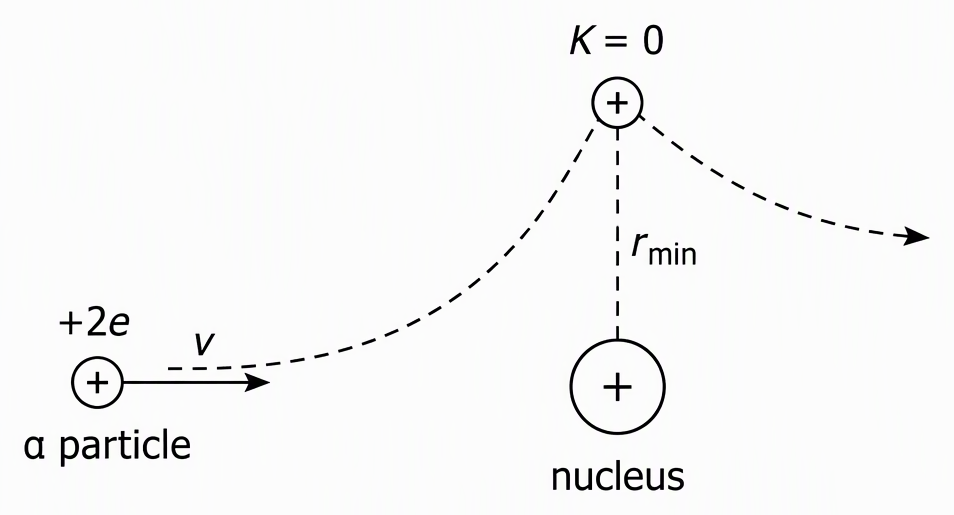
Conservation of energy gives:
Therefore:
The new distance is 1.5 times the old distance. Greater nuclear charge pushes the turning point outward; greater incident energy pushes it inward. Here, the charge increase wins.
A Bohr radius describes a bound electron orbit, not an incoming alpha particle. Electrostatic stopping does not imply contact with the nuclear surface.
How do I calculate a helium-ion wavelength and check it using hydrogen?
Use the nuclear charge in the hydrogen-like energy formula, then check the inverse-square wavelength scaling. Constructed teaching problem 2, not a previous-year question: find the emitted wavelength for singly ionised helium falling from the fourth level to the second, and compare hydrogen for the same transition.
Singly ionised helium has one electron, so the Bohr model applies. Its nuclear charge number is two, not its net ionic charge of one.
Calculate both energies before taking their difference:
This is ultraviolet radiation. For hydrogen:
The scaling check agrees. The same final principal level does not guarantee the same wavelength or spectral region across ions.
For a related follow-up, use Atomic Structure JEE 2023: Helium-Ion Wavelength Solution. JEEnius daily practice problems provide a fresh ten-question set on a topic every day, with free sets daily.
How do I distinguish electron excitation from photon absorption?
An incident electron needs enough kinetic energy to cross an excitation threshold; a photon must match an allowed bound-bound gap. Constructed teaching problem 3, not a previous-year question: ground-state hydrogen atoms are struck by electrons of kinetic energy 12.5 electronvolts. Find the highest accessible level, whether ionisation is possible and the maximum distinct downward lines across the sample.
Assume single-collision excitation and neglect atomic recoil. This calculation establishes energetic accessibility, not excitation probability.
From the ground state:
The thresholds are:
- Second level:
- Third level:
- Fourth level:
The third level is the highest accessible level. Ground-state ionisation is impossible because:
An electron exciting the third level can retain surplus kinetic energy, so its incident energy need not match the gap exactly. It can leave with:
In the standard Bohr-level model, a suitable excited ensemble can produce three distinct downward-transition lines:
One atom starting at the third level can emit at most two photons in a single downward cascade. Three possible lines across many atoms does not mean three photons from each atom.
Now change only the projectile to a photon of 12.5 electronvolts. It matches no ground-state bound-bound gap and lies below the ionisation threshold, so it is not absorbed through either process in this idealised model. Before applying a threshold or line-count formula, identify electron or photon, one atom or ensemble.
What should I practise first, and how should I correct mistakes?
Start with separate question types, then mix them once you can justify the model without a formula sheet. Use NCERT Atoms explanations and exercises first, followed by chapter-filtered JEE Main previous-year questions.
Practise in this order:
- Rutherford concepts and closest-approach ratios.
- Bohr radius, speed and energy scaling.
- Individual transitions and series limits.
- Excitation versus ionisation.
- Ensemble line counting.
Attempt JEE Advanced questions next for multi-condition reasoning, not merely larger calculations. This sequence is a study recommendation, not a guaranteed score threshold.
Before every solution, write three labels: system/model, initial-to-final event, validity condition. After solving, check the sign, units and one scaling prediction.
Keep an error log that tells you what to fix:
- Wrong charge number or electron count: count protons and electrons separately.
- Wrong initial level: write the starting state before calculating a gap.
- Sign/unit error: calculate a positive transferred energy and pair compatible units.
- Threshold-versus-resonance confusion: identify the projectile.
- Invalid line-count assumption: specify one atom or an ensemble.
Re-solve errors separately before attempting unseen questions. Fresh questions should follow correction, not replace it. Then use JEEnius practice mode for topic sets that skip questions already seen, with free sets included.
Next step: practice mode on JEEnius and practise a topic in sets that skip questions you have already seen (free sets included).
Frequently asked questions
How should I start studying Atoms for JEE?
Revise electrostatic potential energy, circular motion, conservation of energy and the photon energy relation first. Work through NCERT Atoms explanations and exercises, then chapter-filtered JEE Main previous-year questions. Practise scattering, Bohr scaling, transitions, excitation and line counting separately before mixing them and attempting JEE Advanced questions.
Which atoms and ions can I use Bohr formulas for?
Use hydrogen-like Bohr formulas for one-electron systems such as hydrogen, singly ionised helium and doubly ionised lithium. The charge number Z is the nuclear atomic number, not the net ionic charge. Neutral helium has two electrons, so these formulas do not apply.
What is the difference between electron excitation and photon absorption?
An incident electron can excite an atom if it has enough kinetic energy to supply an allowed excitation gap, retaining surplus energy after the collision. For bound-bound photon absorption in the idealised model, the photon energy must match an allowed gap. A threshold check alone is therefore insufficient for a photon.
How do I count spectral lines and photons in Atoms questions?
For a suitable ensemble with levels 1 through n accessible, the maximum number of distinct downward-transition lines is n(n-1)/2 in the standard Bohr-level model. One atom initially at level n can emit at most n-1 photons in a single downward cascade. Always identify whether the question concerns one atom or an ensemble before choosing the formula.