
How do I study each reaction without memorising products blindly?
For Alcohols, Phenols and Ethers in JEE, predict products from the substrate, reagent and conditions, not the reagent name alone. Use the same six steps for an NCERT reaction and a mixed conversion question. Memorisation supplies the possibilities; structure and conditions decide which is correct.
- Repair only the prerequisite that failed. You need resonance, inductive effect, conjugate-base stability, nucleophiles and electrophiles, carbocation stability, and the distinction between substitution and elimination. If an acidity answer goes wrong, revisit conjugate-base stability. Do not restart all of General Organic Chemistry because one reaction exposed one gap.
- Classify the substrate from its structure. For an alcohol, inspect the carbon carrying the hydroxyl group and classify it as primary, secondary or tertiary. Phenol has its hydroxyl group directly attached to an aromatic ring. Benzyl alcohol is an alcohol, not a phenol: its hydroxyl group sits on the side-chain carbon. For ethers, identify each oxygen-linked group as alkyl or aryl.
- Name the task and the reagent’s role. Decide whether the question tests acidity, oxidation, substitution, elimination, ether formation, ether cleavage or aromatic substitution. Record solvent, temperature and work-up wherever they affect the product. “Oxidising agent” alone does not tell you whether a primary alcohol stops at an aldehyde.
- Use the relevant electron-flow or stability argument. For acidity, compare the conjugate bases. For bimolecular nucleophilic substitution, inspect the carbon being attacked and its crowding. Check rearrangement only when the pathway permits a carbocation, not whenever moving a group gives a more stable-looking product.
- Reject the closest wrong pathway. Primary-alcohol oxidation depends on conditions. Dehydration is not always just removing the nearest hydrogen and hydroxyl group: carbocation rearrangement can change the skeleton. An aryl carbon does not undergo ordinary backside substitution. State why the tempting alternative fails before accepting your product.
- Verify the finished structure. Check atom connectivity, carbon count, functional group and work-up. An alkoxide before acidic work-up is not the final alcohol. Record each reaction in this format:
Build a compact reaction map, not disconnected flashcards. Use these branches and connect them when a product becomes the next reaction’s starting material:
- Alcohol preparation, oxidation and dehydration.
- Phenol acidity and ring substitution.
- Williamson synthesis and ether cleavage.
Read NCERT actively: cover each product, predict it using these steps, then uncover it and check the conditions. Make separate recall entries for phenol bromination, nitration, Kolbe–Schmitt and Reimer–Tiemann reactions, including reagents and work-up. The three original practice problems below demonstrate reasoning, not complete chapter coverage; they are not previous-year questions.
How do I rank ethanol, phenol and nitrophenols by acidity?
Under the usual aqueous comparison, para-nitrophenol is more acidic than meta-nitrophenol, followed by phenol and ethanol. Compare the stability of their conjugate bases, not how similar their hydroxyl groups look.
Original practice question: Arrange ethanol, phenol, meta-nitrophenol and para-nitrophenol in decreasing acidity. The correct order is:
Apply the method:
- Identify the task: Remove the hydroxyl proton from each compound. The conjugate bases are ethoxide, phenoxide, meta-nitrophenoxide and para-nitrophenoxide.
- Compare ethanol with phenol: Ethoxide has no comparable resonance delocalisation. Phenoxide distributes negative charge through resonance involving oxygen and the aromatic ring.
- Compare the nitro positions: The meta nitro group stabilises the conjugate base mainly through its electron-withdrawing inductive effect. At the para position, the nitro group also permits resonance stabilisation of the conjugate base.
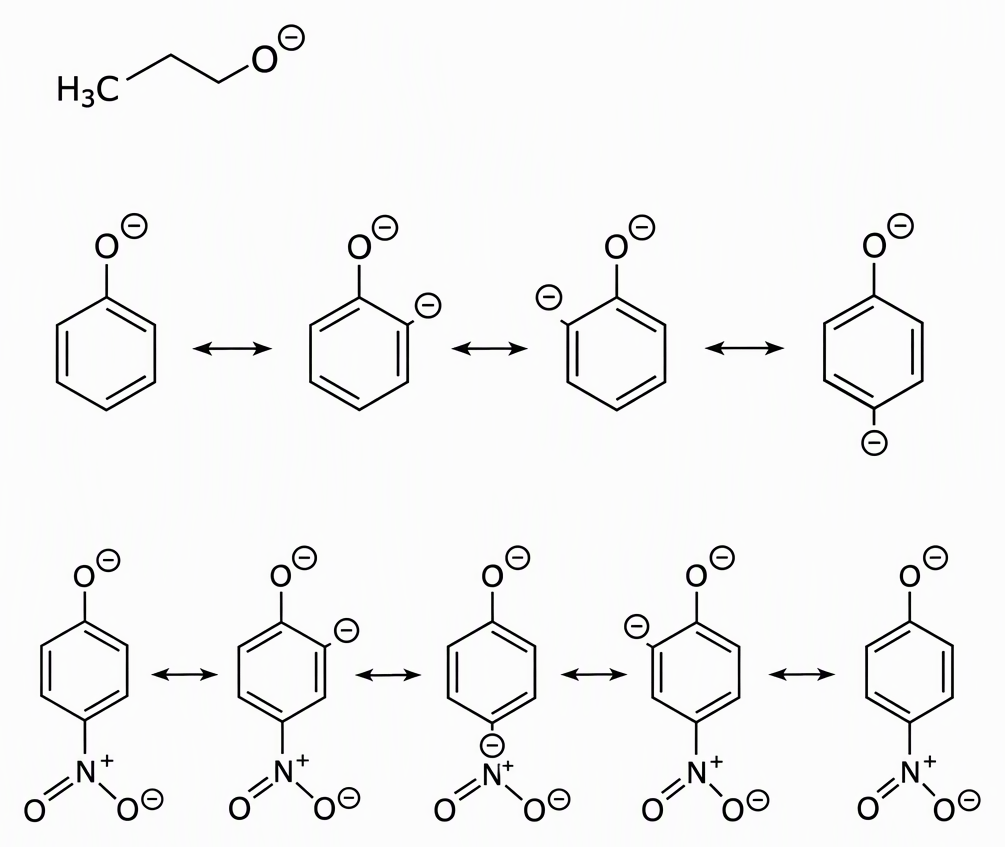
The tempting wrong answer treats both nitro positions as equivalent because “nitro withdraws electrons”. That rule misses whether resonance can connect the substituent to the negative charge. Ranking from hydroxyl-bond appearance alone also ignores conjugate-base stability.
Compare conjugate bases before reaching for a memorised acidity list. Check both the substituent and its position.
How do I solve a multistep alcohol conversion without losing a carbon?
Solve one arrow at a time: this sequence gives propanal, then butan-2-ol, then butan-2-one. The carbon count changes only during the Grignard addition.
Original practice sequence:
- First arrow: Propan-1-ol is primary. PCC in dry dichloromethane gives controlled oxidation to propanal, retaining three carbons.
- Second arrow: The Grignard reagent supplies a methyl group that adds as a nucleophile to the aldehyde carbonyl carbon. The resulting alkoxide is protonated during acidic work-up to give butan-2-ol.
Dry conditions prevent water from consuming the Grignard reagent by protonation. Adding acid before the addition would also destroy the reagent.
- Third arrow: Butan-2-ol is secondary. Acidified potassium dichromate oxidises it to butan-2-one under standard oxidation conditions.
Carbon check: Propan-1-ol and propanal each contain three carbons. Adding one methyl group gives four; the final oxidation retains four.
Numerical extension: Start with 0.10 mol of propan-1-ol, sufficient reagents and quantitative conversion. Each step has a one-to-one mole relationship, so the theoretical ketone mass is:
Reject two wrong turns: PCC under the stated conditions does not take propan-1-ol straight to propanoic acid; excess acidified dichromate under reflux would. Grignard addition cannot leave the carbon skeleton unchanged.
For focused repetition, JEEnius daily practice problems provide a fresh ten-question topic set every day, with free sets daily; use an oxidation set to practise naming every intermediate.
Which Williamson route makes anisole, and how does HI cleave it?
Choose sodium phenoxide plus methyl iodide to make anisole by ordinary Williamson synthesis. On heating with hydrogen iodide, anisole gives phenol and methyl iodide. Both answers follow from substitution at the methyl carbon, not the aryl carbon.
Original practice question: Choose between sodium phenoxide plus methyl iodide and sodium methoxide plus bromobenzene. Then predict cleavage of the anisole formed.
The successful synthesis is:
Phenoxide acts as the nucleophile. Methyl iodide offers an unhindered carbon for bimolecular nucleophilic substitution:
Bromobenzene has bromine attached directly to an aryl carbon with this hybridisation:
That carbon does not undergo ordinary backside substitution. This does not mean aryl halides can never undergo substitution: other mechanisms operate with suitable substrates and conditions. They do not make sodium methoxide plus bromobenzene an ordinary Williamson route.
For cleavage, follow the mechanism in order:
- Protonate the ether oxygen, making the ether easier to cleave.
- Iodide attacks the methyl carbon.
- The methyl–oxygen bond breaks, leaving phenol.
The tempting incorrect pair is iodobenzene plus methanol. It assigns substitution to the aryl carbon and breaks the wrong carbon–oxygen bond. The phenyl group stays attached to oxygen.
For a Williamson disconnection, prefer the less hindered alkyl halide. Tertiary halides with an alkoxide generally favour elimination rather than the desired ether-forming substitution.
What should I practise after these three examples?
Practise reaction families first, then mixed conversions. Start with direct NCERT-based recall and single-step questions before verified JEE Main and JEE Advanced previous-year questions.
Follow this order:
- Repair the prerequisite exposed by a failed question.
- Study alcohol preparation and reactions.
- Study phenol acidity and ring substitution.
- Study ether synthesis and cleavage.
- Solve mixed conversions.
Target these question families:
- Acidity with positional substituents.
- Oxidation with contrasting reagents.
- Dehydration with possible carbocation rearrangement.
- Phenol bromination, nitration, Kolbe–Schmitt and Reimer–Tiemann products.
- Williamson route selection.
- Cleavage of unsymmetrical ethers.
Revise easily confused conditions together. Bromine water gives phenol’s 2,4,6-tribromo product, while controlled bromination in a nonpolar solvent favours monobromination at ortho and para positions. Contrast controlled primary-alcohol oxidation with vigorous oxidation, not just “alcohol gives aldehyde”.
For Advanced preparation, add multistep and multiple-correct problems requiring checks on competing pathways and every option. These styles are not exclusive to one exam.
Use four error-log labels:
- Substrate classification
- Reagent/condition recall
- Mechanism choice
- Bookkeeping
Revisit the matching reaction-map entry before retrying the question. Readiness means explaining the product and rejecting its nearest alternative without notes.
For the next unseen set, JEEnius practice mode offers topic sets that skip questions already seen, with free sets included. Choose the topic matching your latest error-log entry.
Next step: daily practice problems on JEEnius and get a fresh ten-question set on a topic every day (free sets daily).
For a worked example of the same idea, see Amines Practice Questions JEE: 5 Solved Concept Drills.
Frequently asked questions
How should I study alcohols, phenols and ethers for JEE?
Classify the substrate, identify the reaction task and conditions, then use electron flow or stability to predict the product. Reject the closest wrong pathway and check connectivity, carbon count and work-up. Build a compact reaction map, practise direct NCERT-based questions, then move to verified JEE previous-year questions and mixed conversions.
What is the acidity order of ethanol, phenol and nitrophenols?
In the usual aqueous comparison, decreasing acidity is para-nitrophenol > meta-nitrophenol > phenol > ethanol. Phenoxide has resonance stabilisation that ethoxide lacks. The meta nitro group stabilises the conjugate base mainly through induction, while the para nitro group also permits resonance stabilisation.
Does oxidation of a primary alcohol give an aldehyde or a carboxylic acid?
The product depends on the reagent and conditions, not just the alcohol being primary. PCC in dry dichloromethane converts propan-1-ol to propanal. Excess acidified potassium dichromate under reflux instead gives propanoic acid.
Why does anisole give phenol and methyl iodide with HI?
On heating with HI, anisole undergoes oxygen protonation followed by iodide attack at the methyl carbon. The methyl–oxygen bond breaks, giving phenol and methyl iodide. The aryl carbon does not undergo ordinary backside substitution, so iodobenzene and methanol are not the correct products.