
Which Amines practice questions for JEE should you start with?
Start with concept drills if you still confuse basicity, reagents or carbon-count changes. Use PYQs once you can explain those ideas without notes, then use mixed mocks to test recall under paper conditions. Choose Amines practice questions for JEE by the mistake you need to fix, not by a claim that one resource is best for everyone.
Five free original questions with worked explanations follow here. No download is required.
A chapter drill isolates a weakness. An official-paper PYQ shows how an examiner tested the chemistry. A full-length mock tests recall while switching between chapters and subjects. Mocks test whether you can apply what you know; they do not replace learning Amines.
How do original drills, official PYQs and full-length mocks compare?
Choose drills to find concept gaps, PYQs to check exam-level application and mocks to test mixed-paper performance. Compare their prerequisites and answer support before choosing your next practice session.
- Purpose
- Original drills here: Expose a specific conceptual mistake.
- Official-paper Amines PYQs: Show how a concept was actually tested.
- Mixed full-length mocks: Test chapter switching, time use and decisions.
- Prerequisite knowledge
- Drills: Basic familiarity with the chapter.
- PYQs: Fundamentals usable without notes.
- Mocks: Enough syllabus preparation for meaningful mixed practice.
- Chapter targeting
- Drills: Tightly focused on Amines.
- PYQs: Targeted after extracting relevant Chemistry questions.
- Mocks: Mixed coverage, with no guaranteed number of Amines questions.
- Exam authenticity
- Drills: Original teaching questions, not past exam questions.
- PYQs: Authentic evidence when checked against the official paper.
- Mocks: Practice under paper conditions, not evidence of past questions.
- Answer support
- Drills: Worked explanations supplied below.
- PYQs: Official keys establish answers but do not necessarily explain them.
- Mocks: For mixed-paper practice, use JEEnius full-length 75-question, 300-mark, 180-minute mocks with a scored per-subject breakdown, with free tests included.
- Principal limitation
- Drills: Narrow coverage.
- PYQs: A remembered answer can conceal weak reasoning.
- Mocks: A subject score alone cannot identify the chemical misconception.
A correct option counts only when you can defend it. If you recognise a PYQ answer but cannot explain the chemistry, choose an unfamiliar drill before another familiar paper.
Which practice route should you pick right now?
Pick by the explanation you cannot yet give, not simply by your class. A Class 12 student may need prerequisite repair, while a student studying ahead may be ready for PYQs. Choose the next task rather than collecting question banks.
- Class 11, studying ahead: If resonance and acid–base reasoning are weak, repair them first. Explain why a nitrogen lone pair may be more or less available before memorising basicity orders.
- Class 12, chapter just completed: Begin with the original drills below. Move to unseen PYQs when you can justify the answer and reject the closest wrong option without notes.
- Dropper, familiar with PYQ answers: Cover the options and explain the chemistry first. Then try an unfamiliar variant with a changed substrate, medium or reagent.
Match the next task to your exam goal and current difficulty:
- Main-focused: Prioritise reliable single-correct decisions. Check the reagent, medium and substrate before choosing an option.
- Advanced-focused: Move from isolated ideas to linked reaction and reasoning problems. Harder practice should connect concepts, not merely demand obscure facts.
- Strong chapter-wise, weak in mixed Chemistry: Take a full-length mock and manually inspect the relevant errors. Check whether you missed the chemistry, misread a condition or spent too long deciding.
Ten familiar answers recalled from memory reveal less than one properly diagnosed mistake. Use unfamiliar variants to check whether your reasoning survives a change in conditions.
Can you solve these five free Amines questions without hints?
Attempt every question before reading the explanations, and write a brief reason beside each choice. These are five original single-correct concept drills, not PYQs and not replicas of a settled JEE Advanced format. Mark guessed answers for review.
This is a starter set, not complete chapter coverage. Synthesis, separation and further diazonium reactions still need practice.
Question 1: Aniline versus methylamine
In aqueous solution, which statement correctly compares methylamine and aniline?
- A. Aniline is more basic because its nitrogen lone pair is delocalised.
- B. Methylamine is more basic because aniline’s nitrogen lone pair participates in resonance with the ring.
- C. They are equally basic because both are primary amines.
- D. Aniline is more basic because its phenyl group behaves like an electron-donating methyl group.
Question 2: Does the medium change the order?
Which comparison is correct for trimethylamine and dimethylamine in the gas phase and in ordinary aqueous solution?
- A. Trimethylamine is more basic in both.
- B. Dimethylamine is more basic in both.
- C. Trimethylamine is more basic in the gas phase; dimethylamine is more basic in water.
- D. Dimethylamine is more basic in the gas phase; trimethylamine is more basic in water.
Question 3: What happens to the carbon chain?
Separate samples of propanamide undergo reduction with lithium aluminium hydride followed by work-up, and Hofmann bromamide degradation with bromine and aqueous sodium hydroxide. What are the respective amine products?
- A. Propan-1-amine and ethanamine.
- B. Ethanamine and propan-1-amine.
- C. Propan-1-amine in both reactions.
- D. Ethanamine in both reactions.
Question 4: Which amines give the carbylamine test?
Which pair gives a positive carbylamine test with chloroform and alcoholic potassium hydroxide on heating?
- A. Ethanamine and dimethylamine.
- B. Dimethylamine and trimethylamine.
- C. Ethanamine and trimethylamine.
- D. Ethanamine and aniline.
Treat this as exam chemistry, not an at-home experiment. The reagents and isocyanide products require proper laboratory controls.
Question 5: Which sequence converts aniline to phenol?
Which reagent sequence is appropriate?
- A. Sodium nitrite and hydrochloric acid at room temperature, with no further step.
- B. Sodium nitrite and hydrochloric acid at zero to five degrees Celsius, followed by warming with water.
- C. Bromine water, followed by aqueous sodium hydroxide.
- D. Lithium aluminium hydride, followed by water.
Why are these answers correct, and what does each wrong choice reveal?
The answers are 1-B, 2-C, 3-A, 4-D and 5-B. Compare your reasons, not just your letters, with the explanations below. Each skill label identifies what to repair if the answer was wrong or guessed.
1. B, skill: resonance
Methylamine is more basic than aniline in water. In aniline, the nitrogen lone pair is delocalised into the benzene ring, making it less available to accept a proton; methylamine has no corresponding ring delocalisation.
The tempting mistake is A: treating resonance as something that always increases basicity. Check what resonance stabilises and whether the lone pair remains available.
2. C, skill: medium-dependent basicity
Trimethylamine is more basic in the gas phase, where alkyl electron donation favours proton acceptance without solvent effects. In water, dimethylamine is more basic because the balance also includes solvation of the base and its conjugate acid; dimethylammonium is better hydrated than trimethylammonium.
The tempting mistake is A, extending an alkyl-substitution rule to every medium. More alkyl groups do not guarantee greater aqueous basicity.
3. A, skill: carbon accounting
Reduction retains the carbonyl carbon in the organic chain, so propanamide gives propan-1-amine. Hofmann degradation removes that carbon from the amine skeleton, giving ethanamine.
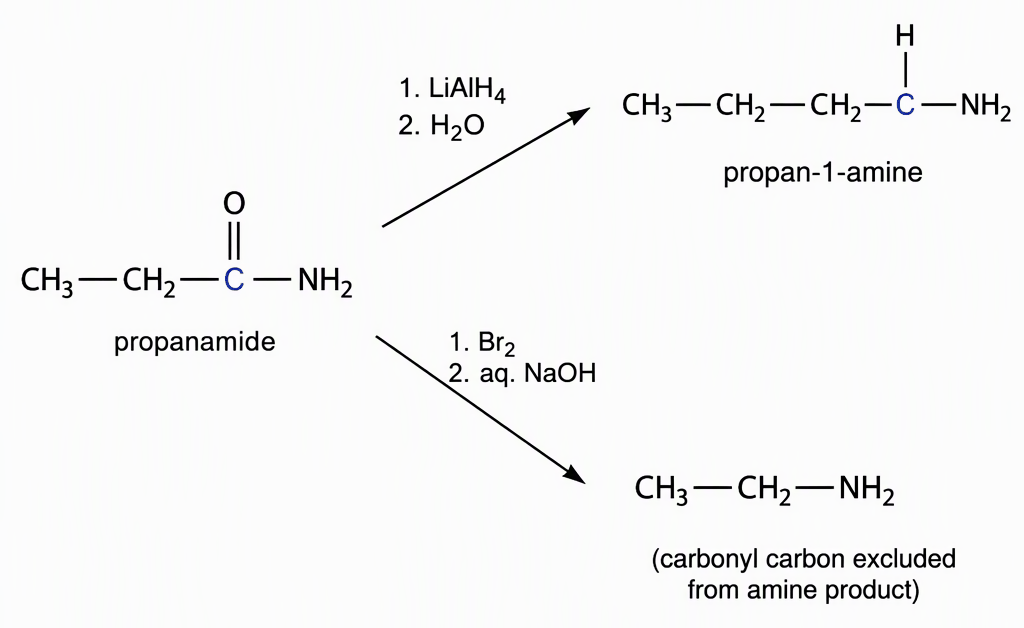
The tempting mistake is C: remembering only that both reactions convert an amide into an amine. Product classification is not enough; count the carbons in the product skeleton.
4. D, skill: amine classification
Both ethanamine and aniline are primary amines and give the carbylamine test. Dimethylamine is secondary and trimethylamine is tertiary, so neither qualifies.
The tempting mistake is A, selecting the two smaller aliphatic amines. The test distinguishes primary amines, not aliphatic amines from aromatic ones; aniline’s lower basicity does not exclude it.
5. B, skill: reagent sequence
Sodium nitrite and hydrochloric acid generate nitrous acid under cold conditions. Aniline first forms benzenediazonium chloride; warming with water then hydrolyses the diazonium group to give phenol.
The tempting mistake is A, treating diazotisation as direct phenol formation and ignoring temperature control. Name the intermediate and keep diazotisation separate from hydrolysis.
How should each wrong answer change your next practice choice?
Choose your next practice route by the cause of the mistake, not your total score. An unfamiliar application needs different practice from a missing rule. A guessed correct answer is still an unresolved concept, so include it in the review.
- Basicity mistake: State the species and medium. Compare electronic effects and solvation before attempting another basicity question.
- Product or chain-length mistake: Draw the substrate and track the carbonyl carbon. Do not rely only on the named reaction.
- Test-reaction mistake: Classify nitrogen substitution, then check which amine classes respond.
- Sequence mistake: Annotate reagents and conditions over each arrow. Identify the intermediate before trying a longer conversion.
Use this review template to record the reasoning, not just the corrected option:
- Question source: Original drill, or the identified exam paper.
- Mistaken assumption: The exact thought that led to your choice.
- Corrected rule: A sentence that includes the relevant conditions.
- Fresh follow-up question: An unseen variant testing the same idea.
For carbon accounting, predict the two products from butanamide under the conditions in Question 3. Track the carbonyl carbon before naming either product.
Conceptual errors go back to drills. Application errors go to PYQs with reliable explanations. Mixed-paper execution errors go to mock review. No starter-set score guarantees readiness; check your reasoning on a fresh problem.
Where should you get authentic PYQs, and when should you use free mocks?
Use officially released papers and answer keys where available, then add worked explanations where needed. For Main, start at jeemain.nta.nic.in; for Advanced, use the official JEE Advanced website. Locate relevant Chemistry questions and preserve the exam, year, session or paper identification.
An official key establishes the accepted answer; a third-party worked solution explains a route and should be labelled separately. Check its reasoning against the exact question. If a source changes the substrate, wording or options, call it adapted, not an exact PYQ.
Main awards four marks for a correct answer, deducts one for a wrong answer and gives zero for an unattempted question. Attempting every question is not strategically mandatory. Advanced has two compulsory papers, with variable question types and marking; do not apply the Main mock pattern to it.
Once your Amines practice questions for JEE no longer need hints, use a JEEnius free full-length mock to test mixed-paper performance. Use the scored per-subject breakdown to locate the weaker subject, then review the individual questions yourself and record the assumption behind each Amines error.
Next step: full-length mock tests on JEEnius and sit a full 75-question, 300-mark, 180-minute paper and get a scored per-subject breakdown (free tests included).
If that step was the hard part, work through Matrices and Determinants JEE 2026: Double Adjoint.
Frequently asked questions
Should I start Amines practice with concept questions or PYQs?
Start with concept drills if you still confuse basicity, reagents or carbon-count changes. Move to unseen PYQs when you can justify your answer and reject the closest wrong option without notes. Use full-length mocks to test recall and decisions across chapters, not to replace learning Amines.
Are these five Amines questions actual JEE PYQs?
No, these are original single-correct concept drills with worked explanations, not past exam questions. They form a starter set rather than complete chapter coverage. For authentic PYQs, use officially released JEE Main and JEE Advanced papers and answer keys where available.
Why is dimethylamine more basic than trimethylamine in water?
Aqueous basicity depends on electronic effects and solvation of the base and its conjugate acid. Dimethylammonium is better hydrated than trimethylammonium, and the overall balance makes dimethylamine more basic in water. In the gas phase, trimethylamine is more basic, so the medium must be specified.
What is the difference between LiAlH4 reduction and Hofmann bromamide degradation?
LiAlH4 reduction of an amide retains the carbonyl carbon in the amine skeleton, while Hofmann bromamide degradation removes it. Propanamide therefore gives propan-1-amine on reduction and ethanamine on Hofmann degradation. Track the carbonyl carbon rather than remembering only that both reactions produce amines.