How do you solve the 3D Geometry / Vectors JEE 2026 intersecting-lines question?
Option C, 360, is the answer to this 3D Geometry / Vectors JEE 2026 question. Two lines meet at R, P belongs to the first line and lies in the first octant, and Q belongs to the second line. The specified distances from P to R and from P to Q constrain their positions.
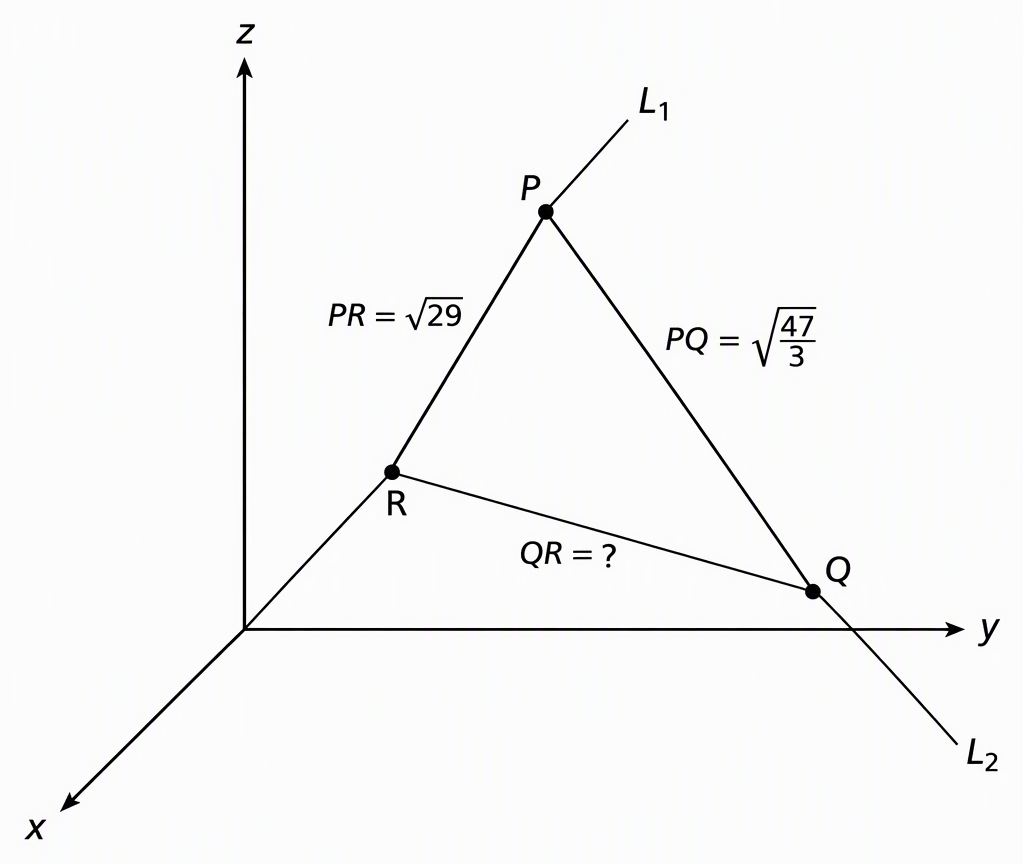
The source is JEE Main, January 2026, Slot 1. “Hard” is the question bank’s difficulty classification, not an official exam rating; 120 seconds is its expected solving time, not a measured student average.
The lines have coordinate forms with real parameters:
The distance conditions are:
Find:
Follow the official parameter-and-distance method with three checks: intersection consistency, octant-based branch selection and all three coordinate differences.
How do you find R and check all three coordinates?
The intersection has all three coordinates equal to negative one. Two coordinate equations determine candidate parameters, but the unused equation must also hold: matching two coordinates alone does not establish an intersection in 3D.
Equating coordinates gives:
Use the third equation in the second:
Therefore:
Check the unused first equation:
Substitution into either line gives:
This parameter value locates R on the second line, not Q. Calculate Q’s parameter separately; do not reuse the intersection value in the next distance condition.
Why does the first-octant condition select only one P?
The distance condition gives two candidate points, but only one has three positive coordinates. The first-octant condition selects that point; distance alone cannot choose which side of R contains P.
Write:
The vector from R to P, whose magnitude is PR, is:
Hence:
Both roots must be considered:
Their corresponding points are:
The first octant requires:
Thus:
How does the given PQ distance locate Q?
The distance equation produces a repeated root, giving one admissible Q rather than two distinct points. Keep all three squared differences through the expansion; omitting a coordinate changes the distance equation.
Set:
Then:
Expand each term:
Collect terms and use the given distance:
Multiply by three and rearrange:
Divide by ten:
Therefore:
How do you calculate QR and obtain option C?
Square and add all three coordinate differences between Q and R, then multiply by the requested factor. No square root is needed because the expression already contains the square of QR.
The coordinate difference is:
Therefore:
This gives option C:
How does a projection mistake produce option B, 348?
Dropping the third coordinate produces exactly 348. This is one demonstrable route to option B, not evidence about the examiner’s intended distractor or which option students usually choose.
Using only the x and y coordinate differences incorrectly gives:
Then:
That calculation gives the squared length of the segment’s projection onto the xy-plane, not its actual three-dimensional length. The missing contribution is:
After multiplication by the required factor:
Write all three coordinate differences before squaring. A negative third-coordinate difference still contributes a positive square.
Which two practice questions check the same method?
The first drill checks octant-based branch selection; the second checks a complete coordinate distance. These are original practice questions, not additional JEE past-paper questions.
How do you select a first-octant point at a given distance?
Choose the positive-parameter candidate here because the other candidate has three negative coordinates. In Question 1, P lies on the following line; find P in the first octant using the given distance from R.
The squared distance gives:
The candidates are:
Only the first satisfies the octant condition:
How do you find QR squared when Q lies on another line?
Write Q using its own line parameter, then apply the full distance from P. In Question 2, the following lines meet at R, P is given, and Q lies on the second line.
Find the square of QR. Substitution gives:
Rearranging:
Thus:
Redo both drills without looking at the solutions. Keep both distance roots until you apply the octant condition, and write a three-entry difference vector before every distance calculation.
Next step: photograph a doubt on JEEnius and photograph any question you are stuck on and get a step-by-step solution, with a free-body diagram when the question needs one (20 free).
Read next: The P-Block Elements JEE 2024: PCl5 Fluorination.
Frequently asked questions
How do you find the intersection of two lines in 3D?
Equate the corresponding coordinates and solve two equations for the line parameters. Check those values in the unused equation, because matching only two coordinates does not establish an intersection in 3D. For the given lines, both parameters equal -1 and R = (-1, -1, -1).
Why does the first-octant condition give P = (1, 2, 3)?
The condition PR = √29 gives two parameter values, t = 0 and t = -2, corresponding to P = (1, 2, 3) and P = (-3, -4, -5). The first octant requires all three coordinates to be positive, so only P = (1, 2, 3) is valid.
Why is there only one possible Q in this question?
Substituting Q = (4 + 5μ, 1 + 2μ, μ) into the given PQ distance equation produces (3μ + 1)² = 0. This repeated root gives μ = -1/3, so Q = (7/3, 1/3, -1/3) is the only admissible point.
Why is the answer 360 and not 348?
The full three-dimensional distance gives QR² = (100 + 16 + 4)/9 = 40/3, so 27(QR)² = 360. Omitting the squared z-coordinate difference gives 348, which uses the segment's projection onto the xy-plane rather than its actual length.