
What is the rolling-disk question from JEE Advanced 2022?
The centre’s translation contributes nothing to the stone’s vertical launch speed in this rotational motion JEE 2022 question. This is JEE Advanced 2022, Paper 1, Physics, not JEE Main. It is a numerical-answer question with no supplied options.
A disk of radius one metre starts from rest and rolls without slipping on a horizontal plane, with constant angular acceleration two-thirds of a radian per second squared. A stone initially at the ground contact separates after square root of pi seconds and then moves as a projectile. Take rightward rolling with clockwise rotation, and gravitational acceleration ten metres per second squared.
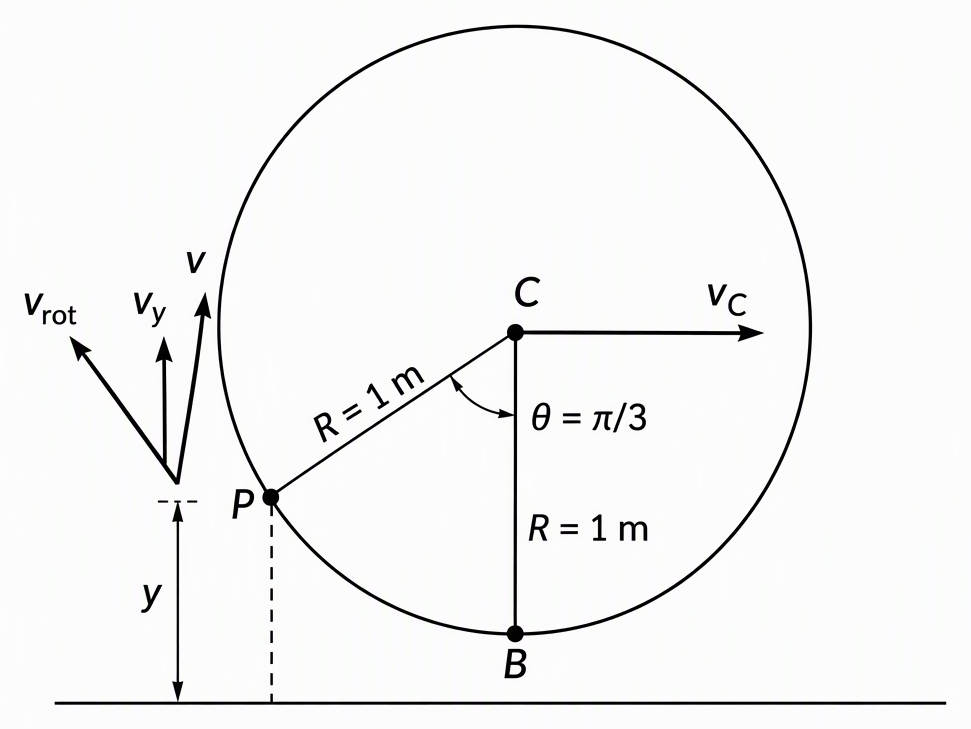
The given quantities are:
Find the unknown coefficient in the stone’s greatest height above the plane:
The question bank classifies this as medium difficulty, with an expected solving time of 180 seconds. That is a practice estimate, not an official exam allowance.
How do you find the angular speed and rotation at release?
Use constant-angular-acceleration kinematics, as in the official solution. Angular speed tells us how fast the disk rotates at release; angular displacement tells us where the stone has reached.
The disk starts from rest:
Its angular speed at release is:
Its angular displacement is:
Measure this angle from the stone’s initial bottom position, not from the horizontal. Clockwise rotation places it on the lower-left rim in the diagram. Reversing the rolling direction reverses the horizontal motion but leaves the maximum height unchanged.
What is the stone’s height when it separates?
The stone separates half a metre above the plane. The disk centre stays one radius above the plane, while the stone lies below the centre by the radius multiplied by the cosine of its rotation from the bottom.
The release height is therefore:
Substituting the release angle:
This is the release height, not the maximum height. The stone leaves with an upward velocity, so it rises further.
Which velocity component determines the stone’s additional rise?
Only the vertical component of the ground-frame release velocity determines the additional rise. The stone’s ground-frame velocity equals the centre velocity plus its velocity relative to the centre:
Rolling without slipping gives the centre speed:
But the centre moves entirely horizontally. The rotational velocity is tangent to the rim relative to the centre, pointing upward-left here; it is not the complete ground-frame launch velocity.
Consequently, the upward component is:
At the release angle, this component is positive:
Use this component, not the total speed, in the vertical projectile equation. Neither horizontal range nor an energy method is needed.
How does the projectile calculation give the final answer?
The maximum height above the plane equals the release height plus the projectile’s additional rise. After separation, gravity reduces the vertical velocity to zero at the highest point.
For the rise above the release point, the vertical kinematic equation gives:
First square the vertical launch speed:
Then calculate the additional rise:
Add the release height:
Compare with the question’s expression:
The requested numerical answer is:
This coefficient is neither the additional rise nor the total height. Keep those quantities separate when entering the answer.
Why is using the rotational speed as the upward speed wrong?
It ignores the direction of the rim-relative velocity and omits the sine factor. This is a numerical-answer question, so the incorrect value below is a derived wrong result, not a listed wrong option.
The mistaken substitution is:
It produces the incorrect rise:
That gives:
Resolve the ground-frame release velocity vertically before calculating projectile rise. The centre contributes no vertical velocity, but that does not make the entire rotational speed vertical.
What three practice questions check the same method?
These original practice variations, not JEE past-paper questions, test angular kinematics, release height and velocity components separately. Each uses the same one-metre disk, starting from rest with the same constant angular acceleration.
- When does the stone first rotate through a right angle, assuming it remains attached until then?
Apply angular displacement from rest:
- If the stone instead releases after a right-angle rotation, what maximum height does it reach above the plane?
Use the original gravitational acceleration. The release position is level with the centre, and the rotational velocity is vertically upward:
- At the original release angle, what is the horizontal ground-frame velocity for rightward rolling?
Subtract the leftward rotational component from the rightward centre velocity:
Redo the second variation without looking at its sketch. Write the release height and vertical launch speed separately before combining them.
Next step: photograph a doubt on JEEnius and photograph any question you are stuck on and get a step-by-step solution, with a free-body diagram when the question needs one (20 free).
Keep going with How to Study Alcohols Phenols Ethers JEE: A Six-Step Method.
Frequently asked questions
Was the 2022 rolling-disk and stone question in JEE Main or Advanced?
The question appeared in JEE Advanced 2022, Paper 1, Physics. It was a numerical-answer question with no supplied options, not a JEE Main question.
What is the answer to the JEE Advanced 2022 rolling-disk question?
The requested coefficient is x = π/6. The stone's maximum height above the plane is H = (1/2 + π/60) m; comparing this with H = (1/2 + x/10) m gives the answer.
How do you find the stone's height when it leaves the rolling disk?
Measure the angular displacement θ from the stone's initial bottom position and use y = R(1 − cos θ). Here, θ = π/3 and R = 1 m, so the release height is 1/2 m above the plane.
Why is the stone's vertical launch speed not equal to Rω?
Rω is the magnitude of the stone's velocity relative to the disk centre, not its vertical component. At angular displacement θ from the initial bottom position, the vertical component is Rω sin θ because the centre moves only horizontally. For this question, the upward launch speed is √(3π)/3 m/s.