What is the answer to the coordinate geometry JEE 2026 skew-lines question?
The worked answer is option C, negative six, for this coordinate geometry JEE 2026 problem. The source is JEE Main, January 2026, Slot 1. The question bank rates it hard on its own scale and gives an expected solving time of 180 seconds. These are question-bank expectations, not an official difficulty rating or a measured student average.
Find the sum of all real parameter values for which the two specified spatial lines have minimum separation equal to the square root of two. This separation is the length of their common perpendicular, not an arbitrary connector between chosen points on the lines.
The supplied equations are:
The options are:
The official method uses parametric lines followed by a scalar triple product. Check the parameter domain before cancelling anything.
How do you write the lines parametrically and check the zero case?
A zero parameter contributes no solution. The symmetric fractions are undefined there, but the parametric forms describe two distinct parallel lines. Their separation is the square root of ten, so zero fails even under the parametric interpretation.
Following the official setup:
Read off one point and one direction vector from each line:
The connector is:
At zero, both lines run along the second coordinate axis. Their fixed first and third coordinates differ:
Their parallel separation is:
Zero therefore contributes no solution. Every subsequent use of the nonparallel formula, and every cancellation of the parameter, requires:
How do you calculate the common normal without losing a sign?
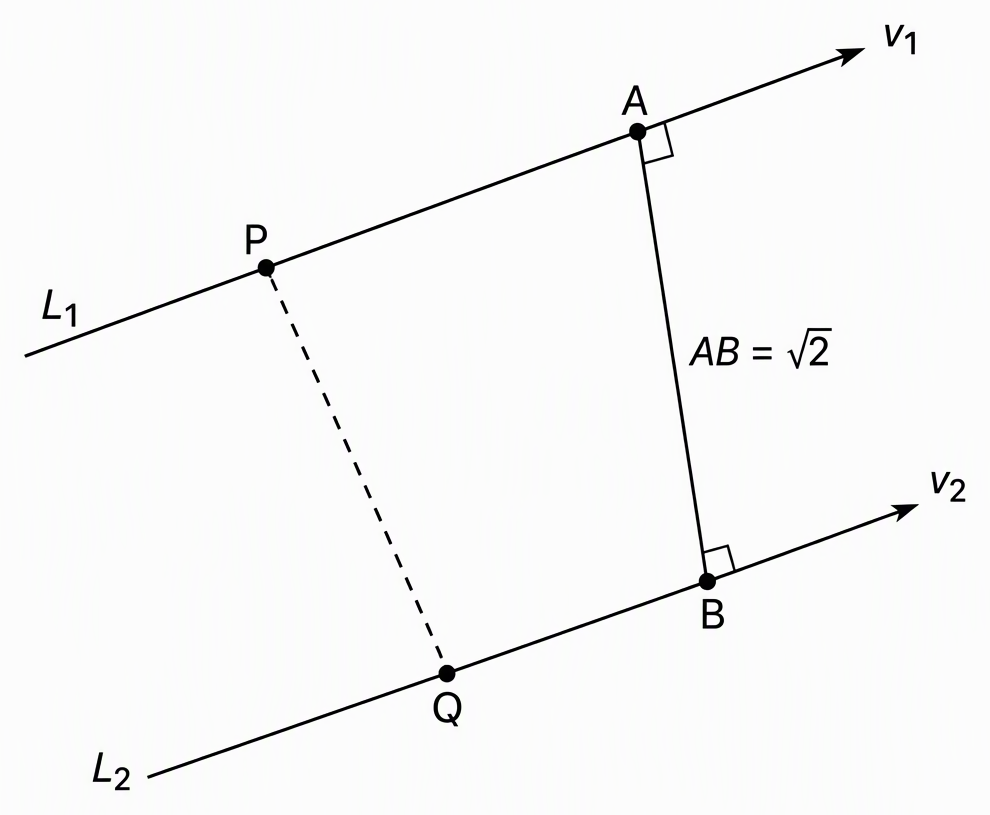
Keep the minus sign on the middle cofactor. The cross product is perpendicular to both directions, so projecting the connector onto this common normal measures the shortest separation. The connector itself need not be perpendicular to either line.
For nonparallel lines:
Expand the determinant component by component:
The three components are:
Hence the common normal is:
Expand the scalar triple product rather than doing its signs mentally:
The squared magnitude of the normal is:
This confirms that the cross product is nonzero for every allowed parameter value. Keep the squared magnitude for the distance calculation: taking its square root now introduces an unnecessary absolute-value step.
How do you apply the distance condition and verify both roots?
Both roots are valid, including the negative one. Square the nonnegative distance equation first, then cancel only after invoking the nonzero restriction. This follows the official algebra without assuming that the parameter is positive.
The domain check permits cancellation of the common factor:
Rearrange and factor:
Therefore:
Check both in the original nonparallel distance expression, simplified with absolute values:
The requested sum is:
Do not assume that taking the square root of a square returns the signed parameter:
Squaring first avoids an unjustified positive-parameter assumption. The substitutions verify the actual distances, not merely the polynomial roots.
How does a missing cofactor minus produce option D?
Changing just one component changes the normal's direction, not merely its sign. Omitting the minus on the middle cofactor gives this incorrect vector:
Its incorrect triple product becomes:
Continuing the erroneous calculation gives:
An absolute value cannot repair this component error: the vector is no longer a common normal. Reversing the whole cross product, or replacing the connector by its reverse, instead negates the complete triple product and leaves the distance unchanged.
Audit perpendicularity before solving the quadratic:
The incorrect vector fails this check for every allowed parameter value. Reject it before using the distance formula.
Which two practice questions test the same method?
These original practice variants, not additional verified PYQs, test when to reuse the nonparallel formula and when to reject it. Attempt both before reading their worked answers.
Question 1: For the same parametric lines, find the parameter when the shortest distance is one.
Zero is excluded because its separation is the square root of ten. For the nonparallel case:
Substitution verifies:
Question 2: For the same parametric lines, determine whether a zero parameter gives coincident or distinct parallel lines, and calculate their distance.
The directions are parallel:
Their different fixed first and third coordinates make them distinct, not coincident. A connector joining points with equal second coordinates has length:
Question 1 reuses the nonparallel formula. Question 2 requires recognising that its cross-product denominator vanishes, so that formula cannot be used.
Next, practise the same domain-and-sign audit on Distance Between Skew Lines JEE 2025: Solved Example.
Frequently asked questions
What is the answer to the coordinate geometry JEE 2026 skew-lines question?
The answer is option C, -6. The parameter values are -7 and 1, and each gives a shortest distance of square root of two between the specified lines.
What is the shortest-distance formula for skew lines?
For nonparallel lines through P and Q with direction vectors v1 and v2, the distance is d = |(Q - P) · (v1 × v2)| / |v1 × v2|. This projects the connector onto the common normal, and the cross-product denominator must be nonzero.
Why is alpha = 0 excluded in this skew-lines problem?
At alpha = 0, the symmetric fractions are undefined, but the parametric forms describe distinct parallel lines. Their distance is square root of ten, not the required square root of two, so zero contributes no solution.
Why does a cross-product sign error give option D instead of C?
Omitting the minus sign on the middle cofactor produces a vector that is not perpendicular to both lines. Using it gives incorrect parameter values of 7 and -1, whose sum is 6, or option D. Taking an absolute value cannot repair an error in just one component.