
What is the Atoms and Nuclei JEE 2022 binding-energy question asking?
Uniformly distributed nucleons fill the nuclear volume, and proton–proton repulsion makes a proton less tightly bound than a neutron in the supplied model. The worked answer to this Atoms and Nuclei JEE 2022 question is B and D: count the repulsion acting on one proton, not the energy of every proton pair.
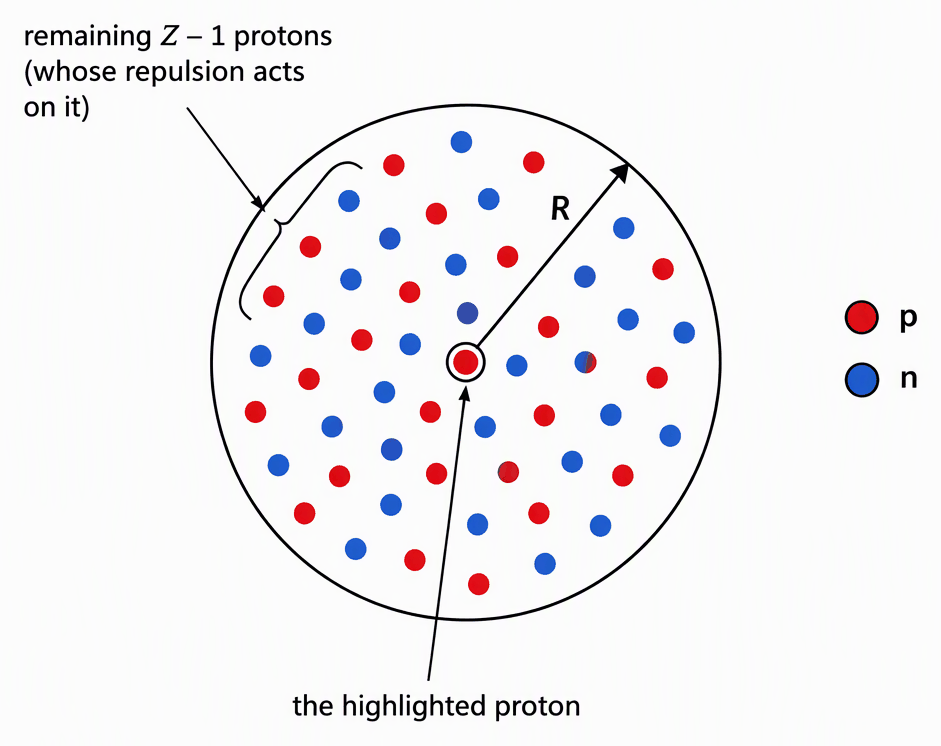
This is JEE Advanced 2022, Paper 1, Physics, a multiple-correct question on nuclear binding energy and Coulomb correction. Medium is the question bank’s difficulty classification, not an official exam rating. Its expected solving time is 180 seconds, also a question-bank estimate, not an official time limit.
The notation is:
The four claims, paraphrased, are:
- A: The binding-energy difference scales with the proton-pair factor:
- B: Its mass-number dependence is:
- C: Proton binding energy exceeds neutron binding energy.
- D: Positron-emitting beta decay increases proton binding energy.
How do you count Coulomb interactions for one proton?
A selected proton interacts with every other proton, so its Coulomb penalty depends on the number of other protons. The whole nucleus’s energy instead counts every distinct proton–proton pair. These are different energy questions and require different counts.
Start with the nuclear radius relation:
Each proton has all the others as possible partners. Multiplying those counts counts each pair twice, so the number of distinct pairs is:
For a uniform distribution, characteristic separations scale with the nuclear radius. The inverse-distance factor in Coulomb energy therefore scales as:
Thus, absorbing the half into the proportionality constant:
This is the total Coulomb energy of the nucleus, not the requested binding-energy difference. For one selected proton, only pairs containing that proton matter; a neutron has no Coulomb repulsion in this model.
Why is the difference negative, and why is B correct?
Repulsion lowers positive binding energy because a less tightly bound nucleon needs less energy to remove. The proton therefore has lower binding energy than the neutron within this Coulomb-correction model. At fixed atomic number, the difference varies inversely with the cube root of mass number.
Introduce a positive proportionality constant:
The binding-energy correction carries a minus sign, even though the repulsion energy itself is positive:
Substitute the radius relation explicitly:
Evaluate the claims separately:
- A is false: the atomic-number factor counts one proton’s interactions, not all pairs:
- B is true: holding atomic number fixed gives the stated mass-number dependence:
- C is false: when proton–proton repulsion exists:
The fixed-atomic-number condition matters. The formula still contains an atomic-number factor; it has not disappeared.
Why does positron emission increase proton binding energy?
Positron emission converts one proton into a neutron. The nucleus retains the same number of nucleons and, under the given radius relation, the same radius. A remaining proton then faces fewer repelling protons, so its Coulomb penalty falls and its binding energy increases within the question’s model.
The nuclear conversion is:
Track composition and size together:
For a selected remaining proton, the other-proton count changes as follows:
Its positive Coulomb penalty consequently changes from:
Reduced repulsion means stronger binding, so D is correct. This follows from the supplied Coulomb-only comparison, not a universal rule for measured nucleon separation energies in arbitrary nuclei.
Verdict: A false, B true, C false, D true. Answer: B and D.
Why does option A use the wrong energy?
Option A results from taking a whole-nucleus expression and treating it as the Coulomb correction for one proton. Even correct radius dependence cannot fix the wrong interaction count. The faulty substitution is:
Compare the two counts directly:
The first count includes pairs that do not contain the selected proton. Those pairs contribute to the whole nucleus’s energy, but cannot be assigned to that proton’s individual Coulomb penalty.
Before applying a nuclear-energy formula, identify the target: the whole nucleus or an individual nucleon. Do this before substituting numbers.
Can you apply the method to three related questions?
Use the radius relation for size changes and the other-proton count for charge changes. These are original practice questions from the same chapter, not additional verified PYQs. Each is hypothetical and follows only from the relations used above.
Question 1: What if the mass number becomes eight times larger at fixed atomic number?
Find the new magnitude of the proton–neutron binding-energy difference. First calculate the radius ratio:
The other-proton count stays fixed, so:
Answer: the magnitude halves; the sign remains negative.
Question 2: How do the counts differ for six protons?
A hypothetical nucleus contains six protons. Its distinct pair count is:
For one selected proton:
Answer: use 15 pairs for total Coulomb energy and five interactions for the selected proton’s penalty.
Question 3: What does beta-minus decay do at fixed mass number?
For a hypothetical beta-minus conversion:
For a selected pre-existing proton, the other-proton count rises:
Its Coulomb penalty increases, so its binding energy decreases within this model. Before checking an answer, write the other-proton count before and after the decay.
Next step: photograph a doubt on JEEnius and photograph any question you are stuck on and get a step-by-step solution, with a free-body diagram when the question needs one (20 free).
Keep going with Alcohols Phenols Ethers Practice Questions JEE: 6 Solved.
Frequently asked questions
What is the answer to the JEE Advanced 2022 nuclear binding-energy question?
The correct options are B and D. In the supplied Coulomb-correction model, the proton–neutron binding-energy difference scales as A^(-1/3) at fixed atomic number, and positron emission increases the binding energy of a remaining proton.
Why is option A wrong in the JEE 2022 binding-energy question?
Option A uses the Z(Z-1) factor associated with the total Coulomb energy of the nucleus. A selected proton interacts with only Z-1 other protons, so its individual Coulomb penalty scales as (Z-1)/R, not Z(Z-1)/R.
Why does the proton–neutron binding-energy difference vary as A^(-1/3)?
In the supplied model, the difference is -K(Z-1)/R, where K is positive and R is the nuclear radius. Substituting R = R0 A^(1/3) gives the A^(-1/3) dependence at fixed atomic number Z. The negative sign means the proton is less tightly bound than the neutron.
Why does positron emission increase proton binding energy?
Positron emission converts a proton into a neutron, reducing Z by one while leaving A and the model's nuclear radius unchanged. A remaining proton then faces Z-2 other protons instead of Z-1, reducing its Coulomb penalty and increasing its binding energy. This conclusion applies to the supplied model, not universally to measured nucleon separation energies.