What is the April 2025 JEE Main hyperbola question?
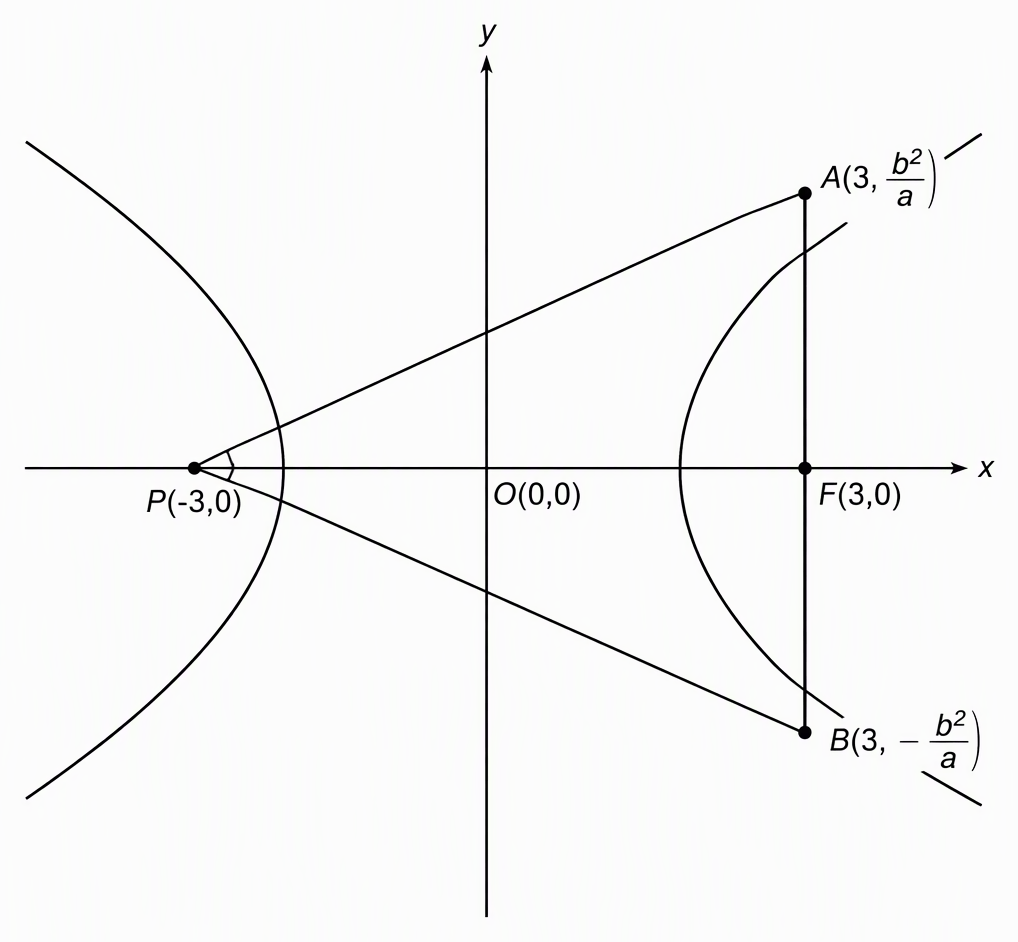
The right angle at the left focus fixes the semi-latus rectum at 6 units in this Conic Sections JEE 2025 question. A hyperbola centred at the origin opens along the horizontal axis; P is its left focus, and the endpoints of the vertical latus rectum through the right focus form a right angle at P.
This is an April 2025 JEE Main Mathematics single-correct question. The question bank rates it hard and assigns an expected-time tag of 300 seconds, not a measured student solving time.
Use the stated focal geometry for the hyperbola:
Express the product in the prescribed form with natural-number coefficients, then find their sum:
The correct choice is A) 1944. Obtaining the surd expression is not the final step: the question asks for the sum of its two coefficients.
How do you find the foci and latus-rectum endpoints?
The other focus lies 3 units to the right of the origin. Both endpoints share that horizontal coordinate because the latus rectum is vertical. Find their vertical coordinates by substituting the focus’s horizontal coordinate into the hyperbola.
For a horizontal hyperbola, the foci and focal relation are:
The given left focus therefore gives:
Substitute the right focus’s horizontal coordinate:
Hence:
The endpoint ordinate magnitude is the semi-latus rectum, not the whole segment. Keep the half-length and full length separate:
Using the full length as an endpoint ordinate doubles the vertical displacement incorrectly.
How does the right angle give an equation?
The vectors from P to the two endpoints are perpendicular, so their dot product is zero. Their horizontal displacement is 6, not 3: each starts at the left focus and ends on the vertical line through the right focus.
Subtract the starting point’s coordinates from each endpoint:
The number 3 is the centre-to-focus distance, not either vector’s horizontal component. Apply the given angle condition:
Both parameters are positive, so take the positive root:
Check this against the geometry:
The endpoints sit 6 units above and below F, matching their 6-unit horizontal displacement from P. The full latus rectum is therefore 12 units long.
How do you solve for the parameters and get 1944?
The required sum is 1944, option A, not either coefficient alone. Combine the focal relation with the equation from perpendicularity, retain the positive root, and expand the product exactly before reading off the coefficients.
Substitution gives:
Apply the quadratic formula:
Reject the negative root because the parameter must be positive:
Now compute the two squared parameters:
Keep the surds exact because the question requires exact coefficients. Expand every term in the product:
Compare this with the prescribed form:
The minus sign belongs to the prescribed expression, so the second natural number is positive. Neither 810 nor 1134 alone answers the question.
Therefore, select option A.
How can a correct calculation still lead to option C?
A solver can reach the correct product, report only the coefficient of the square root, and select C) 810. That answers the intermediate question about the first coefficient, not the requested sum.
The method error is stopping before translating the result into the requested quantity, not using the wrong hyperbola formulas. Selecting 1134 alone likewise reports only the second coefficient.
Write this final-line safeguard before selecting an option:
Then perform the addition. A coefficient matching an option is not enough; it must match what the question asks.
Which three practice questions check the same method?
These original practice questions, not additional verified JEE PYQs, check focus location, endpoint placement and the perpendicular-vector condition. Attempt all three prompts before reading the worked checks. Keep the starting focus explicit when forming each vector.
- Find the foci of the hyperbola:
- Find the endpoints and full length of the latus rectum through the right focus:
- A horizontal hyperbola has the following equation and foci:
Its latus rectum through the right focus subtends a right angle at the left focus. Find:
Worked check 1: Add the squared parameters to obtain the squared focal distance.
Worked check 2: Use the right focus’s horizontal coordinate and the semi-latus rectum for the endpoint ordinates.
Worked check 3: The horizontal displacement between the foci is 2. Apply the same dot product as in the main solution, then retain the positive root.
Before checking your answers, underline the requested quantity in each prompt: foci, endpoints and full length, or parameters.
Next step: photograph a doubt on JEEnius and photograph any question you are stuck on and get a step-by-step solution, with a free-body diagram when the question needs one (20 free).
Keep going with D- and f-Block Elements JEE 2024: Zinc Ion Count in Q.
Frequently asked questions
How do you find the latus-rectum endpoints of a hyperbola?
For the horizontal hyperbola x²/a² − y²/b² = 1, the endpoints through the right focus are (c, ±b²/a), where c² = a² + b². In this question, the left focus is (−3, 0), so c = 3 and the endpoints are (3, ±b²/a). The endpoint ordinate magnitude is the semi-latus rectum b²/a, not the full length 2b²/a.
How does the right-angle condition give b² = 6a?
The vectors from the left focus (−3, 0) to the endpoints (3, ±b²/a) are (6, b²/a) and (6, −b²/a). Their dot product is zero, giving 36 − b⁴/a² = 0. Since a and b are positive, this reduces to b² = 6a.
What is the answer to the April 2025 JEE Main hyperbola question?
The answer is 1944, option A. Combining a² + b² = 9 with b² = 6a gives a = 3(√2 − 1), and the exact product is a²b² = 810√2 − 1134. Thus α = 810 and β = 1134, so α + β = 1944.
Why is 810 not the answer to the hyperbola question?
The question asks for α + β in the prescribed form a²b² = α√2 − β, not just the coefficient of √2. The product 810√2 − 1134 gives α = 810 and β = 1134. Selecting 810 reports only α; the required sum is 1944.