What is the answer to the Coordinate Geometry JEE 2025 square-and-diagonals question?
The answer is 48, option B, because the centre-to-vertex distance is half a diagonal, not a side. This coordinate geometry JEE 2025 question is from JEE Main, April 2025, Shift-02.
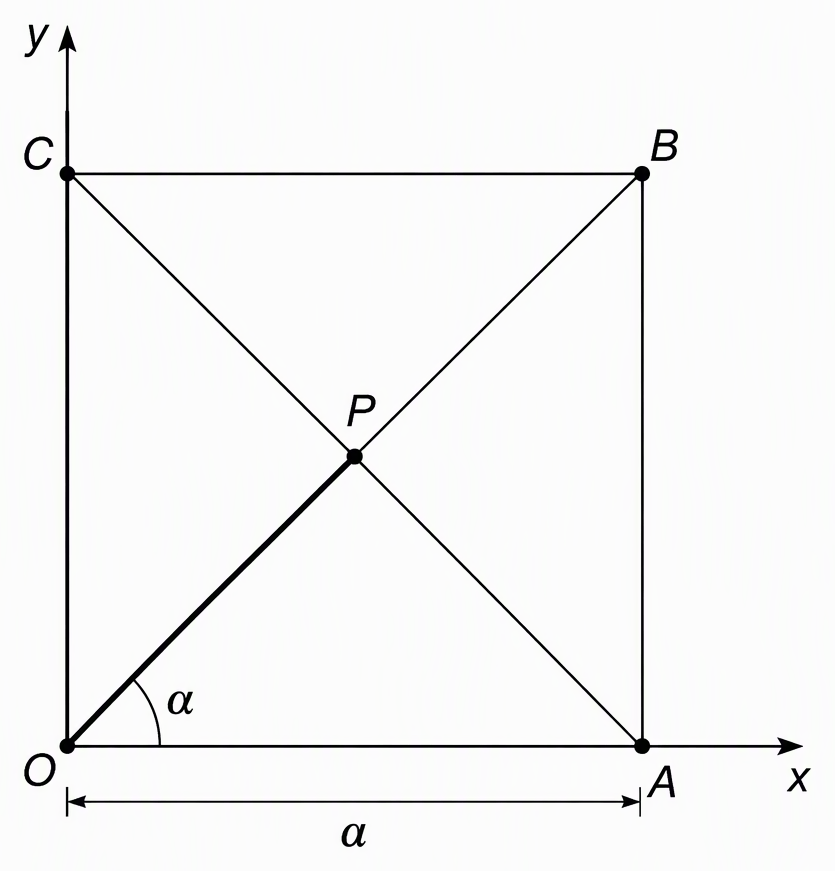
The problem gives square OABC, with its vertices named consecutively and O at the origin. Its side length is labelled a, and side OA makes an acute angle labelled α with the positive x-axis. The two diagonals intersect at the centre P.
The diagonal equations are:
Find the square of the side length:
The question bank tags this problem hard and sets a 120-second target. These are question-bank labels, not NTA difficulty ratings or observed solving times.
How do you solve the diagonal equations to find the centre?
Solve the equations simultaneously: their intersection is the centre because a square’s diagonals bisect each other. The first line passes through the origin, so it is diagonal OB. Its intersection with AC gives P, the midpoint of OB.
Use the official solution’s coefficient substitutions, with different letters to avoid confusion with vertices A and B:
The equations become:
Simplify the coefficient squares first. Their surd terms cancel in the sum:
Multiply the first equation by the first coefficient and the second by the second coefficient:
Add to eliminate the vertical coordinate:
For the vertical coordinate, switch the multipliers:
Subtract the second result from the first:
Therefore, the centre is:
How do you calculate OP and convert it into the side length?
The squared distance from the origin to the centre is 24, but the square’s side squared is twice that value. Follow the official route: calculate OP, derive the diagonal-to-side relation using Pythagoras, then use the midpoint property.
Apply the distance formula from the origin:
Expand both terms explicitly. Their surd terms cancel when added:
In right triangle OAB, the perpendicular sides OA and AB each have the square’s side length. Pythagoras gives:
Since P bisects diagonal OB:
Substitute the calculated distance:
Thus, option B is correct. The acute-angle condition specifies the orientation of OA, but calculating that angle is unnecessary for finding the side squared.
Why does option A, 24, come from a geometry mistake?
Option A results from treating the centre-to-vertex segment as a side. The elimination and distance calculation can both be correct; the error occurs when the calculated distance is assigned to the wrong segment.
The incorrect route is:
O is a vertex and P is the centre. Therefore, OP is half the diagonal, not a side joining two consecutive vertices.
The correct relation is:
Label both endpoints and name the segment before converting a distance into the requested quantity. Write “vertex to centre” beside OP, then write the corresponding side-length relation before substituting the distance.
Which three practice questions test the same method?
These original practice questions, not verified PYQs, test finding the centre, using a supplied centre and handling a vertex away from the origin. In each square, the side squared is twice the squared distance from a vertex to the centre.
Question 1: What is the side squared when a square has a vertex at the origin and these diagonals?
Find the centre by intersecting the given lines, then calculate the squared distance from the origin. The diagonals are:
Substitute the first equation into the second:
Question 2: What are the side length and area when a square has a vertex at the origin and this centre?
Use the supplied centre directly; no simultaneous equations are needed. The centre is:
Take the square root for the side length, not for the area. A square’s area equals its side squared.
Question 3: How do you find the side squared when the given vertex is not the origin?
Find the centre as before, but measure the distance from the given vertex rather than the origin. The vertex and diagonals are:
First verify that V lies on the first diagonal:
Solve the diagonal equations:
When the vertex is not the origin, subtract its coordinates from the centre’s coordinates before squaring. Write “vertex to centre” before applying the distance formula.
Next step: the past-paper archive on JEEnius and search every JEE Main paper from 2002 and every Advanced paper from 2007, by year, subject or chapter, each with a worked solution (free).
Read next: Thermodynamics JEE 2025: Water Electrolysis Work.
Frequently asked questions
What is the answer to the Coordinate Geometry JEE 2025 square question?
The square of the side length is 48, so option B is correct. The squared vertex-to-centre distance is 24, and a square's side squared is twice that value.
How do you find the centre of a square from its diagonal equations?
Solve the two diagonal equations simultaneously because a square's diagonals intersect at its centre. For the given equations, elimination gives P = (√3 − 3, 3 + √3).
Why is 24 the wrong answer in the square-and-diagonals question?
The value 24 is OP², where O is a vertex and P is the centre. OP is half a diagonal, not a side. Since OP = a/√2, the correct relation is a² = 2OP² = 48.
Do I need to calculate the angle alpha to find the square's side?
No, calculating alpha is unnecessary for finding the side squared in this problem. The diagonal equations determine the centre, and the vertex-to-centre distance determines the side length. The acute-angle condition specifies the orientation of OA.