
What is the answer to JEE Advanced 2022 Paper 2 Q7?
The numerical entry is 6 for this Oscillations and Waves, JEE 2022 question. It is Physics, JEE Advanced 2022 Paper 2, Q7, not JEE Main. Time the extension and compression parts separately, including the complete return journey.
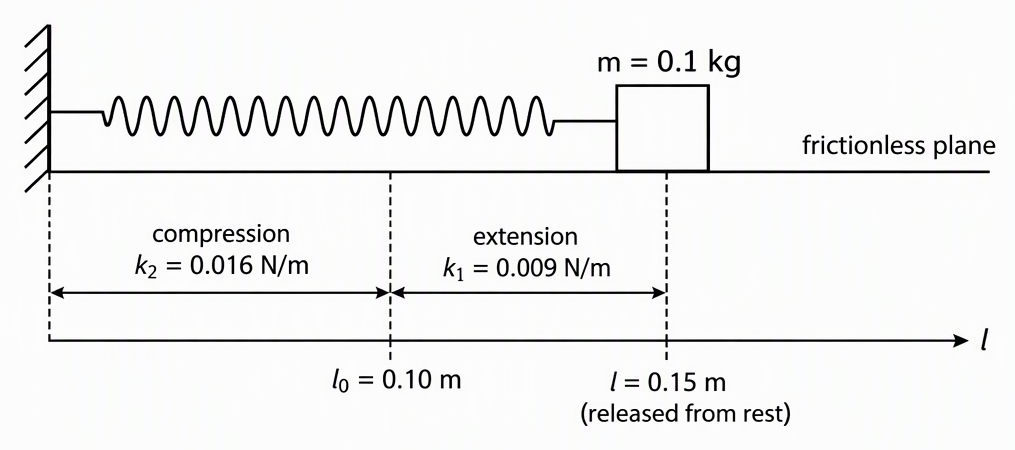
A bob of mass 0.1 kg moves on a frictionless horizontal plane, attached to a spring of natural length 0.1 m. The stiffness is 0.009 N/m during extension and 0.016 N/m during compression. The bob is released from rest at a spring length of 0.15 m, and Hooke’s law applies throughout.
The question asks for the integer nearest the coefficient in:
The exact period is:
How do you calculate the two angular frequencies?
Use each side’s stiffness with the same bob mass. Each side follows SHM with its own angular frequency; the full motion is periodic, but not one sinusoid with a single angular frequency.
Measure displacement from the spring’s natural length:
The restoring force is:
The equilibrium remains:
Following the official solution, calculate the frequencies separately:
The initial extension is:
Release from rest makes this the extension-side turning point. Do not average the stiffnesses: that would replace the given force law with a different one.
Why does one oscillation contain four quarter-cycles?
A complete cycle returns the bob to maximum extension with zero velocity, its initial state. It travels from an extreme to equilibrium or from equilibrium to an extreme four times. Reaching maximum compression completes only half the journey.
The ordered route is:
For SHM, an extreme-to-equilibrium journey advances the phase by:
Its duration, also valid for equilibrium to the next extreme, is:
The four timed legs are:
- Extension extreme to equilibrium:
- Equilibrium to compression extreme:
- Compression extreme to equilibrium:
- Equilibrium to extension extreme:
Here, “quarter-cycle” means one quarter of the SHM period associated with that side, not one quarter of the composite period. At natural length, the bob passes through with nonzero speed; zero restoring force does not mean zero velocity.
The two amplitudes are unequal. Ideal linear-SHM timing is independent of amplitude, so each leg still takes its side’s quarter-period.
Adding the four legs gives:
How do you get the period and numerical entry 6?
Substitute both frequencies, then round only the coefficient of pi. The requested entry is not the period in seconds.
Comparing with the question’s definition:
This does not mean:
As a consistency check:
The compression-side journey therefore takes less time than the extension-side journey. This agrees with the separate leg times.
Why does stopping at maximum compression give the wrong answer 3?
Adding only the first two legs gives half the period and the incorrect entry 3. This is a numerical-answer question with no multiple-choice options; the value below comes from a specific timing error.
Stopping at maximum compression gives:
That produces:
The opposite turning point has zero velocity, but it is not the original position. Equal velocities alone do not identify a completed cycle.
Trace the bob back to its original position with its original velocity before declaring one oscillation complete. Here, that requires both return legs.
Which related questions check whether you understand the method?
Test the minimum length, a different release position and equal stiffness on both sides. These are original related practice questions based on the supplied setup, not verified past-paper questions.
What is the spring’s minimum length?
The minimum length is 0.0625 m. Use conservation of energy between the two turning points, where the kinetic energy is zero:
The compression amplitude is smaller than the extension amplitude because compression is stiffer. Energy conservation is an extension here, not a replacement for the official quarter-cycle period solution.
Does releasing the bob from rest at a spring length of 0.14 m change the period?
No, the period stays unchanged. The new extension amplitude is smaller, but neither angular frequency changes because the mass and both stiffnesses remain unchanged.
The four-leg timing still gives:
What is the period if both stiffnesses are 0.009 N/m?
The period is:
Both sides now have the same frequency. Substituting into the composite formula gives:
Equal stiffnesses recover the standard SHM result:
Use this equal-stiffness limit to check your formula. Then substitute the unequal spring constants.
Next step: photograph a doubt on JEEnius and photograph any question you are stuck on and get a step-by-step solution, with a free-body diagram when the question needs one (20 free).
Keep going with JEE Physics Revision Strategy: A 30-Day Main Plan.
Frequently asked questions
What is the answer to JEE Advanced 2022 Paper 2 Physics Q7?
The numerical entry is 6. The exact period is T = 35π/6 s, so the coefficient in T = nπ s is n = 35/6. Rounding this coefficient to the nearest integer gives 6; the exact period is not 6π s.
How do you find the period when a spring has different stiffnesses in extension and compression?
Calculate the two angular frequencies separately using ω₁ = √(k₁/m) and ω₂ = √(k₂/m). A complete oscillation contains two quarter-period legs on each side, giving T = π(1/ω₁ + 1/ω₂). Do not average the stiffnesses, because that changes the given force law.
Why is 3 the wrong answer to JEE Advanced 2022 Paper 2 Q7?
The entry 3 comes from timing only the journey from maximum extension to maximum compression, which is half an oscillation. This gives 35π/12 s, whose coefficient rounds to 3. A full cycle must return the bob to its original position with its original velocity, so both return legs must be included.
Does releasing the bob at a spring length of 0.14 m change the period?
No, releasing the bob from rest at 0.14 m leaves the period at 35π/6 s. The extension amplitude decreases, but the mass and both stiffnesses remain unchanged. Each side's ideal linear-SHM timing is independent of amplitude.