
How should I revise Physics in the last month for JEE?
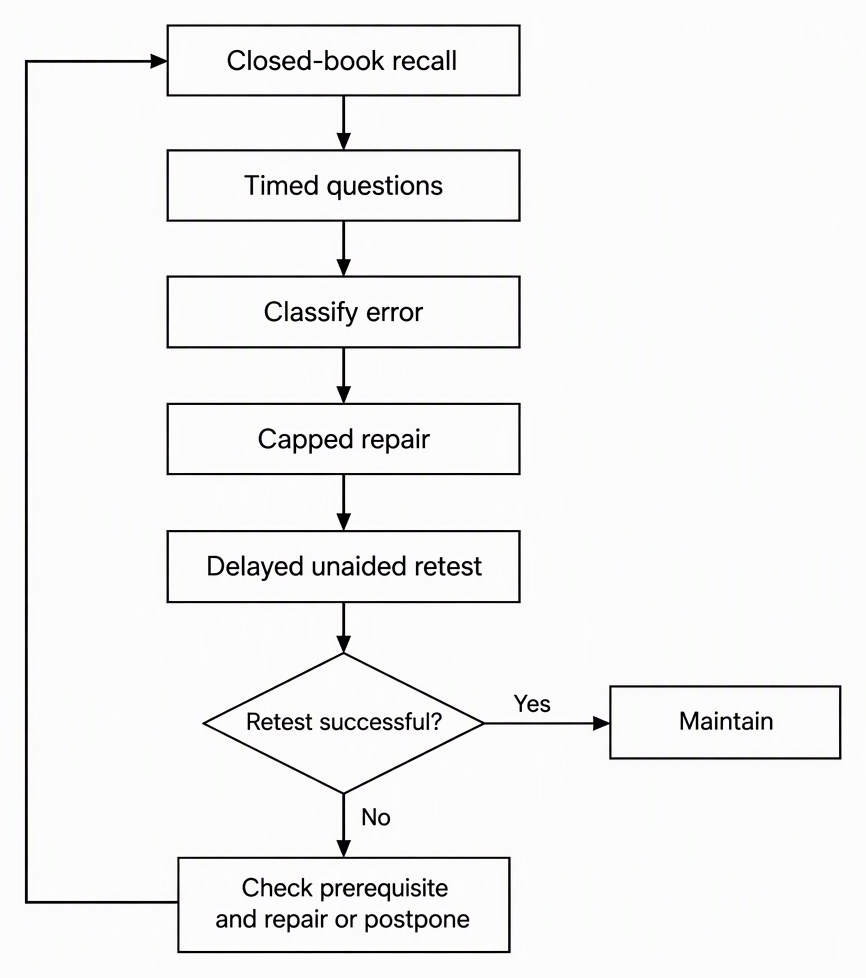
Repair recoverable errors, then check the repair with a delayed test. A useful JEE Physics revision strategy repeats closed-book formula recall, timed questions, error repair and delayed retesting, not another full lecture round. Start with your latest mock’s errors. Use three Physics hours within an eight-hour self-study day as a sample, not a requirement. This plan is Main-first; Advanced needs different questions and testing.
What daily timetable and 30-day calendar should I follow?
Use these blocks on ordinary revision days and replace them on mock days. All hours, practice targets and checkpoints are proposed planning choices, not official requirements or evidence-backed score predictors. This is a full-time revision-day template, not eight additional hours after school or coaching. Shift the clock times around your commitments.
Daily schedule: time; task; required output
- 06:30–07:15; Physics closed-book recall and due retests. Reconstruct formulas without notes; record which scheduled error questions you solved unaided.
- 07:15–08:30; Physics timed practice. Produce an attempted question set and an initial error classification.
- 09:00–10:30; Mathematics. Complete a planned problem set and identify questions needing repair.
- 10:45–12:00; Chemistry. Retrieve the selected material without notes, then check it through questions.
- 14:00–15:00; Mathematics. Repair the morning’s gaps and attempt fresh questions.
- 15:15–16:30; Chemistry. Practise the selected topic and correct errors in your revision notes.
- 17:00–18:00; Physics solution analysis and targeted repair. Record the blocking error, corrected principle and next retest day.
The arithmetic is Physics 3 hours, Chemistry 2.5 hours and Mathematics 2.5 hours: 8 hours total. Gaps are breaks, meals or personal time, not hidden study blocks.
30-day calendar: days; focus; required checkpoint
- Days 1–3; diagnostic sorting. Use existing evidence and short samples to build a maintain, repair or postpone queue.
- Days 4–14; repair and chapter practice. Give each selected gap a capped repair block, fresh questions and a delayed retest.
- Days 15–23; mixed retrieval and retesting. Mix chapters so the question, not the chapter heading, tells you which method applies.
- Days 24–28; exam simulation and recurring-error repair. Use reviewed mock errors to select the remaining repair work.
- Days 29–30; tapering and compact recall. Use shorter blocks for your formula sheet, familiar questions and high-value retests.
Suggested full JEE Main mock days are Days 7, 14, 21, 26 and 28. Replace the ordinary schedule with a 3-hour mock, 2-hour review and 3 hours of targeted work across the subjects. Never add testing on top of the eight-hour day.
Days 29–30 are an explicit exception: reduce the workload, avoid a last-day full mock and protect normal sleep. Relative day numbers make the calendar usable for either Main session.
How do I revise Physics without neglecting Chemistry and Mathematics?
Keep daily contact with all three subjects. JEE Main gives each subject 25 questions and 100 marks, so Physics does not deserve the entire month because it feels weakest. The sample allocation gives it a modest repair allowance while protecting Chemistry and Mathematics practice. Extra Physics time must address an identified gap.
Subject allocation: full-time day; four-hour alternative
- Physics: 3 hours; 90 minutes.
- Chemistry: 2.5 hours; 75 minutes.
- Mathematics: 2.5 hours; 75 minutes.
For the four-hour version, split Physics into 20 minutes of recall and due retests, 40 minutes of questions and 30 minutes of review. Reduce the question count rather than deleting review: unchecked answers give you no basis for selecting the next repair.
Protect Mathematics with a named problem block, not whatever time remains after Physics. Use JEE Maths Revision Strategy: A 30-Day Main Plan to assign that block a separate output.
Use reviewed mock errors to judge whether extra Physics time is productive. Forgotten relations, sign mistakes and familiar calculations that break down justify a temporary repair block. Several missing prerequisites may justify postponement instead.
Adapt the schedule to actual school, coaching and family commitments, not labels such as Class 12 or dropper. Study-hour allocation is not examination-time allocation: do not carry these proportions into the paper. Choose your paper strategy from your timed mock performance.
What mistakes can ruin a last-month Physics revision plan?
The main danger is counting exposure as progress: pages reread, videos watched or mocks completed. Count independent solutions and successful delayed retests instead. A revision task should produce evidence of what you can solve, identify a gap or test a previous repair. Correct these habits before increasing your study hours.
- Passive rereading: Close the notes and reconstruct formulas on a blank page. Check omissions, then solve a fresh question using one of the relations.
- Lecture overload: Identify the exact concept blocking your solution. Watch only the relevant segment, close the video and solve without following along.
- Recognising a solution: Familiarity is not mastery. Require an unaided delayed retest before moving the chapter to maintenance.
- Collecting resources: Retain one concise theory source, one question source and one mistake record. Stop transferring the same content between books.
- Accumulating mocks: Review wrong, guessed and unusually slow correct answers before scheduling more testing. A correct guess still needs investigation.
- Finishing every untouched chapter: Apply a repair-time cap. Postpone chapters whose missing prerequisites cannot fit within it.
- Overfilling the day: Replace ordinary blocks on mock days. Do not borrow from sleep or double tomorrow’s workload after a missed day.
JEE Main has negative marking, so an unfinished revision plan is not a reason to guess indiscriminately. Practise identifying whether you have a valid starting principle before committing time to a question.
Which Physics chapters should I revise first?
Prioritise specific, recoverable gaps before polishing secure chapters or starting the hardest untouched material. Start from the current official syllabus at jeemain.nta.nic.in and your existing notes. Use recent mock and practice evidence, not unsupported chapter-weightage lists. Change a chapter’s place in your queue when fresh attempts or delayed retests justify it.
Use these three states:
- Maintain: You can recall the needed relations and solve independently. Keep the chapter in mixed practice and spaced recall.
- Repair: A specific formula, concept or execution gap blocks otherwise familiar questions. Name that gap and assign a limited task.
- Postpone: Prerequisites are missing, or repeated repairs remain unproductive. Record what must be learnt before reopening the chapter.
Create a tracker with five fields: chapter, recent question evidence, error type, next repair task and retest date. These are illustrative entries, not reported student results:
- Photoelectric effect; confused stopping potential with kinetic energy in an attempted question; concept/units; reconstruct the relation and solve a fresh variant; retest on Day 6 after a Day 4 repair.
- Rotational motion; could not choose the system or identify external torque; concept/prerequisite; check system choice and torque before another attempt; retest on Day 7 if prerequisite work is scheduled on Day 5.
Where recent evidence is absent, try a five-question sample spanning different subtopics. It screens for gaps; it does not prove chapter mastery.
Set a suggested initial repair cap of one 60-minute block, followed by fresh questions. If you still cannot set up a solution, identify the missing prerequisite and explicitly schedule it or postpone the chapter.
Confusing the stopping-potential relation calls for a narrow repair if the rest of the setup is sound. Being unable to choose a system or identify external torque points to prerequisite work. After attempting a relevant question, use Rotational Motion JEE 2021: Torque and Angular Momentum as an optional worked example, not evidence of fixed weightage.
After a missed day, preserve due error retests and the highest-priority repair, drop lower-priority extra practice and resume the calendar. Do not restart Day 1.
What exactly should I do inside each Physics revision block?
Leave a checkable output from every block: a reconstructed formula entry, timed attempts, a short repair record or an unaided retest result. Use closed-book recall to expose gaps, timed questions to test application and repair to correct the blocking step. Require a delayed test because recognising a correction immediately does not establish retention.
Recall formulas with their limits. Include the equation, symbol meanings, validity conditions, units and one common trap:
- Condition: Acceleration must be constant over the interval; use a consistent axis and signed quantities.
- Units: Velocity in metres per second, acceleration in metres per second squared and displacement in metres.
- Trap: Displacement is not automatically the total distance travelled.
Solve, then classify. Split the 75-minute practice block into 45 minutes of timed solving and 30 minutes of initial checking and error classification. Use both single-correct MCQs and numerical-answer questions. Adjust the question count to difficulty rather than forcing speed.
Tag mistakes as concept, formula retrieval, algebra, units/signs or question reading. Reserve the evening block for the most useful repairs, not rereading every solution.
As an optional question source, JEEnius daily practice problems provide a fresh ten-question set on a topic every day, with free sets daily. The set is a source, not a quota you must force into every timed block.
Repair briefly, retest honestly. Each entry needs your wrong step, the corrected principle and a fresh or delayed test, not a copied full solution. An immediate redo checks understanding; a delayed unaided redo checks retention.
A paper notebook works: record the question reference, correction and next retest day. If a retest falls after exam day, do not force it into an overloaded final day; prioritise remaining tests that address recurring, repairable errors.
How should mocks change my plan, and what changes for JEE Advanced?
Use each mock to select the next repair blocks, not simply collect another score. Compare your own successive attempts for recurring errors, retention and time use. For Advanced, retain the repair-and-retest loop but change the questions and simulation schedule. Do not apply Main’s question counts or marking rules to Advanced.
JEE Main Paper 1 simulation specification
- Duration and mode: 180 minutes, or 3 hours; use a computer-based interface where available.
- Questions and marks: 75 questions and 300 marks overall; 25 questions and 100 marks per subject.
- Question types per subject: 20 single-correct MCQs and 5 numerical-answer questions.
- Marking: Award 4 marks for a correct answer, deduct 1 for a wrong answer and award 0 for an unattempted answer.
Select papers aligned with the current official syllabus. There is no optional question selection within the prescribed set, but you can still leave an answer unattempted for zero marks. Blind attempts are not required or sensible.
Record attempted, correct, wrong and unattempted Physics questions, recurring error categories and unusually slow correct solutions. Flag guessed answers, including correct ones. Compare these records with your previous attempts, not invented percentile benchmarks.
Separate revision failure from paper-management failure. Forgetting a relation needs retrieval practice; staying on an unproductive question needs a skip-and-return rule. Practise moving on when you have no workable setup, then returning after accessible questions.
For Days 29–30, check readiness through evidence, not a promised score increase:
- Previously repaired questions survive delayed, closed-book retests.
- The same errors recur less often in fresh attempts.
- Your compact formula sheet contains conditions and traps you can explain.
- Familiar representative questions can be solved without reading solutions.
Prioritise that sheet, familiar questions and remaining high-value retests. Avoid new resources and major untouched chapters.
Advanced has two compulsory three-hour papers and no fixed question or marking pattern. Follow each selected paper’s instructions and marking scheme. For an Advanced-focused month, use multi-concept problems and include a two-paper simulation day; replace ordinary blocks with those six testing hours and schedule review separately rather than adding testing to the Main timetable.
For an optional retest system, the JEEnius mistake notebook automatically saves every wrong question and returns it at 1, 3, 7 and 14 days until you answer it correctly three times; it is free and unlimited. Tonight, record your highest-priority wrong question, its corrected principle and the day you will solve it again without help.
Next step: the mistake notebook on JEEnius and every question you get wrong is saved automatically and returned to you at 1, 3, 7 and 14 days until you get it right three times (free, unlimited).
Frequently asked questions
How should I revise JEE Physics in the last 30 days?
Start with errors from your latest mock and identify gaps you can realistically repair. Repeat closed-book formula recall, timed questions, targeted repair and delayed unaided retests. Move towards mixed practice and exam simulation, then reduce the workload during the final two days.
How many hours should I study Physics daily in the last month?
The sample full-time revision day assigns Physics 3 hours, with 2.5 hours each for Chemistry and Mathematics. For a four-hour study day, use 90 minutes for Physics: 20 minutes of recall and due retests, 40 minutes of questions and 30 minutes of review. These are planning templates, not requirements or extra hours to add after school and coaching.
Which Physics chapters should I revise first for JEE?
Prioritise chapters with specific, recoverable gaps shown by recent mocks or practice, rather than relying on unsupported weightage lists. Classify chapters as maintain, repair or postpone. Try an initial 60-minute repair block followed by fresh questions; if you still cannot set up a solution, schedule the missing prerequisite or postpone the chapter.
How many JEE Main mocks should I take in the last month?
The proposed calendar schedules five full mocks on Days 7, 14, 21, 26 and 28. Each mock day replaces ordinary study blocks with a three-hour test, two-hour review and three hours of targeted work across subjects. Review wrong, guessed and unusually slow correct answers rather than merely collecting scores.
Can I use this Physics revision plan for JEE Advanced?
Keep the recall, repair and delayed-retest loop, but use multi-concept problems and Advanced-specific papers. Advanced has two compulsory three-hour papers with no fixed question or marking pattern, so follow each paper's instructions. Replace ordinary blocks with a two-paper simulation and schedule review separately rather than adding six testing hours to the Main timetable.