
What order should I study Magnetism in for JEE?
Study Magnetism for JEE as a source–field–response chain: what creates the field, where it points, and what it does. Start with these dependencies, not another complete rereading.
Step 1: Check four prerequisites. Try these without notes:
- Find a cross-product direction using the right-hand rule.
- Resolve a velocity into components parallel and perpendicular to a given direction.
- Use the centripetal-force relation for circular motion.
- Apply equal voltage across two parallel resistors to relate their currents.
Revise only the prerequisite that fails. A current-division mistake does not require restarting vectors, and a direction mistake does not require rereading Current Electricity.
Step 2: Follow this learning sequence. Each stage supplies tools for the next.
- Fields due to currents.
- Forces on moving charges and current-carrying conductors.
- Charged-particle motion.
- Current loops, magnetic dipoles and galvanometers.
- Magnetism-and-matter concepts included in your target exam syllabus.
A force calculation often needs a field calculation first; particle motion then uses that force. Galvanometer conversion adds a separate dependency: current division.
Step 3: Use a closed-book learning cycle. Study one derivation or explanation, close the source, and reproduce its diagram and assumptions. Attempt an unfamiliar problem before moving on.
Use NCERT explanations for conceptual reading, particularly magnetism and matter. Reading completion is not problem-solving readiness: progress when you can solve an unfamiliar problem and explain why its equation applies without looking at the solution.
How do I choose the right Magnetism equation?
Choose the equation after identifying the source, field geometry and responding object. Treat finding the field and calculating its effect as separate decisions.
Step 4: Make the geometry explicit. Draw the source, observation point and coordinate axes. Mark current, velocity and magnetic-field directions before substituting values.
For a wire, identify the perpendicular distance to its axis. For a coil, distinguish its plane from its normal.
Step 5: Determine the field. Choose the method from the source geometry:
- Biot–Savart law: use it for current elements and suitable wire or arc geometries, with integration when required.
- Ampère’s law: use it to extract the field when symmetry makes the integral useful, such as an ideal infinitely long straight wire.
- Superposition: calculate each contribution and add fields as vectors, not automatically as positive magnitudes.
Ampère’s law remains valid for steady currents even without enough symmetry. It may simply be inconvenient for calculating the field.
Attach assumptions to shortcuts. For an ideal infinitely long straight wire, using the perpendicular distance from its axis:
Step 6: Identify the response. Match the relation to the object:
- Moving charge:
- Straight conductor in a uniform field: the length vector points along the current.
- Magnetic dipole: for a coil, the area normal follows the right-hand rule.
For non-relativistic motion under only a uniform magnetic field, use perpendicular velocity, not total speed, for the circular radius. The parallel component does not contribute to magnetic force.
Step 7: Check direction, dimensions and one limiting case. A magnetic field acting alone leaves a particle’s speed and kinetic energy unchanged.
A wrong field points to a source or geometry error. A correct field but wrong force usually points to the cross product or charge sign.
Where do the magnetic fields of two parallel wires cancel?
For same-direction currents, cancellation is possible between the wires, closer to the weaker-current wire. Establish that region before equating magnitudes. The following is an illustrative problem, not a claimed previous-year question.
Two ideal infinitely long wires have positions and currents:
Find the zero-field point on the line joining them. By the right-hand rule, their fields oppose between the wires and reinforce outside them.
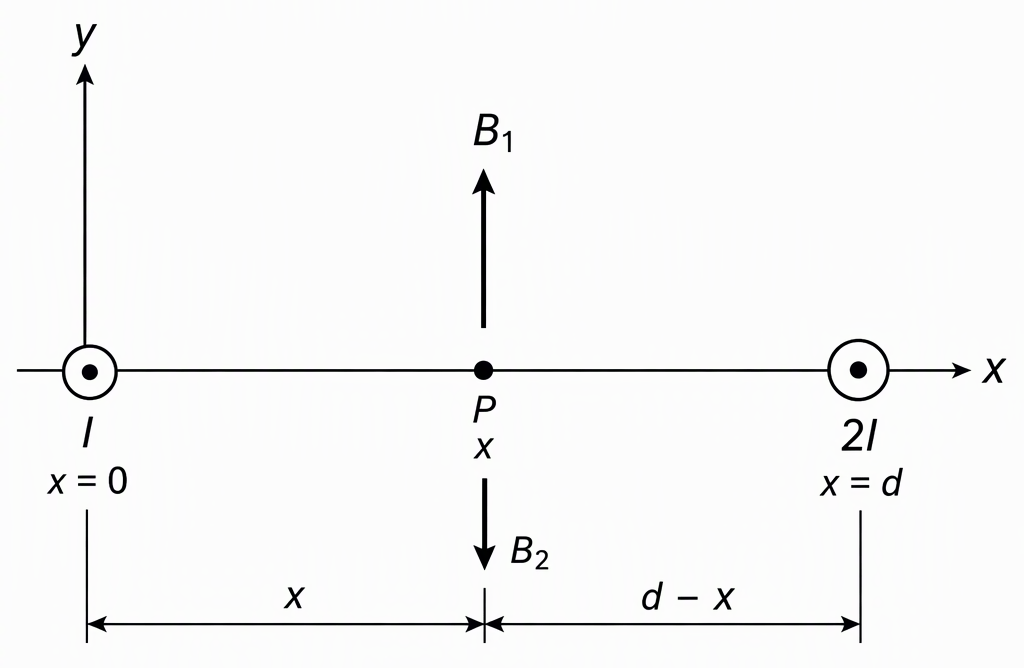
Within the allowed region, equate magnitudes:
The result is measured from the weaker-current wire. It passes the physical check: the weaker source must be nearer for its field to match the stronger source.
Transferable lesson: decide where cancellation is possible before writing a magnitude equation. Equal magnitudes alone do not establish a zero vector sum.
For optional follow-up, JEEnius daily practice problems provide a fresh ten-question set on a topic every day, with free sets daily. Use the set to check field directions before doing arithmetic.
What happens when a charged particle enters a magnetic field obliquely?
The perpendicular velocity component produces circular motion, while the parallel component stays unchanged. Together they produce a helix. Consider an illustrative non-relativistic particle with positive charge in a uniform magnetic field, with no other force acting:
The initial force points along the negative y-direction:
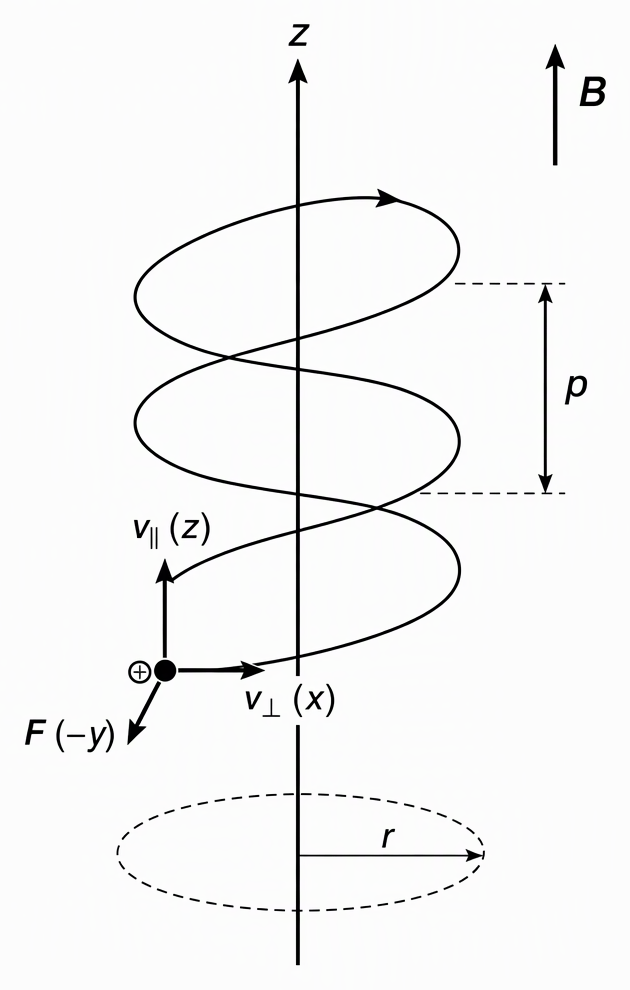
The perpendicular force supplies centripetal acceleration:
The period follows from one circular revolution:
During that time, the unchanged parallel component carries the particle forward by one pitch:
With zero parallel component, the path is a circle. With zero perpendicular component, the force vanishes and the path is straight along the field.
Two errors need separate correction: using total speed in the radius formula and claiming the magnetic force increases kinetic energy. The force remains perpendicular to velocity and does no work; reversing the charge reverses the initial force direction.
How do I convert a galvanometer into an ammeter?
Connect a shunt in parallel so that excess current bypasses the galvanometer. This is a circuit problem once the full-scale current is known. The instrument’s magnetic operation does not require another torque calculation.
For an illustrative galvanometer, let its resistance, full-scale current and desired ammeter range be:
At full scale, the branch currents are:
Equal voltage across the parallel branches gives:
For a numerical example, use these illustrative values:
Substitution gives:
This small resistance is sensible: almost all the current must bypass the instrument. Increasing the desired range increases the denominator, so the required shunt resistance decreases.
Do not confuse this parallel shunt with the series resistance used for voltmeter conversion. Next, try Magnetism JEE 2018: Galvanometer Shunt Resistance and derive the branch-current equation before substituting.
What should I practise next to find my weak concepts?
Begin with isolated direction and field drills; progress when you can explain the equation and its conditions without notes. Choose the next task from your errors, not an arbitrary question-count target.
- Isolate basics: right-hand-rule directions, negative charges, wire and loop fields, and vector superposition.
- Vary the examples: unequal or reversed wire currents, perpendicular and oblique particle entry, and galvanometer range changes.
- Fill the remaining areas: force between parallel currents, coil torque, magnetic-dipole potential energy, and magnetism-and-matter concepts listed in your target syllabus.
Move from direct JEE Main previous-year questions to multi-stage JEE Advanced problems combining field calculation with motion, equilibrium or geometry. These are useful practice combinations, not a prediction of a fixed Advanced question pattern.
Tag each wrong attempt by its cause. Use the tag to choose what to repair:
- Direction: incorrect right-hand rule or missed charge sign.
- Geometry: wrong distance, angle or component.
- Model selection: an equation used outside its conditions.
- Prerequisite: weak vectors, circular motion or current division.
- Algebra: incorrect rearrangement, substitution or units.
Reattempt the mistake from a blank page, then solve a related unseen problem before treating the weakness as repaired. Unseen questions test transfer; deliberately revisiting mistakes is a separate revision task.
As an optional way to find fresh questions, practice mode offers topic sets that skip questions already seen, with free sets included. Choose the topic linked to your latest error, and keep the failed question for a separate blank-page reattempt.
Next step: practice mode on JEEnius and practise a topic in sets that skip questions you have already seen (free sets included).
Frequently asked questions
In what order should I study Magnetism for JEE?
Start with fields due to currents, then forces on moving charges and current-carrying conductors, followed by charged-particle motion. Next study current loops, magnetic dipoles and galvanometers, then magnetism-and-matter concepts included in your target exam syllabus. This sequence follows the dependencies from field sources to their effects.
What prerequisites do I need before studying Magnetism?
Check cross-product directions, resolution of velocity into parallel and perpendicular components, centripetal force, and current division in parallel branches. Test these without notes and revise only the prerequisite that fails. A current-division error does not require restarting vectors.
How do I choose the right formula in Magnetism problems?
Identify the field source, draw the geometry and mark all relevant directions before substituting values. Choose Biot–Savart law, Ampère’s law or superposition to determine the field, then select the force or torque relation for the responding object. Check the equation’s assumptions, dimensions and one limiting case.
How should I practise Magnetism for JEE Main and Advanced?
Begin with isolated direction, field and vector-superposition drills, then vary wire currents, particle-entry angles and galvanometer ranges. Progress from direct JEE Main previous-year questions to multi-stage JEE Advanced problems. Classify mistakes by direction, geometry, model selection, prerequisite or algebra, then reattempt each failed question and solve a related unseen problem.