
How should I start studying Kinetic Theory for JEE?
Study Kinetic Theory for JEE by separating molecular quantities from bulk quantities before choosing a formula. Keep the mass of one molecule, molar mass and total sample mass distinct. Begin each problem with these three steps.
- Establish the model and constraints. Use the ideal-gas model at equilibrium temperature, with elastic collisions and isotropic random motion, meaning no direction is preferred. Record what stays fixed: particle number, volume, pressure or temperature. These constraints decide which ratios are valid.
- Count particles correctly. Keep molecule count and amount in moles separate. Define your symbols before substituting:
The molecular and molar forms describe the same gas. Choose the form that matches the quantities supplied:
Use kelvin throughout. For absolute SI calculations, match the mass convention to the gas constant:
- Connect pressure to molecular motion. Pressure comes from momentum transferred to container walls. Equal mean-square velocity components give the factor of one-third:
Pressure uses mean-square speed, not the square of mean speed. Isotropic random motion gives zero mean velocity, not zero mean speed.
Derive pressure from momentum transfer once, then combine it with the ideal-gas law to derive mean translational energy. Understand those derivations; do not reproduce them before every practice problem.
How do I choose the right energy or speed formula?
Choose the quantity asked, then simplify with ratios. Mean translational energy is per molecule; internal energy belongs to the whole sample and includes all active modes. For speed, distinguish most probable, mean and rms values before substituting.
- Choose the energy and active degrees of freedom. Mean translational energy per molecule depends only on temperature:
Total internal energy includes all active quadratic degrees of freedom. Use the stated model and temperature regime to select them:
- Monatomic gas: three active degrees of freedom.
- Rigid diatomic gas with vibrations inactive: five active degrees of freedom.
Do not assume five from “diatomic” alone at every temperature. Only when heat capacities are needed, use these molar quantities:
- Take ratios before inserting constants. Use the stated constraints to decide which factors cancel:
- Most probable speed:
- Mean speed:
- Root-mean-square speed:
For collision questions, use number density and molecular collision diameter. In the dilute, identical-molecule model:
At fixed diameter, the ideal-gas law gives:
Heating at fixed volume and particle number leaves number density unchanged. Mean free path therefore does not change.
- Check dimensions, constraints and direction. A hotter sample of the same gas has higher rms speed. A heavier species at the same temperature has lower rms speed but equal mean translational energy. Check that the quantity under the speed formula’s square root has dimensions of speed squared:
Does the faster gas have more kinetic energy?
Equal-temperature ideal gases have equal mean translational energy per molecule, even when their rms speeds differ. This original illustrative problem, not a previous-year JEE question, compares ideal helium and oxygen at the same temperature. Find their rms-speed ratio and mean translational-energy ratio using the supplied molar masses:
First identify the common temperature. It cancels from the speed ratio:
Mean translational energy depends only on temperature, not molecular mass. Its ratio is therefore:
The common molar-mass units cancel in the speed ratio. Absolute speeds calculated with the SI gas constant require kilograms per mole.
The wrong turn is treating energy as proportional to speed. Translational energy depends on molecular mass times mean-square speed:
For a transfer check, quadruple one sample’s kelvin temperature without changing its species. Its rms speed doubles, while its mean translational energy becomes four times as large:
How does a piston change pressure when density also changes?
Track both density and mean-square speed: pressure is proportional to their product. In this original illustrative problem, a fixed amount of ideal gas is compressed to half its initial volume and ends at twice its initial absolute temperature. Find the density, rms-speed and pressure ratios.
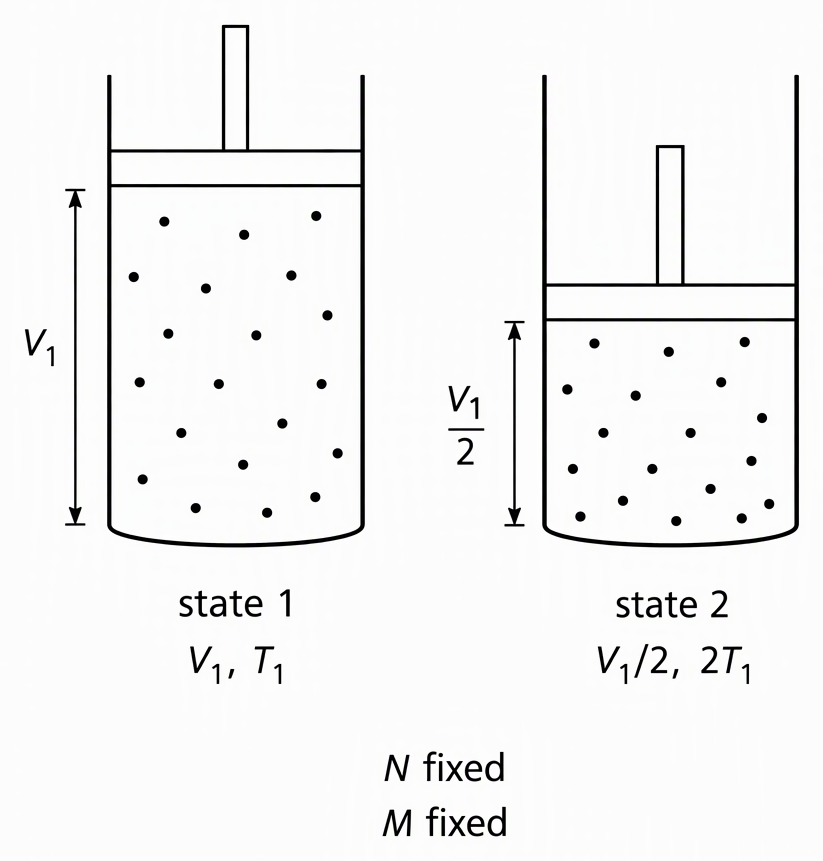
Record the fixed quantities and endpoint data. Do not assume an isothermal or adiabatic process:
Constant sample mass makes density inversely proportional to volume. With the gas species fixed, rms speed depends on the square root of temperature:
Use the molecular-pressure equation, retaining the density change. The factor of one-third cancels:
Cross-check through the ideal-gas law. The amount in moles is fixed:
Using only the speed-squared change incorrectly gives a pressure ratio of two. Density doubled too.
For fixed molecular diameter, mean free path is inversely proportional to number density. Number density doubles here, so mean free path halves:
How do I find internal energy and gamma for a gas mixture?
Add species energies and heat capacities before calculating the mixture’s ratio. In this original illustrative problem, an ideal mixture contains equal mole amounts of a monatomic gas and a rigid diatomic gas at a common temperature, with vibrations inactive. Find total internal energy, mixture molar heat capacity at constant volume and gamma.
The amount of each component and the common temperature are:
The components have three and five active degrees of freedom. Add their energies:
Keep the amounts and active modes unchanged when differentiating with respect to temperature. This gives the total heat capacity:
Divide by total moles to obtain the molar heat capacity. The mixture contains twice the stated component amount:
Do not mistake the coefficient in total internal energy for molar heat capacity. For this ideal mixture:
Both species contribute translational energy. Only the diatomic component contributes rotational energy here:
Do not average the species’ gamma values. A ratio of summed heat capacities is not the average of their ratios. The calculated result passes the limiting check:
Being between the component values supports the answer, but does not replace the calculation. For follow-up practice, JEEnius daily practice problems provide a fresh ten-question set on a topic every day, with free sets daily.
What should I practise after learning these formulas?
Move to mixed questions only when you can explain your equation choice and solve an unseen variant. First read the relevant NCERT explanations, reproduce the pressure-to-energy connection without looking, then reconstruct the formula map from memory.
Practise in this order:
- Mass and unit conversions.
- Temperature–speed ratios.
- Pressure–density changes.
- Translational versus total energy.
- Heat capacities and mixtures.
- Mean-free-path constraints.
Next, attempt chapterwise JEE Main previous-year questions. Then move to multi-concept and assumption-sensitive JEE Advanced questions.
Keep an error log with specific labels:
- Wrong mass convention.
- Celsius used.
- Mean speed confused with rms speed.
- Changing density ignored.
- Wrong active degrees of freedom.
After an error, write the missed condition and solve an unseen variant. Recognising a repeated answer is not a progression test.
JEEnius practice mode offers topic sets that skip questions already seen, with free sets included. Use an unseen set after correcting your logged errors.
Before moving on, explain aloud why different-mass gases at equal temperature have equal mean translational energy but unequal rms speeds. Then state the constraint needed for:
Your explanation must say that particle number per unit volume is fixed, for example, in a sealed rigid container. Without that condition, temperature alone does not determine pressure.
Next step: daily practice problems on JEEnius and get a fresh ten-question set on a topic every day (free sets daily).
Read next: Real-valued Functions JEE 2024: Continuity at Zero.
Frequently asked questions
How should I start studying Kinetic Theory for JEE?
Start by distinguishing molecular mass, molar mass and total sample mass, along with molecule count and amount in moles. Record which quantities stay fixed before selecting an equation, and use kelvin throughout. Derive pressure from molecular momentum transfer once, then combine it with the ideal-gas law to obtain mean translational energy.
Do gases at the same temperature have the same rms speed?
No: rms speed is proportional to the square root of temperature divided by molar mass, so a heavier species moves more slowly at the same temperature. Equal-temperature ideal gases still have equal mean translational energy per molecule. Helium has 2√2 times the rms speed of oxygen at the same temperature, but their mean translational-energy ratio is one.
How do I calculate gamma for an ideal gas mixture?
Add the component heat capacities at constant pressure and at constant volume separately, then divide the two totals; do not average the component gamma values. For equal mole amounts of a monatomic gas and a rigid diatomic gas with vibrations inactive, the mixture's molar heat capacities are 2R at constant volume and 3R at constant pressure. Its gamma is therefore 3/2.
What should I practise after learning Kinetic Theory formulas?
Practise mass and unit conversions, temperature–speed ratios, pressure–density changes, translational versus total energy, heat capacities and mixtures, then mean-free-path constraints. Follow these with chapterwise JEE Main previous-year questions before attempting multi-concept JEE Advanced questions. Label each error by its cause, write the missed condition and solve an unseen variant before moving on.