
How should I study indefinite integration for JEE in seven steps?
- Repair only the prerequisites that block recognition. For indefinite integration for JEE, test the chain rule, product rule, logarithmic and inverse-trigonometric derivatives, polynomial division, factorisation and basic trigonometric identities through short tasks. Do not restart all of calculus.
Differentiate these three expressions, stating the rule used:
Then divide the first expression below, factor the second and simplify the third:
- Build a compact reverse-derivative sheet. Include powers, reciprocals, exponentials and elementary trigonometric functions. Every entry needs its constant of integration:
Add the standard inverse-trigonometric forms and a scale-factor rule:
Use formulas on intervals where the integrand is real and defined. Pair each formula with its cue, especially these two; a constant multiple of the required derivative is enough:
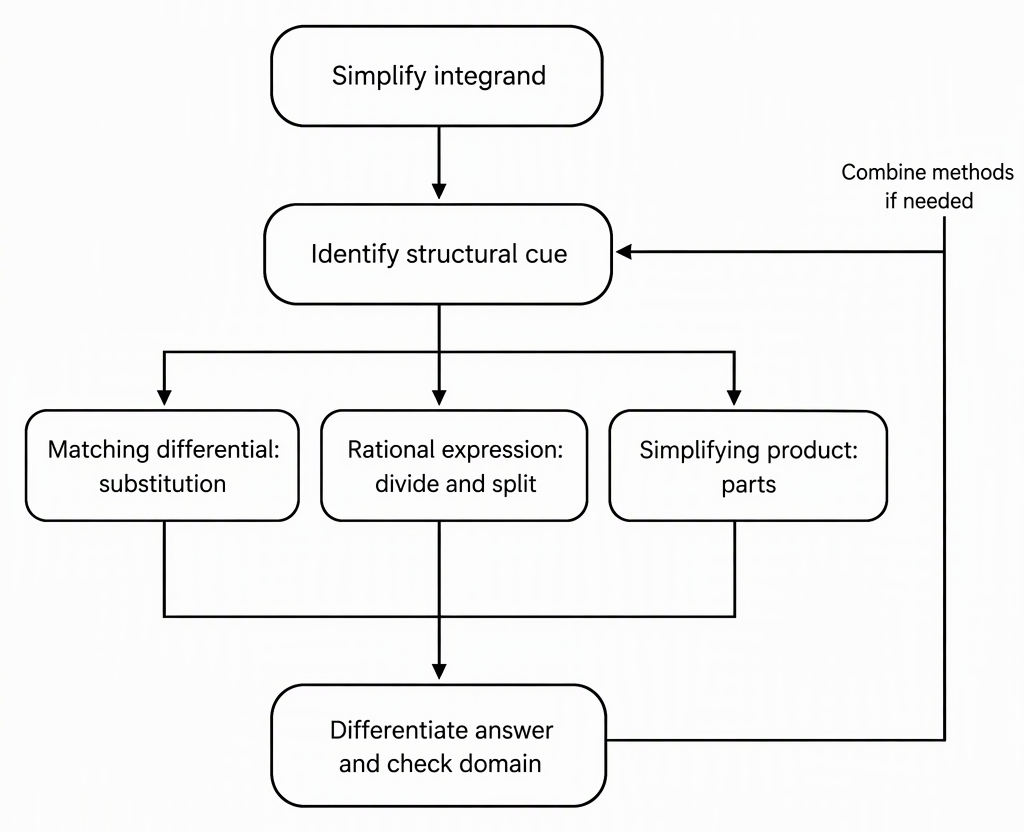
- Simplify before choosing a technique. Expand or factor only if it exposes a useful structure. Use trigonometric identities selectively, and divide an improper rational function before considering partial fractions.
- Test substitution by checking the differential. Name the inner expression and check whether its derivative is present, allowing a constant factor. Brackets or a square root alone are not evidence for substitution.
- Inspect rational functions structurally. Compare degrees, seek a denominator-derivative component, then factor or complete the square. Partial-fraction denominators must follow the factorisation, including every power of a repeated factor:
- Choose parts only when the remaining integral becomes simpler. Differentiating one factor should help, while integrating the other should be manageable:
LIATE suggests which factor to differentiate: logarithmic, inverse-trigonometric, algebraic, trigonometric, exponential. It is a heuristic, not an automatic instruction.
- Differentiate your answer and preserve its domain. Include the arbitrary constant. Keep logarithmic absolute values unless positivity is established.
These are useful checks, not a theorem demanding one fixed order; some integrals combine methods. Before calculating, write “visible cue, proposed first move, reason”; after checking, classify any error as recognition, algebra or differentiation.
How do I recognise a hidden derivative in a trigonometric integral?
The denominator contains cosine, and its derivative is negative sine, which is present up to a sign. Choose substitution, not a trigonometric identity: matching the complete differential gives a standard arctangent form.
Set the inner expression equal to a new variable and carry the minus sign with its differential:
The transformed integral is:
Check explicitly by the chain rule:
Tangent-half-angle substitution also works, but introduces a rational expression and avoidable algebra. I would choose the direct substitution because it reaches a standard form immediately.
Finding an inner function is only half the job: match its complete differential, including the sign. A missing minus sign is an execution error, not evidence that the method was wrong.
What should I do when a rational integral has equal numerator and denominator degrees?
Divide before attempting substitution or partial fractions: equal degrees mean the fraction is improper. Then split the remaining numerator into a denominator-derivative term and a remainder. This example needs division, a logarithm and an inverse-trigonometric form, not elaborate partial fractions.
Division gives:
Split the remaining numerator:
The first term is half the denominator’s derivative. For the leftover term, complete the square:
Integrate the matching derivative and the remainder separately:
The logarithm needs no absolute-value bars because its argument is positive for every real input. Differentiation reconstructs the original fraction:
As a numerical spot-check at zero, both expressions give:
That spot-check does not replace symbolic verification. The tempting incomplete move is substituting the denominator immediately: its differential does not absorb the entire numerator. Isolate the matching derivative and handle the remainder.
For follow-up practice, JEEnius daily practice problems provide a fresh ten-question set on a topic every day, with free sets daily.
When should substitution come before integration by parts?
Substitute first when a factor matches the differential of an inner expression. Here, the linear factor supplies that match up to a constant, leaving a simpler parts problem. A product alone is not a reason to begin with integration by parts.
Choose the expression inside the logarithm; it is positive throughout the original real domain:
The substitution gives:
Apply parts with the logarithm as the factor to differentiate:
Multiplying its derivative by the integrated factor leaves one, so the remaining integral is simpler:
Back-substitute and absorb the constant term into the arbitrary constant:
The absorbed constant is:
Differentiate to check:
Direct parts also works with these choices:
Reversing those roles requires integrating the logarithmic factor first, a harder intermediate task. I would substitute first because it exposes the simpler integral before any parts calculation.
A successful substitution need not finish the question. It may remove one layer and reveal a second technique.
What should I practise until I can solve unlabelled integration questions?
Start with short method-labelled sets to learn execution, then remove the labels. A substitution worksheet tests execution, not whether you can recognise substitution. Use this progression:
- Direct reverse-derivative forms.
- Substitution.
- Rational functions and partial fractions.
- Integration by parts.
- Trigonometric transformations.
- Mixed-method questions.
Before full solving, write the structural cue, first move and why it should simplify the integral. Compare this pair:
The same inner substitution finishes the first but leaves a parts problem in the second. The first becomes:
Keep three error-log categories:
- Wrong method cue: the proposed move did not simplify the integral.
- Algebra/sign mistake: the method worked, but execution failed.
- Incorrect antiderivative or domain handling: differentiation failed, or restrictions were lost.
Re-solve every logged mistake with the solution hidden. Adjust your starting point:
- Class 11: check prerequisites before starting.
- Class 12: mix older methods into current practice.
- Droppers: use an unlabelled diagnostic before repeating familiar worksheets.
Next, attempt topic-wise JEE Main PYQs, then selected JEE Advanced PYQs and mixed revision. This is a study progression, not a claim that the exams use separate techniques.
You are ready when you can justify a first move, finish and verify an unlabelled problem without hints. Use unseen questions to test recognition, but keep a separate error notebook for deliberate re-solving.
JEEnius practice mode offers topic sets that skip questions already seen, with free sets included.
Next step: daily practice problems on JEEnius and get a fresh ten-question set on a topic every day (free sets daily).
If that step was the hard part, work through Free JEE Main Mock Test: Mocks vs Previous-Year Papers.
Frequently asked questions
What should I revise before starting indefinite integration for JEE?
Test the chain rule, product rule, logarithmic and inverse-trigonometric derivatives, polynomial division, factorisation and basic trigonometric identities. Repair only the gaps that prevent you from recognising an integrand's structure; do not restart all of calculus.
How do I choose between substitution and integration by parts?
Test substitution when an inner expression's derivative is present, allowing a constant factor. Choose integration by parts when differentiating one factor helps and integrating the other is manageable. A product alone does not justify parts, and substitution may reveal a simpler parts problem.
What order should I practise indefinite integration questions in?
Start with direct reverse-derivative forms, then substitution, rational functions and partial fractions, integration by parts, trigonometric transformations and mixed-method questions. Use short method-labelled sets first, then remove the labels to test recognition. Follow with topic-wise JEE Main PYQs, selected JEE Advanced PYQs and mixed revision.
How do I check whether my indefinite integral answer is correct?
Differentiate your answer and verify that it reproduces the original integrand on the relevant domain. Include the arbitrary constant and retain logarithmic absolute values unless positivity is established. A numerical spot-check can catch errors, but it does not replace symbolic verification.