
Which free JEE Main mock test should I choose?
Choose a free JEEnius full-length mock for a scored full-paper attempt; choose an untouched previous-year paper under timed conditions when actual exam-question practice is the priority. For a fresh baseline, pick a free JEE Main mock test whose questions you do not recognise. Familiar questions make either route less useful as an independent diagnosis.
JEEnius includes free tests among its full-length mocks: 75 questions, 300 marks, 180 minutes and a scored per-subject breakdown. This does not mean every test is free or attempts are unlimited.
An untouched previous-year paper, attempted with a timer and checked against its answer key, gives you practice with actual exam questions. Neither route is automatically a better baseline: question familiarity and test conditions matter more than the label.
How does a free online mock compare with a timed previous-year paper?
The online route gives you a scored subject breakdown; the self-administered previous-year route gives you actual exam questions but requires answer-key checking. Neither automatically gives a clean measure of readiness. That depends on question familiarity, syllabus coverage and whether you preserve the timed conditions.
- Paper pattern
- JEEnius free full-length mock: 75 questions, 300 marks and 180 minutes.
- Timed previous-year paper plus answer key: Check the structure used in that year. An older paper may not follow the current pattern.
- Question source
- JEEnius free full-length mock: The supplied facts do not establish question source or originality. Do not assume every question is unseen.
- Timed previous-year paper plus answer key: Uses actual exam questions. Confirm the paper’s identity and use its corresponding answer key.
- Scoring
- JEEnius free full-length mock: Provides a scored per-subject breakdown.
- Timed previous-year paper plus answer key: Requires answer-key checking and subject-wise tallying.
- Exam mode
- JEEnius free full-length mock: Fidelity to the NTA interface is not verified.
- Timed previous-year paper plus answer key: A printed attempt does not test screen-based navigation. JEE Main is computer-based.
- Diagnostic value
- JEEnius free full-length mock: More useful for a baseline when its content is unfamiliar.
- Timed previous-year paper plus answer key: Recognised PYQs can inflate apparent readiness, even when you cannot recall the complete solution.
- Free access
- JEEnius free full-length mock: Free tests are included; the free-test count and access conditions are unspecified.
- Timed previous-year paper plus answer key: Access conditions depend on the source.
Chapter quizzes and question banks are useful for targeted repairs. They cannot replace a complete three-hour paper because they do not test sustained decisions across Physics, Chemistry and Mathematics.
Which option suits Class 11, Class 12 and droppers?
With most of the syllabus covered but no reliable baseline, choose a full-length mock with scored subject breakdowns. With substantial syllabus gaps, prioritise covered-topic practice. For droppers, the deciding factor is often question familiarity rather than whether the resource is called a mock or a previous-year paper.
- Class 12, most chapters covered but no reliable baseline: Pick a full-length mock with scored subject breakdowns. Review the errors to separate weak understanding from poor full-paper execution.
- Comfortable with individual chapters but losing focus across subjects: Choose a complete timed paper, not another chapter quiz. Test your subject switching, sustained attention and decisions to leave time-consuming questions.
- Dropper who has solved many PYQs: Choose the paper with the least recognised content. Opening a test for the first time does not mean its questions are new to you.
- Student studying actual JEE Main question construction: Pick an untouched previous-year paper after checking its pattern and syllabus coverage. Examine wording, conditions and the reasoning needed to eliminate options.
- Student with unreliable internet and a usable paper: A timed printed attempt is a practical fallback. Follow it with separate computer-based practice when possible.
- Class 11 student with substantial syllabus gaps: Prioritise covered-topic practice. If you attempt a full paper, label uncovered chapters separately instead of treating the total as a verdict on ability.
For parents, compare the student’s diagnosis and follow-up work, not just totals. Different paper difficulty and question familiarity can affect scores, so ask what was corrected before asking why the total changed.
What should I check before spending three hours on a paper?
Check the question count, question types, marking and access conditions before starting the timer. A current-pattern full-length test must include all three subjects, numerical-answer questions and the correct negative marking. A “full-length” label alone does not establish any of these.
- Question count: Current Paper 1 has 75 questions, with 25 each in Physics, Chemistry and Mathematics.
- Question types: Each subject has 20 single-correct MCQs in Section A and 5 numerical-answer questions in Section B.
- Time and marks: Allow 180 minutes. The maximum is 300 marks overall and 100 per subject.
- Marking: In both question types, award 4 marks for a correct answer, deduct 1 for a wrong answer and award 0 for an unattempted question.
- Section B selection: There is no optional-question selection within Section B. That does not mean you must guess: leaving a question unattempted earns 0.
- Access: Inspect stated conditions before beginning. Check whether the result and answer review are available without payment; a free attempt does not establish that everything afterwards is free.
These access checks apply to any provider; they are not claims about additional JEEnius features. For older previous-year papers, check syllabus relevance and pattern against current official information at jeemain.nta.nic.in. If you remove or replace questions, call it an adapted practice paper, not an exact original-shift simulation.
How should I attempt and review either paper?
Use one uninterrupted 180-minute sitting, then turn the errors into a repair task before another full mock. Keep notes, solutions and answer keys out of reach. Pausing the timer or checking a method changes what the result measures, even if you finish every question later.
Before starting, choose a subject order to test. There is no universal Physics–Chemistry–Mathematics sequence; note where your chosen order helped or cost time.
After finishing, record correct, wrong and unattempted questions separately for each subject. Under the current marking scheme, calculate each subject’s marks as follows:
Build an error log from the subject-wise results. Classify mistakes, choose a targeted repair and check it with a closed-notes reattempt.
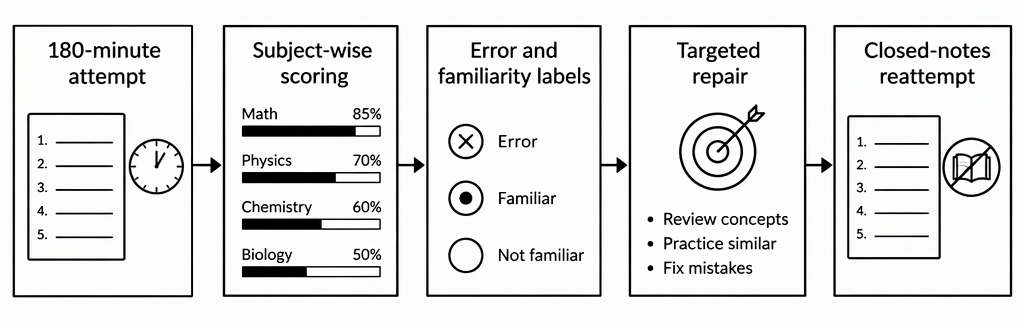
Use these column headings in your own notebook or spreadsheet, not as assumed built-in platform tools:
- Question: Paper identifier and question number.
- Subject: Physics, Chemistry or Mathematics.
- Error category: Concept gap, calculation error, misread condition, time-pressure decision or uncovered syllabus.
- Corrective action: The precise concept or habit to repair.
- Reattempt status: Not yet reattempted, solved independently or still stuck.
- Familiarity flag: Recognised or unfamiliar, including questions answered correctly. Recognition weakens the evidence of independent solving ability.
For a missed Chemistry concentration question, review the concentration definition, then solve related questions without notes. Use Free JEE Chemistry Question Bank: PYQs, PDFs and Mocks to support that repair.
Complete at least one targeted repair before another full mock. Re-reading a solution is not the same as reproducing the reasoning independently.
What can my free mock score not tell me?
A raw score out of 300 is not an official NTA percentile. It measures performance on that paper under those conditions. Establishing your position among candidates in an actual JEE Main shift requires that shift’s candidate-score distribution.
NTA converts raw marks into percentiles separately for each shift. The total NTA percentile comes from the total raw score, not from averaging the three subject percentiles.
Do not turn one mock total into an admission prediction or compare it with a universal “good score”. Compare successive attempts alongside paper difficulty, syllabus coverage and recognised questions before calling a rise improvement or a fall decline.
Choose the next task from the unresolved weakness. For full-paper execution, use another complete paper after review. For a specific concept gap, targeted work comes first: another score does not repair the concept.
What else should I check before choosing a free JEE Main mock test?
Free-test availability does not establish registration terms, attempt limits or worked-solution access. Check those separately, and judge the score alongside syllabus coverage and question familiarity.
Are JEEnius full-length mock tests genuinely free?
Free full-length tests are included. Registration requirements and the number of free attempts are not supplied, so check the particular test’s terms rather than assuming unlimited access.
Do the free tests include worked solutions?
The verified offer includes a scored per-subject breakdown, not confirmed worked-solution availability. Check the stated review provision before relying on it for step-by-step explanations.
Can I use a previous-year paper as a mock?
Yes, with a timer and its corresponding answer key. Older patterns and recognised questions limit direct comparison, so record those differences alongside your score.
Should I take a full mock before finishing the syllabus?
You can use it to diagnose covered topics and experience the full duration. Keep uncovered chapters separate; total marks alone are a poor judgement of what you understand.
Can raw mock marks tell me my NTA percentile?
No reliable official-percentile conclusion follows from raw mock marks alone. Open your error log, choose one missed concept and solve related questions without notes before your next three-hour attempt.
Next step: full-length mock tests on JEEnius and sit a full 75-question, 300-mark, 180-minute paper and get a scored per-subject breakdown (free tests included).
Frequently asked questions
Are JEEnius full-length mock tests free?
JEEnius includes free full-length mocks with 75 questions, 300 marks, 180 minutes and a scored per-subject breakdown. This does not mean every test is free or attempts are unlimited. Check the particular test’s registration requirements and access terms before starting.
Do free JEEnius mock tests include worked solutions?
The confirmed offer includes a scored per-subject breakdown; worked-solution availability is not established. Check the test’s review provisions before relying on it for step-by-step explanations.
Can I use a previous-year JEE Main paper as a mock test?
Yes, attempt it in one uninterrupted timed sitting and score it using its corresponding answer key. Check the paper’s pattern and syllabus against current official information. Recognised questions weaken its value as an independent baseline, so record familiarity alongside your score.
Should I take a full JEE Main mock before finishing the syllabus?
A full mock can help you diagnose covered topics and experience the three-hour duration. Label uncovered chapters separately rather than treating total marks as a verdict on ability. If substantial syllabus gaps remain, prioritise covered-topic practice.
Can I calculate my NTA percentile from a mock test score?
A raw mock score cannot reliably establish an official NTA percentile. NTA percentiles depend on the candidate-score distribution within each actual exam shift. The total percentile comes from the total raw score, not an average of the three subject percentiles.