
Should I practise Hydrocarbons from NCERT or JEE previous-year questions?
For free Hydrocarbons practice questions for JEE, use NCERT exercises to repair shaky reaction rules and conditions, Main PYQs once the basics are secure, and Advanced PYQs when you can explain linked steps. The five original drills below are a quick diagnostic, not a replacement for a chapter question bank.
Every question and worked explanation is directly in this article. No download is required.
What does each free Hydrocarbons practice option help with?
NCERT exercises repair concepts; PYQs test their application in exam formats; this page’s drills identify selected errors. Choose by the learning problem, not the size of the collection. This comparison covers resource formats, not an audit of commercial question banks.
- NCERT Hydrocarbons exercises
- Best use: Repairing reaction rules and concepts.
- Question style: Textbook exercises, not uniformly JEE-style MCQs.
- Explanation availability: Related textbook discussion, not worked solutions for every exercise.
- Main limitation: Limited exam-format rehearsal.
- When to choose it: You cannot explain why a product forms.
- JEE Main Hydrocarbons PYQs
- Best use: Applying secure basics to exam questions.
- Question style: Actual Main questions in their original format.
- Explanation availability: Official keys verify answers, but do not necessarily teach reasoning.
- Main limitation: Recognising an old answer can hide weak understanding.
- When to choose it: You can justify routine reactions without notes.
- JEE Advanced Hydrocarbons PYQs
- Best use: Testing linked reasoning.
- Question style: Actual Advanced formats with question-specific instructions.
- Explanation availability: Official keys verify answers; worked reasoning needs a separate source.
- Main limitation: Poor substitutes for repairing basic rules.
- When to choose it: Routine products no longer cause difficulty.
- This page’s original diagnostic drills
- Best use: Locating selected conceptual errors.
- Question style: Five single-correct questions.
- Explanation availability: Worked explanations below.
- Main limitation: Selected concepts, not whole-chapter coverage.
- When to choose it: You need to identify what to repair first.
Free official textbook access and official past-paper access are separate from third-party chapterwise sorting or solutions. Access conditions for those third-party resources are not verified here.
Which option should Class 11, Class 12 students and droppers choose?
Choose by what you can explain without notes, not by your class label. A Class 11 student who explains mechanisms correctly can move beyond textbook exercises. A dropper who remembers products but cannot justify them still needs concept repair.
- Class 11, unable to explain a product: Revisit the relevant NCERT explanation and exercises before attempting a large mixed set. Identify the reacting bond, reagent and condition. Writing a product from memory is not enough.
- Class 12, reactions known but reagents confused: Attempt this diagnostic first. Repair the specific confusion, such as ionic versus radical addition, then practise Main PYQs that test that distinction.
- Dropper, old answers feel familiar: Solve without options first wherever feasible. Write the decisive reaction condition before checking the key. Otherwise, recognition can pass for reasoning.
- Advanced aspirant, routine products comfortable: Choose Advanced PYQs that link reactions or concepts. Follow each question’s stated response and marking instructions rather than assuming every question is single-correct.
Completing five introductory questions does not establish Advanced readiness. Use the reasoning beside each answer to choose the next practice set, not simply the number of correct letters.
Can I try five free Hydrocarbons practice questions for JEE now?
Attempt these five original single-correct questions without notes; solutions follow in the next section. They are not PYQs or questions from a particular exam year. Record a reason or reaction condition beside every answer so that a correct guess is not mistaken for understanding.
Question 1: How many monochlorination products does propane give?
Propane undergoes radical chlorination under light. Count distinct constitutional products formed by replacing exactly one hydrogen with chlorine. Exclude further chlorination.
- A. One
- B. Two
- C. Three
- D. Four
Question 2: How does peroxide change HBr addition to propene?
Propene reacts with hydrogen bromide in two separate experiments: first without peroxide under ordinary ionic-addition conditions, then with peroxide under suitable radical conditions. Which pair gives the major products in that order?
- A. 1-bromopropane; 1-bromopropane
- B. 1-bromopropane; 2-bromopropane
- C. 2-bromopropane; 1-bromopropane
- D. 2-bromopropane; 2-bromopropane
Question 3: What does reductive ozonolysis of but-2-ene produce?
But-2-ene undergoes ozonolysis followed by a zinc and water work-up. Which option states the carbonyl products obtained from one molecule of the alkene?
- A. Two molecules of ethanal
- B. One molecule each of methanal and propanone
- C. Two molecules of ethanoic acid
- D. One molecule of butan-2-one
Question 4: Which hydrocarbon has the most acidic carbon-bound hydrogen?
Compare ethyne, ethene and ethane under comparable conditions. Which option lists them in decreasing acidity of their carbon-bound hydrogen?
- A. Ethane, ethene, ethyne
- B. Ethene, ethyne, ethane
- C. Ethyne, ethane, ethene
- D. Ethyne, ethene, ethane
Question 5: Where does toluene undergo ring nitration preferentially?
Toluene undergoes ring mononitration using concentrated nitric acid and concentrated sulfuric acid. Which ring positions, measured relative to the methyl group, are favoured?
- A. Meta positions
- B. Ortho and para positions
- C. Para position exclusively
- D. Ortho positions exclusively
What are the answers, and which rule explains each choice?
The answer key is 1: B, 2: C, 3: A, 4: D, 5: B. Check your written reasons as carefully as your options. A correct letter with a wrong mechanism needs repair too.
Why does propane give two constitutional monochlorination products?
The two terminal carbons are equivalent, while the middle carbon is distinct. Replacing a hydrogen at either end gives the same compound, 1-chloropropane. Replacing a hydrogen on the middle carbon gives 2-chloropropane. Thus, B is correct: two constitutional products.
Counting the left and right ends separately produces a false third product. Counting every hydrogen separately also ignores molecular equivalence. This count does not imply equal product yields: proportions depend on the numbers and relative reactivities of the different hydrogens.
Why does propene give different products with and without peroxide?
Without peroxide, the major product is 2-bromopropane; with peroxide under suitable radical conditions, it is 1-bromopropane. Therefore, C is correct. In ionic addition, protonation favours the more stable secondary carbocation, which bromide then attacks.
In the radical pathway, a bromine radical adds so that the intermediate carbon radical is secondary rather than primary. That intermediate abstracts hydrogen from hydrogen bromide, giving 1-bromopropane.
The common mistake is applying one orientation rule regardless of conditions. The standard peroxide-effect rule for hydrogen bromide must not be transferred mechanically to hydrogen chloride or hydrogen iodide: their radical-chain energetics differ.
Why does but-2-ene give only one kind of carbonyl compound?
Cleaving the double bond gives two molecules of ethanal, so A is correct. Each double-bond carbon originally carries one hydrogen and one methyl group. After cleavage, each becomes an aldehyde carbonyl carbon with those same attachments.
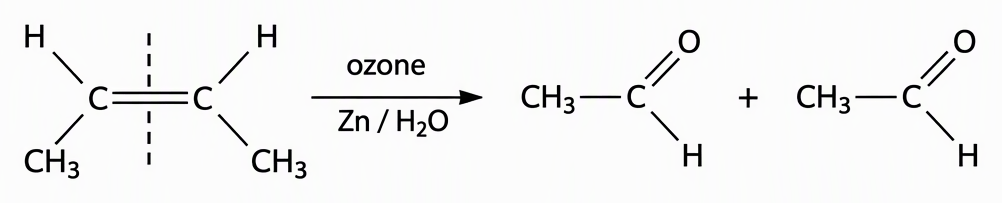
Two product molecules do not mean two different compounds. Choosing ethanoic acid ignores the reductive work-up; choosing a four-carbon ketone ignores double-bond cleavage.
Why is ethyne more acidic than ethene and ethane?
The decreasing acidity order is ethyne, ethene, ethane, making D correct. Compare the conjugate bases formed by removing a carbon-bound proton. Greater s-character in the orbital holding the negative charge helps stabilise that charge nearer the nucleus.
The relevant carbon hybridisations, in the same order, are:
The likely error is comparing hydrogen count or treating a strong carbon-hydrogen bond as the only factor. Acidity depends on the stability of the products of proton loss, not bond strength alone.
Why does toluene favour ortho and para nitration?
The methyl group directs ring electrophilic substitution towards ortho and para positions, so B is correct. Electron donation, including hyperconjugation, helps stabilise the intermediates for these pathways relative to meta attack. “Favoured” does not mean that one position forms exclusively.
Choosing only para may overapply steric reasoning and wrongly discard ortho substitution. A side-chain product would confuse ring nitration with side-chain radical halogenation, which uses different reagents and conditions.
How should I use my mistakes to choose the next free set?
Choose the next set by the rule you could not justify, not by an arbitrary score threshold. Record a wrong answer, a correct guess and a correct answer with faulty reasoning separately. A wrong answer needs diagnosis; a guess leaves understanding unproven; faulty reasoning reveals a misconception despite the right letter.
Use these repair targets:
- Product-counting error: Review molecular equivalence. Check whether differently drawn products are identical.
- HBr-addition error: Link conditions to ionic or radical mechanisms before selecting orientation.
- Ozonolysis error: Track each double-bond carbon’s attached groups through cleavage.
- Acidity error: Compare hybridisation and conjugate-base stability.
- Nitration error: Review directing effects; separate ring substitution from side-chain reactions.
Follow this sequence:
- Attempt without notes.
- Check the worked explanation.
- Write the corrected rule in your own words.
- Solve a fresh related question.
- Revisit the original later without looking at your old answer.
Move to mixed Main PYQs when you can explain the relevant choices without notes. For Advanced, add linked-reasoning questions and follow the actual paper’s instructions: Advanced has no fixed question-type or marking pattern.
Once addition products are secure, use Haloalkanes Practice Questions JEE: 5 Solved Drills. It extends practice from hydrocarbon addition products into haloalkane chemistry.
When should I move from chapter questions to a full mock?
Repair the chapter error first; use a full mock to check whether the correction holds in a mixed paper. Chapter drills isolate chemistry weaknesses. A full mock tests question selection, switching between Physics, Chemistry and Mathematics, and performance across the paper.
Do not use a full-paper score alone to diagnose why you reversed HBr addition or miscounted products. Fix that rule and solve a fresh example before testing its application under exam pressure.
When you can explain those chapter choices without notes, JEEnius offers full-length mocks, including free tests, with 75 questions, 300 marks, 180 minutes and a scored per-subject breakdown. These are JEE Main Paper 1 specifications, not JEE Advanced. Use a mock then to check whether the repaired learning holds.
Next step: full-length mock tests on JEEnius and sit a full 75-question, 300-mark, 180-minute paper and get a scored per-subject breakdown (free tests included).
Frequently asked questions
Should I practise Hydrocarbons from NCERT or JEE PYQs?
Use NCERT explanations and exercises when you cannot justify a reaction rule or product. Move to JEE Main PYQs once you can explain routine reactions without notes. Use Advanced PYQs to test linked reasoning after the basics are secure.
Are these Hydrocarbons questions actual JEE previous-year questions?
No, these are five original single-correct diagnostic questions, not PYQs. Each has a worked explanation directly in the article, with no download required. They test selected concepts rather than the whole chapter.
How does peroxide change HBr addition to propene?
Without peroxide under ordinary ionic-addition conditions, propene gives 2-bromopropane as the major product. With peroxide under suitable radical conditions, it gives 1-bromopropane. Do not apply this peroxide-effect rule mechanically to HCl or HI.
Does solving all five questions mean I am ready for JEE Advanced?
No, five introductory questions do not establish Advanced readiness. You should be able to justify routine products without notes, then practise Advanced PYQs that link reactions or concepts. Follow each question's response and marking instructions rather than assuming a fixed format.