
Which Gravitation practice should I start with for JEE?
For Gravitation practice questions for JEE, start with chapter drills if you cannot explain your formulas, verified PYQs if you solve routine questions independently, and full-length mocks to test whole-paper execution. Below are six free, original questions with worked solutions, with no external download needed.
None of these formats replaces the other two. Drills isolate a concept, previous-year questions show how an exam tests it, and mocks test whether you can apply it while managing Physics, Chemistry and Mathematics together.
How do chapter drills, verified PYQs and full-length mocks compare?
Drills isolate a skill, PYQs calibrate it against actual exam questions, and mocks test execution across subjects. Choose by the problem you need to fix, not the size of a question collection. Here is how the formats compare on the same criteria.
- Best use: Original topic-wise drills: repairing one concept. Verified PYQs: applying knowledge to authentic exam problems. Full-length mocks: managing the complete paper.
- Chapter focus: Drills: tightly controlled. PYQs: focused when filtered by chapter. Mocks: spread across the syllabus.
- Exam authenticity: Drills: author-created, even when labelled “JEE-level”. PYQs: authentic past-paper questions with verified provenance. Mocks: simulations, not past papers.
- Diagnosing a specific misconception: Drills: strong when each question isolates one assumption. PYQs: useful, though several skills may overlap. Mocks: need follow-up chapter work to isolate the cause.
- Testing question selection: Drills: limited. PYQs: useful in mixed sets. Mocks: strongest for deciding what to attempt, defer or leave across subjects.
- Main limitation: Drills: cannot establish exam readiness. PYQs: remembered answers can inflate confidence. Mocks: do not guarantee targeted Gravitation coverage.
A verified PYQ should identify the exam, year and relevant paper or shift. “JEE-level” describes intended difficulty; it does not prove that a question appeared in an exam.
Separate an answer key from a worked solution. The former gives the result; the latter states assumptions and explains the decisive step.
Which format should Class 11, Class 12 students and droppers choose?
Choose from the work you can produce without help, not your class label. A Class 12 student may need a basic potential drill, while a Class 11 student may already handle PYQs independently. Your written reasoning is better evidence than an invented diagnostic score threshold.
- Class 11, chapter just completed: Choose drills first if field, potential and orbital energy still blur together. Explain what each quantity measures before substituting values.
- Class 12, familiar chapter: Use the diagnostic below to locate gaps. Repair those gaps, then move to verified PYQs rather than automatically restarting every derivation.
- Dropper, familiar PYQ answers: Recognition is not a fresh test of understanding. Solve unseen original questions and justify each step before checking the solution.
- Comfortable in Gravitation, weak in mixed papers: Choose full-length mocks. Examine question selection, accuracy and subject balance rather than repeating comfortable chapter questions.
- Advanced aspirant: Treat these drills only as a foundation check, not Advanced-level preparation. Follow them with verified Advanced questions and their actual instructions.
A harder question is not automatically better if you still confuse orbital radius with altitude. Repair that distinction first, then test it in an exam question.
Can I try six free Gravitation questions before seeing the solutions?
Solve the six questions below on paper before scrolling to the answers. These are original diagnostic questions, not PYQs, and they check foundations rather than replicate either exam. For each, record the formula, its applicability condition and your reasoning.
Use the following convention throughout:
Assume isolated Newtonian systems and spherically symmetric mass distributions for the shell and central bodies. Do not impose an exam-time benchmark on this attempt: the task is to expose assumptions, not reward fast recall.
- Shell centre: A thin spherical shell has the mass and radius specified below. Find the gravitational field and potential at its centre.
- Slow lifting: Move a particle slowly from the surface of a spherical body to twice the body's radius from its centre. Find the external work, neglecting rotation and other bodies.
- Circular speed: Find a satellite's circular orbital speed around a spherical body. Neglect the satellite's effect on the body; the orbit lies outside its surface.
- Orbital energy: A satellite changes between the two exterior circular orbits specified below. Find the increase in total mechanical energy between endpoints, not a particular manoeuvre's fuel requirement.
- Gravity at depth: A non-rotating spherical planet has uniform density. Express gravitational acceleration at the specified depth in terms of surface acceleration and radius.
- Orbital periods: Two satellites have negligible masses compared with the same spherical central body. Their circular orbits lie outside it. Find the period ratio and explain why satellite mass does not enter.
What are the worked solutions, and what does each mistake reveal?
Check the assumptions and decisive step, not just the final expression. A correct answer reached through an invalid argument still needs repair. These are mathematical results from author-created problems, not exam statistics or chapter-frequency claims.
1. Diagnostic label: field–potential confusion
Symmetry makes the vector field contributions cancel at the centre. Potential is scalar: every shell element contributes negatively and is the same distance from the centre.
Zero field therefore does not mean zero potential. It means no net gravitational force on a test particle there.
2. Diagnostic label: work-sign error
Slow motion allows a negligible change in kinetic energy. External work then equals the increase in gravitational potential energy.
The external agent supplies positive work because the particle moves against attraction. If you obtained a negative answer, check whose work you calculated.
3. Diagnostic label: radius–altitude confusion
For a circular orbit, gravitational force supplies the required centripetal force. Satellite mass cancels from this equation.
The distance is measured from the body's centre, not its surface. Convert altitude to orbital radius before substituting:
4. Diagnostic label: orbital-energy confusion
Use total mechanical energy, not potential energy alone. For the initial circular orbit:
The final speed is lower, so kinetic energy decreases. Potential energy increases by a larger amount, making total energy less negative; this endpoint difference is not a fuel calculation.
5. Diagnostic label: hidden density assumption
At an interior point, spherical layers outside that radius produce no net field. Only the enclosed mass contributes, and uniform density makes that mass proportional to the cube of the interior radius.
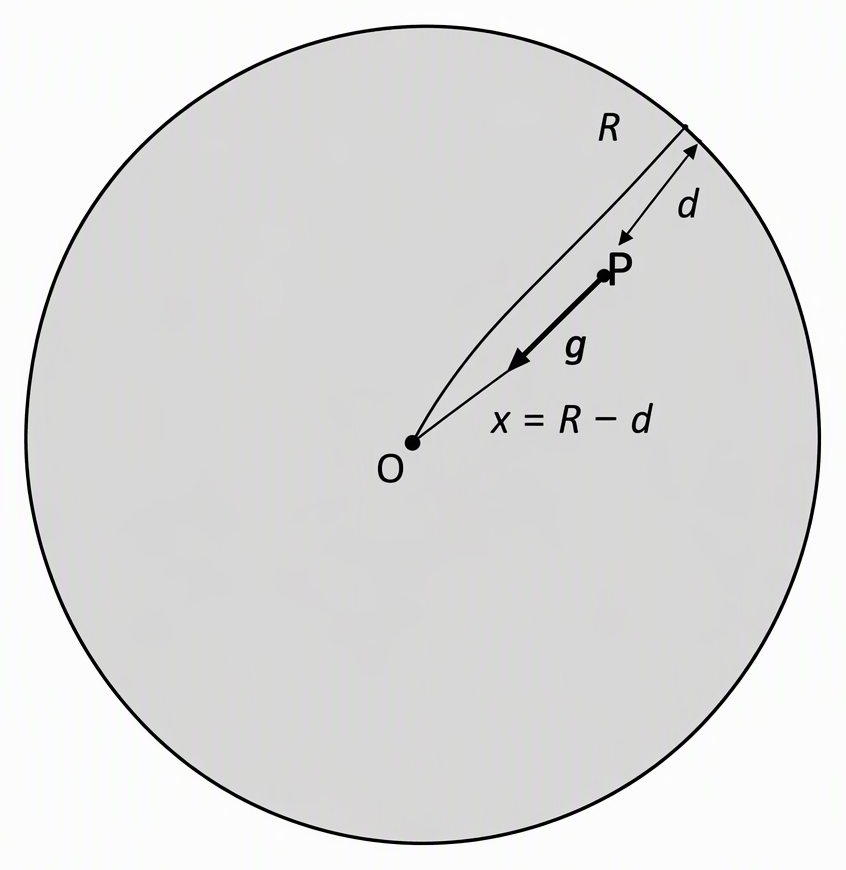
Define the planet's total mass and the interior radius below. Apply the inverse-square law using only the enclosed mass:
This linear result depends on uniform density, not spherical shape alone. At the exact centre, symmetry gives zero field; the limiting expression agrees. Check both surface and centre:
6. Diagnostic label: incorrect period scaling
Divide the circular path length by orbital speed. Both satellites orbit the same central mass, so the common factors cancel in their period ratio.
Satellite mass cancels from the force equation used for orbital speed. Treating the central body as unaffected assumes each satellite's mass is negligible compared with it.
What should I practise next based on the error I made?
Choose your next set from the cause of the error, not the number of correct answers. An unknown assumption needs concept repair; a sign slip needs a clean reattempt; independently justified solutions support moving to authentic exam questions. Do not convert this diagnostic into predicted marks, percentile, chapter weightage or a readiness guarantee.
- An assumption was unfamiliar: Return to that subtopic and solve a fresh variant before opening a mixed set. After Question 1, for example, examine another point inside the shell and justify field and potential separately.
- The method was right but algebra or signs failed: Redo the question without looking. Explain the sign or check a limiting case explicitly.
- Every answer was independently justified: Move to verified Main PYQs. Advanced aspirants should then attempt verified Advanced questions, not treat these foundations as sufficient preparation.
- Chapter work is comfortable but mixed-paper execution fails: Use full-length mocks to examine selection, accuracy and subject balance.
PYQs should retain their original question type and marking instructions. Advanced has no fixed question pattern or marking scheme, so do not practise every question as though it were single-correct.
Are these six questions enough for JEE Gravitation?
No. They check a narrow set of foundations, not the full range of exam problems. Use the errors to choose subtopics for repair, then extend your work through verified PYQs. Recalling these six answers later is not equivalent to solving six unseen questions.
For the whole-paper stage, JEEnius offers full-length mocks, including free tests, with 75 questions, 300 marks, 180 minutes and a scored per-subject breakdown. These are full-length papers, not Gravitation-only tests. After one, inspect the subject breakdown and identify whether each lost Physics question came from a concept gap, a calculation error or a selection decision before choosing your next practice set.
Next step: full-length mock tests on JEEnius and sit a full 75-question, 300-mark, 180-minute paper and get a scored per-subject breakdown (free tests included).
Read next: Definite Integrals JEE 2024: Tangent-Area Answer Audit.
Frequently asked questions
Should I start JEE Gravitation practice with drills, PYQs or mocks?
Start with chapter drills if you cannot explain your formulas and their assumptions. Move to verified PYQs when you can solve routine questions independently. Use full-length mocks when chapter work is comfortable but question selection, accuracy or subject balance breaks down across a complete paper.
Are these six Gravitation questions actual JEE PYQs?
No. They are original diagnostic questions with worked solutions, designed to check foundations rather than reproduce JEE Main or Advanced papers. Use them to identify gaps in reasoning, not to estimate exam readiness.
Are six solved questions enough for JEE Gravitation?
No. These six questions cover a narrow set of foundations, not the full range of exam problems. Repair the gaps they reveal, then attempt verified Main PYQs; Advanced aspirants should also practise verified Advanced questions with their original instructions.
How do I check whether a Gravitation question is a genuine JEE PYQ?
A verified PYQ should identify the exam, year and relevant paper or shift. A label such as “JEE-level” describes intended difficulty but does not establish that the question appeared in an exam. Retain the original question type and marking instructions when practising.