
Can this tangent-area question and answer key be trusted?
The supplied algebra gives 20, but does not validate the geometric problem or its answer key. This definite integrals JEE 2024 entry needs a publication hold: its year field says 2024, but its date field says 2023-01-24. A confirmed year-and-shift attribution needs that mismatch resolved. It is a numerical-answer question; no multiple-choice options were supplied.
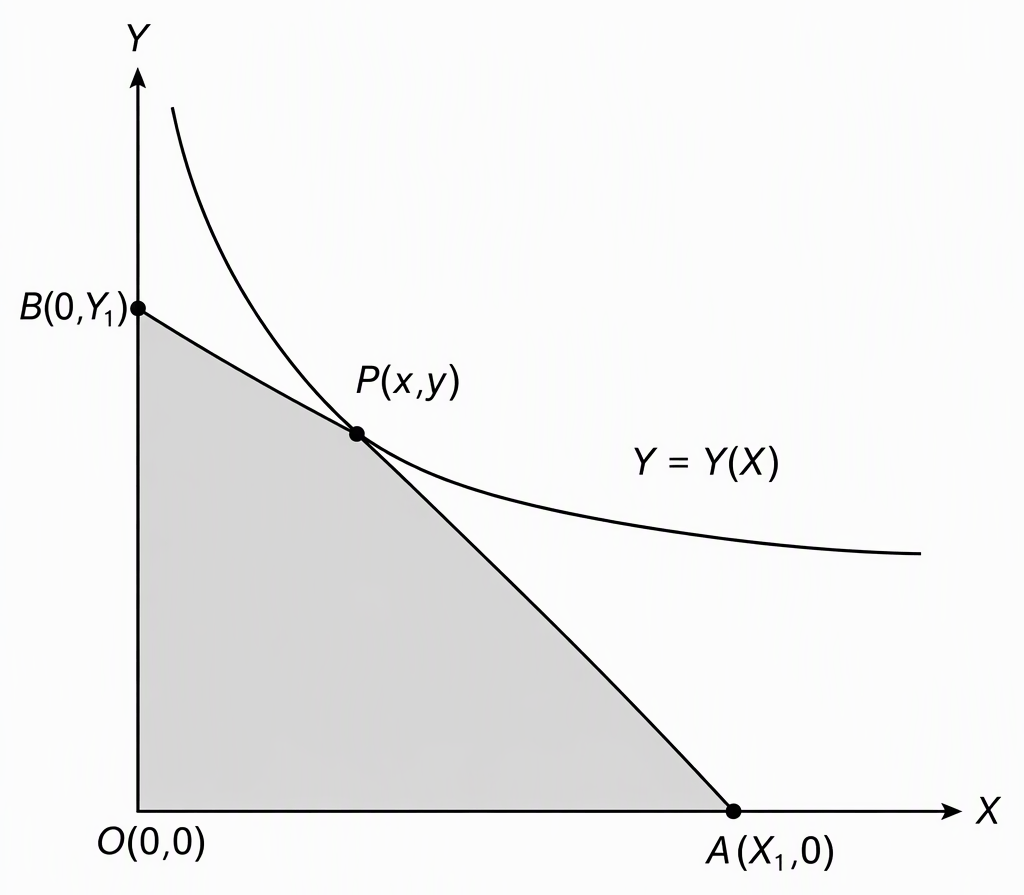
The task concerns a curve in the first quadrant. At a point on it, the tangent meets the coordinate axes and forms a triangle with the prescribed area below.
The requested quantity is:
The question’s derivative notation is inconsistent. Following the supplied solution, we interpret its line as the tangent at the stated point:
How do you calculate both tangent intercepts?
Set the vertical coordinate to zero to find the horizontal intercept, then set the horizontal coordinate to zero to find the vertical intercept. The first substitution requires a nonzero tangent slope. Keep this restriction: later cancellation does not make a horizontal tangent valid.
Define the slope and write the tangent equation:
At the horizontal intercept:
At the vertical intercept:
The supplied solution uses:
However, geometric area is generally:
Dropping the absolute value assumes a positive intercept product. A point lying in the first quadrant does not guarantee that both tangent intercepts are positive.
How does the area condition become a differential equation?
The reciprocal-slope terms cancel after expansion, leaving a first-order linear differential equation. That is the supplied method, despite the source’s “Definite integrals” label. We follow the algebra while retaining the slope and sign restrictions from the geometry.
Equate the supplied area expressions:
Multiply both sides by 2:
Expand all four product terms before simplifying:
Cancel the matching reciprocal-slope terms:
Now substitute the derivative for the slope:
The horizontal coordinate is positive, so division by its square is permitted:
This equation follows from the supplied area relation only under the stated restrictions. Solving it does not establish that the resulting curve satisfies those restrictions.
What does the integration give, and why is the answer unverified?
The supplied algebra gives 20, not a verified answer to the original geometric problem. The derived curve fails the tangent requirement at the initial point and the geometric-area check at the evaluation point. Complete the integration, then test both restrictions.
For positive horizontal coordinates, the linear coefficient and integrating factor are:
Multiply through and recognise a product derivative:
Integrating gives:
Apply the initial condition:
Therefore, the supplied derivation yields:
The three outputs conflict:
- Supplied algebra: 20, as calculated above.
- Answer field: 28.
- Supplied solution’s final assertion, without a valid derivation:
Differentiate the derived curve:
The original area expression is undefined at the specified initial point. The tangent there is horizontal and cannot form a finite intercept triangle.
At the evaluation point:
Thus:
The prescribed expression also gives the negative signed value, not geometric area. Require a corrected source question and matching official solution before publication. Do not change the normalization constant to force either claimed answer.
Why can’t you change the constant to match the answer key?
Changing the stated additive constant changes the differential equation, so it changes the problem. The supplied solution’s final “constant correction” is not an arithmetic repair. It introduces an unsupported alteration solely to match a conflicting answer.
Replace the stated constant hypothetically:
The same expansion produces:
A legitimate arithmetic correction fixes a calculation while preserving the given conditions. This alteration does not establish the asserted final value.
Check both the initial condition and the original geometric area relation. Satisfying only the simplified differential equation misses restrictions lost during cancellation.
Which three practice questions build the integration skills used here?
These are original practice questions, not verified JEE previous-year questions. They progress from power-rule integration to accumulation using limits, then to integrating the expression obtained above. Each has a definite answer independent of the disputed tangent-area source.
- Evaluate the following power integral. Increase the exponent by one and divide by the new exponent. Evaluate the upper limit before subtracting the lower limit.
- Find the function’s value at the upper limit from the given derivative and initial value. The integral gives the change in the function, not its final value.
Find:
Using accumulation:
- Evaluate the following integral of the derived curve expression. Use the logarithm rule for the reciprocal term and the power rule for the quadratic term.
Redo these without looking at the working. Then return to the tangent problem and check the slope and intercept signs before accepting any computed area.
Next step: the past-paper archive on JEEnius and search every JEE Main paper from 2002 and every Advanced paper from 2007, by year, subject or chapter, each with a worked solution (free).
Related on JEEnius: Ionic Equilibrium JEE 2018: Dilution Question Solved.
Frequently asked questions
Is the answer to the tangent-area question 20 or 28?
The supplied algebra gives 12Y(2) = 20, while the answer field states 28 and the supplied solution ends with an unsupported 28/3. The derived curve fails the original tangent and geometric-area checks, so 20 is not a verified answer either. A corrected source question and matching official solution are needed.
How do I find the area of a triangle formed by a tangent and the coordinate axes?
For a tangent at (x, y) with nonzero slope m, the intercepts are X₁ = x − y/m and Y₁ = y − mx. The geometric area is |X₁Y₁|/2. A point in the first quadrant does not guarantee positive tangent intercepts, so do not drop the absolute value without checking their signs.
What is the integrating factor for y' − 2y/x = −2/x²?
For x > 0, the integrating factor is exp(∫−2/x dx) = x⁻². Multiplying through gives d(yx⁻²)/dx = −2x⁻⁴, so y = 2/(3x) + Cx². This solves the differential equation, but any restrictions from the original geometric problem must still be checked.
Is this tangent-area question a verified JEE 2024 previous-year question?
Its attribution is unverified because the supplied year field says 2024 while the date field says 2023-01-24. The mismatch must be resolved before assigning a confirmed year and shift. The article's three practice integrals are original questions, not verified JEE previous-year questions.