
What is the answer to the ray optics JEE 2023 focal-length error question?
The numerical entry for this ray optics jee 2023 question is 1: the maximum first-order focal-length error is one percent. The official method differentiates the reciprocal lens relation, then adds the absolute error contributions.
The source is JEE Advanced 2023, Paper 1, Physics, from Ray Optics and Optical Instruments. The question bank classifies it as medium and suggests 120 seconds, not an official exam time limit.
A thin convex, converging lens forms a real image, with the object on the left and the image on the right. Both measured distances are from the lens.
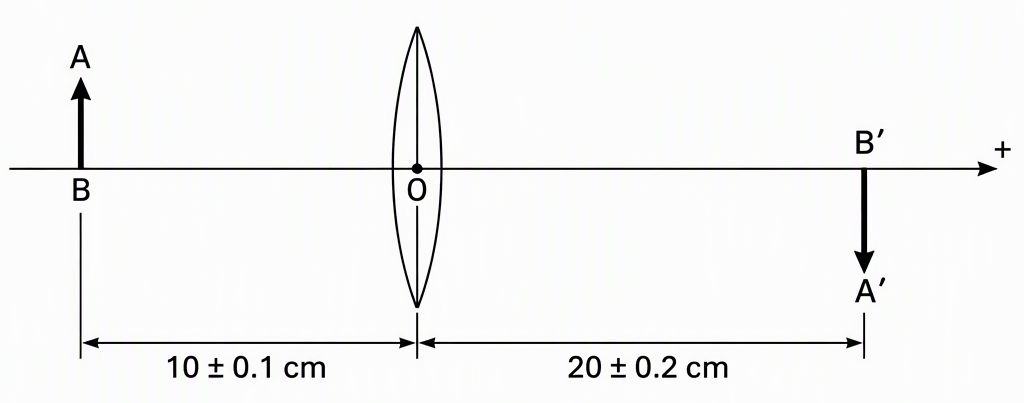
The question states: “In an experiment for determination of the focal length of a thin convex lens, the distance of the object from the lens is”
“and the distance of its real image from the lens is”
The error in determining the focal length is expressed as
Find the coefficient. This is a numerical-answer question; the supplied record contains no answer options.
How do you differentiate the lens formula before adding errors?
Use signed distances in the lens formula, but nonnegative magnitudes for uncertainties. Differentiate first to relate the signed changes, then add their absolute contributions to obtain the maximum first-order error.
Under the Cartesian convention, right is positive. The object is left of the lens, the real image is right of it, and the converging lens has positive focal length:
The thin-lens relation is
Differentiate:
Signed differential terms may oppose each other for particular measurement changes. The maximum possible first-order error, however, adds their absolute contributions:
Since the focal length is positive,
The uncertainty magnitudes are
Neither becomes negative because the object coordinate is negative. A coordinate sign tells you position; an uncertainty magnitude tells you the size of the possible error.
How do you calculate the focal length without mixing distance signs?
The nominal focal length is twenty-thirds of a centimetre. The signed lens relation and the positive-distance magnitude form give the same result, provided you keep their conventions separate.
Using signed distances:
For the official solution’s magnitude calculation, define
For this real-object, real-image arrangement,
This form uses positive distance magnitudes. Do not insert the negative signed object distance into it.
How does substituting the uncertainties give the answer 1?
The substitution gives a fractional error of one hundredth. Multiply by one hundred to convert it to a percentage; the requested numerical entry is 1, not 0.01.
Substitute into the differentiated error expression:
The image-distance term is
The object-distance term is
Adding and multiplying by the focal length gives
The inverse-centimetre units cancel against the focal length in centimetres. The resulting fractional error is dimensionless:
The official final answer is
Why does mechanically adding percentage errors give an incorrect 3%?
Three percent is a derived incorrect result, not an official wrong option: this question is numerical. The mistake is treating the numerator and denominator as independent measurements, although both reuse the same object and image distances.
The faulty calculation starts with valid individual errors:
The maximum relative error in the sum is also valid:
Mechanically adding numerator and denominator percentage errors then gives
Increasing either positive distance increases both the product and the sum. You cannot independently choose the product’s largest increase and the sum’s largest decrease to maximise their quotient.
Differentiate the original lens relation with respect to the actual measured quantities, then add the magnitudes of their contributions. This accounts for each measurement’s effect on the focal length.
The official solution uses maximum-error addition. Root-sum-square propagation instead applies to statistical uncertainties under suitable independence assumptions; it answers a different uncertainty question.
How do you solve two related thin-lens error exercises?
Use the same differentiated relation, changing only the uncertainty information requested or supplied. Both questions below are author-created follow-up exercises from Ray Optics and Optical Instruments, not additional JEE 2023 PYQs.
What is the maximum absolute focal-length error for the original measurements?
For Question 1, the absolute error is approximately 0.067 cm. Keep the original object and real-image measurements, then multiply the focal length by the fractional error:
This is an absolute error in centimetres, not the one-percent relative error. They describe the same uncertainty in different forms.
What if the object distance is exact and only the image distance has uncertainty?
For Question 2, the percentage error becomes one-third of a percent. Keep the object distance at exactly 10 cm with negligible uncertainty, and the real-image distance at
The nominal focal length is unchanged, but the object-distance uncertainty is zero:
Only the image-distance contribution remains:
Removing the object-distance uncertainty removes its contribution, not the entire focal-length uncertainty. Before substituting, write both uncertainty magnitudes explicitly, including zero when a measurement is exact.
Next step: photograph a doubt on JEEnius and photograph any question you are stuck on and get a step-by-step solution, with a free-body diagram when the question needs one (20 free).
For a worked example of the same idea, see How to Study Electromagnetic Waves JEE: Study Order.
Frequently asked questions
What is the answer to the ray optics JEE 2023 focal-length error question?
The maximum first-order percentage error in the focal length is 1%. Since the question expresses the error as n%, the numerical entry is 1, not 0.01.
How do you calculate the maximum error in focal length?
Differentiate the signed lens formula, 1/f = 1/v - 1/u, then add the absolute error contributions: Δf/f² = Δv/v² + Δu/u². For u = -10 cm and v = 20 cm, the focal length is 20/3 cm. Substituting Δu = 0.1 cm and Δv = 0.2 cm gives Δf/f = 0.01, or 1%.
Why is the focal-length error 1% and not 3%?
In f = UV/(U + V), the numerator and denominator reuse the same measured distances, so their errors cannot be maximised independently. Mechanically adding their percentage errors gives the incorrect 3%. Differentiating with respect to the actual measured distances gives the correct maximum first-order error of 1%.
Is the object-distance uncertainty negative when u is negative?
No. The negative object coordinate indicates its position under the Cartesian sign convention, while uncertainty is a nonnegative magnitude. Here u = -10 cm, but Δu = 0.1 cm.
What is the absolute focal-length error in the JEE 2023 lens question?
The maximum first-order absolute error is Δf = (20/3) × 0.01 = 1/15 cm, approximately 0.067 cm. This is the same uncertainty as the 1% relative error, expressed in centimetres.