
What is the satellite-height question in Gravitation JEE 2023?
Gravity depends on distance from Earth’s centre, not height above its surface. In this Gravitation JEE 2023 question, satellites P and Q travel in separate circular orbits around Earth. Their heights are measured from the surface, but distances in the gravitational law are measured from the centre.
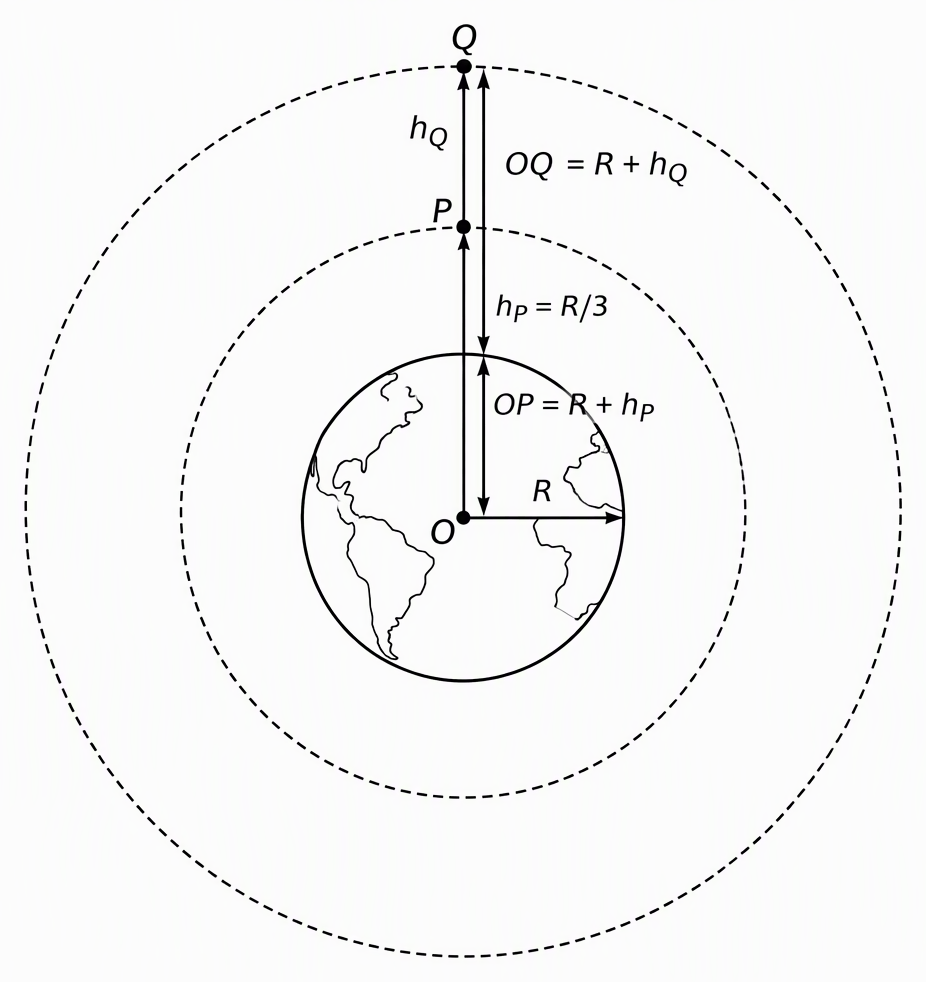
The source is JEE Advanced 2023, Paper 1, Physics, a single-correct MCQ. The question bank classifies it as medium difficulty and gives an expected solving time of 90 seconds. Neither is an official JEE rating or time limit.
Earth’s radius is denoted by:
The supplied height and gravitational-acceleration ratio are:
Find Q’s height above Earth’s surface. The options are:
Which distance should you use in the gravity formula?
Use Earth’s radius plus the satellite’s height, not the height alone. The inverse-square law measures distance from Earth’s centre. Write both centre-distances before forming the ratio.
Define the constants:
At a height above the surface, gravitational acceleration is:
The denominator contains the square of the centre-distance. For P, add Earth’s radius to its given height:
Therefore, the gravitational acceleration at P is:
For Q, keep the unknown height in the centre-distance:
Hence its gravitational acceleration is:
The circular-orbit wording does not require orbital speed or period. The supplied acceleration ratio is sufficient; calculating either quantity adds unnecessary work.
How does the acceleration ratio give Q’s height?
Divide P’s gravitational acceleration by Q’s and cancel the common gravitational factor. The positive square root gives the ratio of Q’s centre-distance to P’s. This gives Q’s orbital radius first; subtract Earth’s radius to obtain its height.
Start with the two acceleration expressions:
Dividing by the lower fraction moves its denominator into the numerator. Cancel the common factor explicitly:
Substitute the given ratio:
Take the positive square root, because both radial distances are positive:
Multiply by P’s centre-distance:
Now subtract Earth’s radius:
The answer is option A. Keep the orbital radius and requested surface height separate:
How can you check that Q must be farther out?
P experiences stronger gravity because the supplied acceleration ratio exceeds one. P must therefore be closer to Earth’s centre, and Q must have the greater surface height. This checks the derivation; it does not replace it.
The calculated heights have the correct ordering:
Substituting the centre-distances also recovers the given ratio:
The ordering check rejects B, because:
It cannot distinguish A from C and D, since all three put Q higher than P. The numerical check confirms the exact ratio.
How can mixing height and radius produce option C?
One possible erroneous route to C uses Earth’s radius for P and surface height for Q. Both distance substitutions are wrong, even though the resulting algebra lands on a listed option.
Here is the incorrect setup:
There are two separate errors:
- For P: Earth’s radius replaces the actual centre-distance.
- For Q: surface height replaces the actual centre-distance.
The inverse-square law compares distances from Earth’s centre, not a mixture of surface height and Earth radius. The correct equation is:
Repair the setup before doing algebra: write both centre-distances first, then form the ratio. Subtract Earth’s radius only after finding Q’s centre-distance.
Which three practice questions test the same method?
These original practice variations, not additional verified JEE 2023 PYQs, test adding Earth’s radius, recovering height, and orienting the inverse-square ratio. Attempt each before reading its worked answer.
Define gravitational acceleration at Earth’s surface as:
- At half an Earth radius above the surface, what fraction of surface gravity remains?
This tests whether you add Earth’s radius before squaring. Write the centre-distance in the denominator, not the height.
- At what height is gravity nine-sixteenths of surface gravity?
This tests whether you recover height from centre-distance. Take the positive square root, solve for the orbital radius, then subtract Earth’s radius.
- How do gravitational accelerations compare at heights of one and two Earth radii?
This tests the direction of the ratio. The lower location has stronger gravity, so its acceleration divided by the upper location’s must exceed one.
Cover the solutions and redo all three. On each attempt, make your first written line the centre-distance, not the gravity formula.
Next step: the past-paper archive on JEEnius and search every JEE Main paper from 2002 and every Advanced paper from 2007, by year, subject or chapter, each with a worked solution (free).
For a worked example of the same idea, see How to Study Electromagnetic Induction JEE: Study Order.
Frequently asked questions
What is the answer to the Gravitation JEE 2023 satellite question?
For h_P = R/3 and g_P/g_Q = 36/25, satellite Q's height is 3R/5 above Earth's surface, so option A is correct. Its orbital radius is 8R/5; subtract Earth's radius R to get the height.
Why do we use R + h instead of h in the gravity formula?
The inverse-square law uses distance from Earth's centre, not height above its surface. For Earth radius R and satellite height h, that distance is R + h, so gravitational acceleration is g = GM/(R + h)^2.
How do you find satellite height from a gravitational acceleration ratio?
Write each centre-distance as r = R + h, where R is Earth's radius and h is height above the surface. Since g = GM/r^2, the ratio is g_P/g_Q = (r_Q/r_P)^2. Take the positive square root to find the unknown centre-distance, then subtract R to obtain the height.
Do we need orbital speed to solve the JEE 2023 satellite-height question?
No, the given height of P and the gravitational acceleration ratio are sufficient. Use g_P/g_Q = [(R + h_Q)/(R + h_P)]^2 and solve for h_Q. Calculating orbital speed or period adds unnecessary work.