
How should I start studying electromagnetic induction for JEE?
Do not begin by searching for a formula. First identify the circuit and what changes. Study electromagnetic induction for JEE as one process: connect geometry to flux, determine polarity, model the circuit and check energy.
Before starting, check that you can use magnetic force, resistance and Kirchhoff’s laws, the right-hand rule for vector area, and elementary differentiation:
Study in this order: flux and Faraday–Lenz, then motional emf, then self and mutual inductance, then coupled circuit–mechanics problems. Establish circuit closure before tackling magnetic braking.
- Mark the conducting path and magnetic field. Sketch the loop or conductor, label the field direction and decide whether the path is closed. An induced emf does not automatically imply a circulating current.
- Write the external magnetic flux. Start with the integral; simplify only after checking the geometry.
For a uniform field over a flat loop:
The angle is measured from the area normal, not from the plane.
- Identify what changes: field strength, overlap area or orientation. For identical turns, use the external flux linkage:
Differentiate only after identifying the changing quantities. Flux differentiation and a motional-emf calculation can describe the same moving-loop effect, so do not add them as independent sources.
How do I determine current direction and choose the circuit equation?
Fix the sign convention before calculating current, then decide whether resistance alone describes the circuit. Lenz’s law determines the induced tendency, but circuit closure and inductance determine the actual current.
- Choose a positive loop direction and its right-hand-rule normal. A positive calculated emf acts along that chosen direction. Lenz’s law says the induced response opposes the change in linked flux, not necessarily the existing field.
For a moving rod, determine charge separation using:
For positive charges, the cross product gives the force direction and hence terminal polarity. The following result applies when the rod, velocity and magnetic field are mutually perpendicular:
- Draw the equivalent circuit. For a closed resistive circuit with negligible self-inductance:
For constant self-inductance, with no other source:
The last term already accounts for self-induction. Do not include the coil’s self-flux in the external emf and then subtract the inductive term again.
- Check dimensions, direction and limiting cases. Where motion or inductors appear, check energy too.
Keep these checkpoints beside your working:
- Constant linked flux gives zero net induced emf.
- An open moving rod can have terminal voltage without sustained circuit current.
- Ideal-inductor current cannot jump under a finite applied voltage.
How do I solve a stationary-loop problem with a changing magnetic field?
Choose the area normal first, then differentiate the signed flux. Illustrative problem, not a previous-year JEE question: a stationary single-turn loop lies in the page, with area and resistance denoted below. A uniform perpendicular field points into the page, and self-inductance is negligible.
Choose anticlockwise as positive. Its right-hand-rule normal points out of the page, opposite to the external field:
Faraday’s law gives:
The loop is closed and purely resistive, so:
For positive time, the current is anticlockwise. Independently, increasing into-page flux requires an induced field out of the page, confirming that direction.
At the initial instant:
A large magnetic field does not imply a large induced emf. The rate of change matters.
For regular follow-up, JEEnius daily practice problems provide a fresh ten-question topic set every day, with free sets daily.
How do I solve a sliding-rod problem beyond finding the emf?
Find polarity, current and magnetic force in that order, then verify the mechanical power. Consider a vertical conducting rod sliding right at constant speed on horizontal rails joined by a resistor on the left. The uniform field points into the page.
Rail and rod resistance, friction and self-inductance are negligible. The resistor supplies the total circuit resistance.
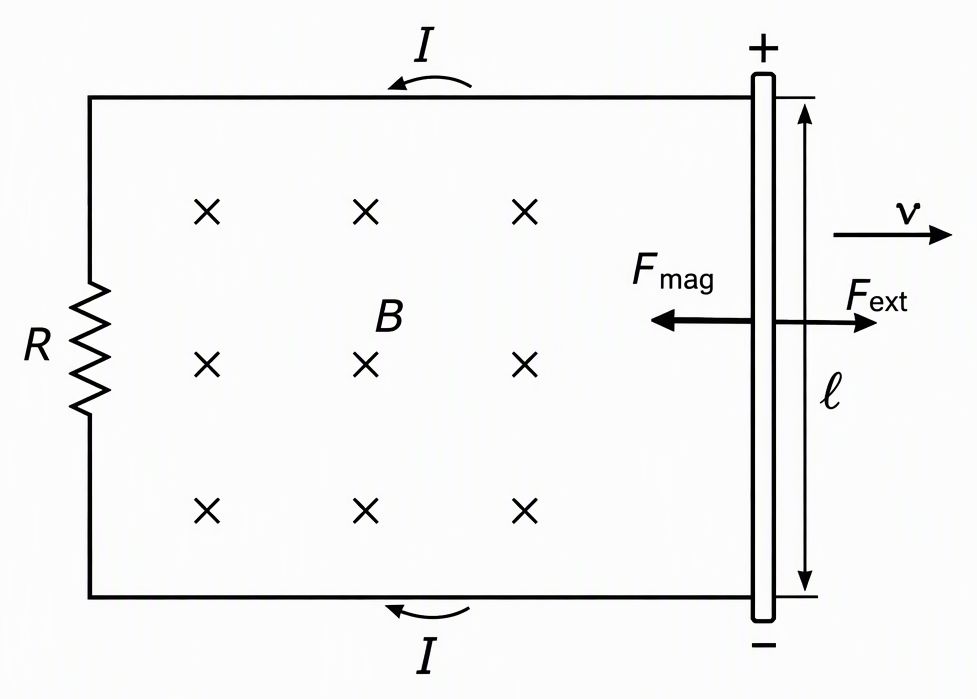
The enclosed into-page flux increases, so current is anticlockwise. Independently, the velocity cross magnetic field points upward, pushing positive charges towards the rod’s upper end.
Current flows upward through the rod. Its magnetic force points left; maintaining constant speed requires an equal external force rightward.
For an illustrative numerical calculation, take:
Check that mechanical power equals resistor heating:
With an open circuit, the ideal rod still develops the same terminal voltage, but sustained current and current-dependent magnetic drag vanish. Flux differentiation and the magnetic-force-on-charges method agree; they are not two emfs to add.
Why does current in an RL circuit not immediately reach its final value?
The rising current changes the coil’s own flux linkage, producing a self-induced emf that opposes the rise. Connect an ideal DC source, a resistor and a constant ideal inductance in series at the initial instant, with zero initial current.
Kirchhoff’s loop equation is:
Separate variables and integrate using the initial condition:
Rearranging gives:
Check the switching instant, initial slope and steady state:
The initial current is zero, but its rate of increase is not. The source voltage initially appears across the inductor rather than the resistor.
The usual shortcuts have limited meanings:
- At switching: this initially unenergised ideal inductor behaves like an open circuit because its current is zero.
- In DC steady state: it behaves like a short circuit because its current is constant and its voltage is zero.
Do not apply the first shortcut to an inductor already carrying current. Its current must remain continuous at switching.
Multiplying the loop equation by current gives the energy check:
Source power supplies resistor heating and stored magnetic energy:
When inductance matters, current changes with time. Dividing emf by resistance alone is not a complete solution.
What should I practise next for JEE Main and Advanced?
Start with a diagnostic set, repair the identified errors, then move to mixed problems. The quantities below are a suggested study prescription, not exam-frequency statistics or guaranteed completion targets.
Make the first ten-question set:
- Three flux-and-direction questions.
- Three moving-conductor questions.
- Two self-inductance questions.
- Two mutual-inductance questions.
For constant mutual inductance, practise:
Determine direction from the specified winding orientation. Never assign a sign without defining the convention.
Next practise:
- Rotating loops.
- Partial entry into or exit from a field.
- Flux-time graphs.
- Nonuniform-field flux integrals.
For each, identify the changing quantity before differentiating. Move to Main previous-year questions for accurate setup and calculation, then Advanced previous-year questions involving changing speed, magnetic braking and inductive circuits. These are progression choices, not exclusive exam categories.
For every wrong answer:
- Classify the error as geometry, direction, circuit model or algebra.
- Redo the problem from a blank page.
- Attempt a fresh question of the same type.
Use a readiness check, not a promised mastery date: explain the mechanism, current direction and one limiting-case check without notes. If one fails, practise that decision before increasing difficulty.
After correcting a missed problem, use JEEnius practice mode for topic sets that skip already-seen questions, with free sets included. Apply the same six-step method to the fresh question before checking its answer.
Next step: practice mode on JEEnius and practise a topic in sets that skip questions you have already seen (free sets included).
If that step was the hard part, work through Ellipse Practice Questions JEE: 6 Worked Solutions.
Frequently asked questions
In what order should I study electromagnetic induction for JEE?
First revise magnetic force, resistance, Kirchhoff’s laws, the right-hand rule for vector area and elementary differentiation. Study flux and Faraday–Lenz first, followed by motional emf, self and mutual inductance, and coupled circuit–mechanics problems. Check whether the conducting path is closed before calculating current or magnetic braking.
How do I find induced current direction using Lenz’s law?
Choose a positive loop direction and its right-hand-rule area normal, then identify how the signed external flux changes. The induced response opposes the change in linked flux, not necessarily the existing magnetic field. For a closed circuit with negligible self-inductance, the induced emf determines current direction; when inductance matters, solve the circuit equation with the initial current.
When can I use I = emf/R in electromagnetic induction?
Use I = emf/R for a closed resistive circuit with negligible self-inductance and no other source. If constant self-inductance matters, use emf − IR − L(dI/dt) = 0 and the initial condition. An open moving rod can develop terminal voltage without sustaining a circuit current.
What questions should I practise for electromagnetic induction in JEE?
Start with ten diagnostic questions: three on flux and direction, three on moving conductors, two on self-inductance and two on mutual inductance. Then practise rotating loops, partial field entry or exit, flux-time graphs and nonuniform-field flux integrals. Progress to Main previous-year questions for setup and calculation, then Advanced problems involving changing speed, magnetic braking and inductive circuits.