
How should I start studying differential equations for JEE?
Study differential equations for JEE by classifying before integrating, then verifying in the original equation. Repair the calculus skill blocking you, rewrite the equation, and choose the simplest valid method. A formula list cannot detect a solution lost during division.
Step 1: Check the prerequisites. Test differentiation, the chain rule, substitution in integration, partial fractions, and these standard integrals:
Repair the particular gap you find. Do not restart all of calculus because one partial-fraction decomposition went wrong.
Check three foundation ideas too:
- Order: the order of the highest derivative present.
- Degree: the power of the highest-order derivative, once the equation is polynomial in its derivatives after valid simplification. Degree is not always defined.
- Formation: differentiate a family and eliminate its arbitrary constants. For example:
Step 2: Rewrite before selecting a method. Use this recognition checklist:
- Visible form: separable.
First move: separate variables. Caution: record branches excluded by dividing by the factor involving the dependent variable.
- Visible form: first-order homogeneous.
First move: substitute:
Caution: this ratio-based meaning differs from a homogeneous linear equation, whose right-hand side is zero.
- Visible form: linear.
First move: find an integrating factor. Caution: treating the original independent variable as dependent may reveal a linear equation instead:
Forms can overlap. Pick the simplest valid route, and do not force every differential equation into these three types.
What steps should I follow after choosing the method?
Use the same sequence every time: transform, integrate, apply the condition, verify. Write restrictions before doing algebra, not as an afterthought.
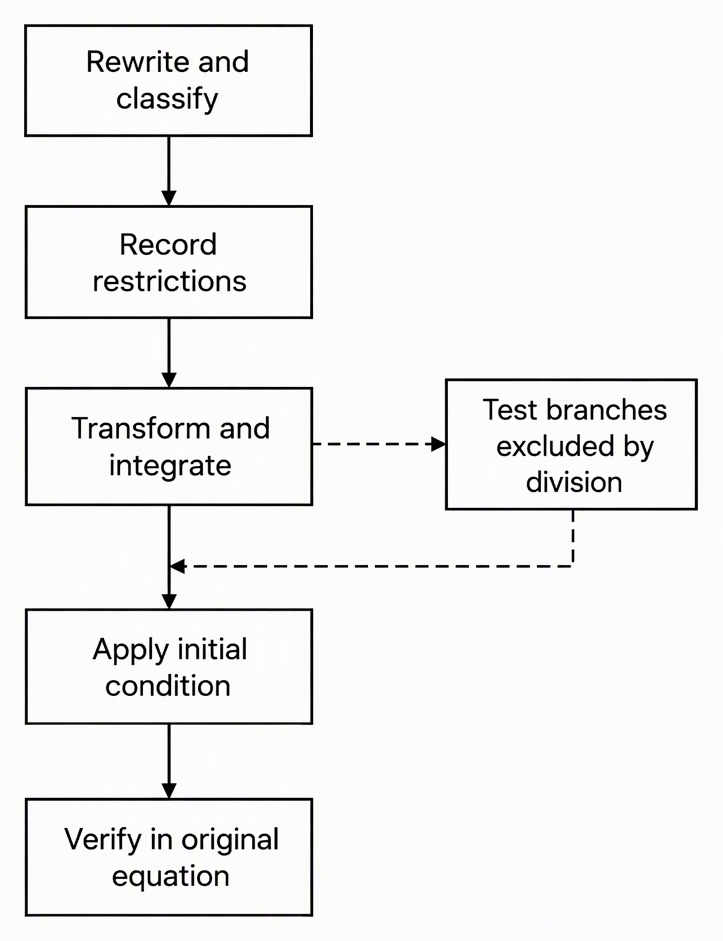
Step 3: Transform while recording restrictions. Separate original restrictions from those introduced by division or substitution.
For separation:
Separately test constant candidates obtained from:
For homogeneous substitution, use the product rule:
Do not replace the original derivative by just the derivative of the new variable.
For a linear equation, first make the derivative’s coefficient one. Then use:
Step 4: Integrate. These first-order general solutions require one arbitrary constant. Keep absolute values in logarithms unless the working interval permits their removal:
Step 5: Apply the initial condition. First obtain a valid solution family and restore any excluded solutions that satisfy the original equation. Otherwise, the condition may appear impossible because you divided away its solution.
Step 6: Verify. Differentiate the answer, substitute into the original equation, check the initial value, and state interval restrictions. Use the labels recognise, transform, solve, verify, as in the examples below.
How can separation lose the solution required by an initial condition?
Division can remove a constant solution, including the solution the initial condition requires. All three examples here are original illustrative problems, not claimed PYQs. Start with:
Recognise: the right-hand side separates into a factor involving each variable.
Transform: dividing by the dependent-variable factor temporarily excludes:
For the remaining branches:
Solve: integration and exponentiation give:
Now test the excluded constant directly in the original equation:
It is valid, so the complete family can now allow the coefficient to be zero. Apply the condition:
Verify: its derivative is zero, the original right-hand side is zero, and the initial value is one. The solution is valid for every real input.
Exponentiating a logarithm does not recover the excluded zero branch. Testing the original equation does.
For continued practice, JEEnius daily practice problems provide a fresh ten-question set on a topic every day, with free sets daily. Record every division restriction as you solve.
How do I solve a homogeneous equation and find its valid interval?
Use a ratio substitution when the right-hand side depends only on the dependent variable divided by the independent variable. Check restrictions from the original equation, excluded branches, and zeros of the final denominator. Consider:
Recognise: this is first-order homogeneous. It is not linear in the dependent variable because of the squared term.
Transform: the original equation excludes zero as an input. Substitute:
Before dividing, record the excluded branch:
That solution works on intervals avoiding zero, but fails the given initial condition.
Solve: for nonzero branches:
The initial point selects the positive-input branch:
Verify: differentiate and compare:
The initial value is one. The maximal interval containing the initial point is:
The original equation excludes zero, and the solution has a pole at the upper endpoint. A correct expression without this interval leaves the initial-value solution incomplete.
Why must I standardise a linear equation before finding its integrating factor?
The integrating factor uses the coefficient of the dependent variable after the derivative’s coefficient becomes one. Reading that coefficient too early gives the wrong factor. Solve:
Recognise: this is linear, but not yet standardised. Normalising is more productive than trying to separate the terms as presented.
Transform: division is valid on the stated domain:
The required coefficient is:
Therefore:
Solve: multiply through and use the product rule in reverse:
Apply the initial condition:
Verify: differentiate:
Substitute into the original, unnormalised equation:
The initial value is one, and the solution is valid throughout the stated positive-input domain. Checking the original equation also catches mistakes made during normalisation.
What should I practise after learning the three methods?
Move from labelled exercises to mixed recognition, then initial-value problems. If you are still learning integration, begin with the prerequisite checkpoint. If revising, begin with a ten-question classification-only drill and repair only the gaps it exposes.
For that drill, write the method and first algebraic move without completing the integration. Ten questions is a practice recommendation, not an exam statistic.
Use this sequence:
- Complete short exercises on order, degree, and formation by eliminating constants.
- Solve labelled separable, homogeneous, and linear problems.
- Mix the methods without labels, including equations needing rearrangement.
- Add initial conditions, excluded branches, and interval checks.
- Use actual JEE Main PYQs for recognition and accurate execution. Use actual JEE Advanced PYQs to test transfer to less direct formulations, not to infer guaranteed weightage.
Proceed when you can justify the method, perform the transformation, and independently verify the answer. Use those checks, not a fixed-hour completion target.
Keep an error log with four labels:
- Classification: wrong method.
- Transformation: wrong substitution, division, or normalisation.
- Integration: wrong antiderivative or algebra.
- Solution/domain check: lost branch, failed condition, or invalid interval.
Redo a missed problem without its solution visible, then attempt an unseen problem of that type. Keep deliberate reattempts separate from unseen practice.
For the unseen portion, JEEnius practice mode offers topic sets that skip questions already seen, with free sets included. Choose your drill mix yourself and use the verification checklist to judge readiness.
Next step: practice mode on JEEnius and practise a topic in sets that skip questions you have already seen (free sets included).
For a worked example of the same idea, see Electrochemistry Practice Questions JEE: 6 Solved Drills.
Frequently asked questions
What should I revise before studying differential equations for JEE?
Check differentiation, the chain rule, substitution in integration, partial fractions and standard integrals. Also review order, degree and formation of differential equations by eliminating arbitrary constants. Repair the specific gaps you find rather than restarting all of calculus.
How do I choose the right method for a differential equation?
Rewrite the equation before classifying it. Look for a separable form, dependence on y/x for the substitution y = vx, or a first-order linear form that admits an integrating factor. Forms can overlap, so choose the simplest valid route rather than forcing every equation into one category.
Can separating variables lose a solution?
Yes. Dividing by a factor involving the dependent variable can exclude a constant solution, including one required by the initial condition. Record the excluded candidates and test them in the original equation before applying the condition.
How do I find the integrating factor of a linear differential equation?
First put the equation in the form dy/dx + P(x)y = Q(x), with the derivative’s coefficient equal to one. The integrating factor is e raised to the integral of P(x). For x(dy/dx) + 2y = x² on x > 0, P(x) is 2/x, not 2, and the integrating factor is x².
How should I practise differential equations for JEE?
Start with order, degree and formation, then solve labelled separable, homogeneous and linear exercises. Move to mixed recognition, initial conditions, excluded branches and interval checks before practising actual JEE Main and JEE Advanced PYQs. Log errors by classification, transformation, integration and solution/domain checks, then redo missed problems before attempting unseen ones.