
How do I solve Continuity questions in six steps?
To study Continuity for JEE, check the domain first, then compare the left-hand limit, right-hand limit and actual point value separately. Standard continuity rules cover safe intervals. Calculate limits only where the formula, domain or branch behaviour needs attention.
- Check your limits prerequisites. Try these two diagnostics without notes:
Also explain why approaching a point differs from substituting it. A limit uses nearby values, not the value at the point. If these distinctions are unclear, revise limits before parameter questions.
- Write the domain before doing algebra. Flag branch boundaries, denominator zeros, logarithm and root restrictions, and greatest-integer thresholds. These are candidates for inspection, not automatic discontinuities. An excluded point is not a discontinuity within the stated domain; asking for a continuous extension there is a separate task.
- Clear the safe intervals using standard rules. Polynomials are continuous everywhere; sums and products of continuous functions remain continuous. A quotient requires a nonzero denominator. A composition needs valid domains and continuity of the relevant functions at their corresponding inputs.
- Make three entries at each interior checkpoint. Use nearby inputs to select the left and right branches. The equality sign selects only the actual point value.
Inputs just below a boundary need not use the branch containing equality. Keep the three entries separate even when two use the same formula.
- Compare all three entries and solve together. Continuity requires finite values satisfying:
When parameters occur at several boundaries, retain every equation and solve them simultaneously. Unequal one-sided limits cannot be repaired by redefining one point. Equal finite limits can be matched by choosing the appropriate point value.
- Verify and state exactly what was requested. Substitute the parameters back into every checkpoint, then give the constants or continuity set. On a closed interval, use the right-hand condition at the left endpoint and the left-hand condition at the right endpoint:
Keep continuity separate from differentiability. A corner does not break continuity:
How do I fill a removable hole without losing the point value?
Choose the missing point value to equal the common finite limit. Simplifying the nearby expression calculates that limit but does not assign the missing value. Keep the original point definition visible until the comparison.
Original practice example, not a JEE previous-year question: Find the constant for continuity on the real line.
The separately defined value makes the domain all real numbers. Only 1 needs testing. Factor first:
Cancellation is valid only away from the checkpoint:
Retain three separate entries before choosing the constant:
Substitution verifies that all three entries equal 2. Every other point is covered by the continuity of the simplified polynomial.
The unextended rational expression is undefined at 1 but continuous everywhere in its own domain. The error to avoid: treating the following indeterminate form as a function value instead of a signal to simplify the limit.
How do I find constants when a piecewise function has two boundaries?
Form a continuity equation at each boundary, then solve the equations together. Checking only the first join leaves the second join untested. Select the branches before doing algebra.
Original practice example: Find both constants for continuity on the real line.
The domain is all real numbers. Each branch is polynomial on its interval, so only 1 and 2 need separate calculations.
At the first join, the left branch supplies the LHL. The middle branch supplies the RHL and the actual value because it includes equality at 1:
At the second join, approach from the left using the middle branch. The final branch supplies the RHL and the actual value because it includes equality at 2:
Solve both conditions together, not as separate choices of constants. The same parameters must work at both joins:
Substitute back at both checkpoints:
The equality-containing branch determines the point value, not both one-sided limits. Derivative matching is unnecessary because this question asks only for continuity.
For fresh drills on this skill, JEEnius daily practice problems provide a fresh ten-question set on a topic every day, with free sets daily.
Can a greatest-integer jump disappear in a product?
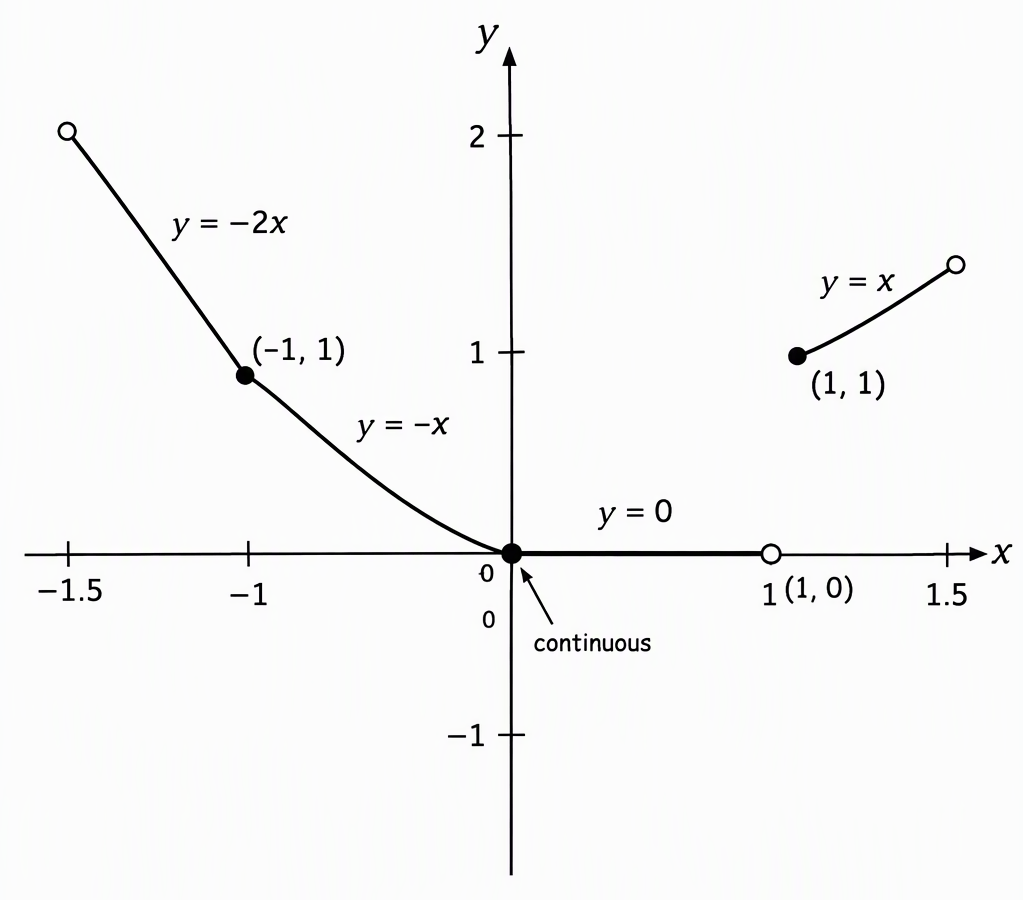
Yes. Multiplication removes the jump at zero in this example, but not at any other integer. A discontinuous factor does not force the complete product to be discontinuous. Test the expression, not just its factors.
Original practice example: Determine all points of continuity of:
The floor symbol means the greatest integer less than or equal to the input. The domain is all real numbers.
At any noninteger point, the floor value is locally constant. The function therefore agrees with a polynomial nearby:
Every noninteger point is continuous, so only integers need testing. At an integer, the floor value just to the left is the preceding integer; just to the right, it equals the checkpoint integer:
This rule also holds for negative integers. Do not confuse the floor function with truncation towards zero:
The three entries at a general integer give the continuity condition:
Near zero, the left-hand expression is the negative of the input, while the right-hand expression is zero. Both approach the defined value zero.
The continuity set is:
Every nonzero integer is a discontinuity. The floor function itself jumps at every integer, but its product with the input does not.
What should I practise after learning the checkpoint method?
Practise limits and domain checks first, then extensions, parameters and mixed functions. Keep this order: isolate branch-selection errors before adding oscillation.
- Limits and domain checks: factor rational expressions and identify valid inputs.
- Removable-hole extensions: calculate the limit without overwriting the point definition.
- Single-boundary parameters: select both nearby branches correctly.
- Multiple-boundary systems: retain and solve every boundary equation.
- Modulus and greatest-integer functions: test the complete expression.
- Mixed problems with bounded oscillation: distinguish a vanishing product from an oscillation that persists.
Use these two follow-up checks. First, extend:
The squeeze theorem gives the limit and required point value:
Second, no assigned value makes the following function continuous at zero:
Its values keep reaching 1 and negative 1 arbitrarily close to zero. Its limit therefore does not exist.
Write all three checkpoint entries before solving unfamiliar problems. Reduce written work only after branch selection becomes reliable. Log mistakes under exactly four labels:
- Domain missed
- Wrong branch
- Limit calculation wrong
- Point value ignored
Re-solve each logged problem without looking at its solution. Your mastery test is to justify the candidate points, compute the three entries and explain why no other points need testing.
Attempt topic-filtered JEE Main previous-year questions before harder mixed JEE Advanced questions. JEEnius practice mode offers topic sets that skip questions already seen, with free sets included. Use these for fresh practice; separately revisit logged mistakes rather than expecting unseen-question sets to repeat them.
Next step: daily practice problems on JEEnius and get a fresh ten-question set on a topic every day (free sets daily).
For a worked example of the same idea, see D Block Practice Questions JEE: 6 Free Solved Questions.
Frequently asked questions
How do I check continuity at a point in JEE questions?
Write the domain first and identify points that need inspection, such as branch boundaries. At an interior checkpoint, calculate the left-hand limit, right-hand limit and actual function value separately; continuity requires all three to be finite and equal. At the endpoints of a closed interval, use the one-sided limit from within the interval.
How do I find the missing value for a removable discontinuity?
Calculate the common finite limit and assign that value at the missing point. Simplifying the nearby expression does not automatically define the original function there. If the one-sided limits differ, changing one point value cannot make the function continuous.
How do I find constants in a piecewise continuous function?
Form a continuity equation at every branch boundary, then solve all equations simultaneously. Nearby inputs determine the branches used for the one-sided limits, while the branch containing equality determines the point value. Substitute the constants back into every boundary condition.
Is x floor(x) continuous at zero?
Yes: just left of zero, x floor(x) equals -x, while just right of zero it equals zero, so both limits equal its value of zero. At an integer n, the left-hand limit is n(n-1), while the right-hand limit and point value are n squared. These agree only at n = 0, so the function is continuous at zero and every noninteger, but discontinuous at every nonzero integer.
What order should I practise continuity questions for JEE?
Start with limits and domain checks, then practise removable holes, single-boundary parameters and multiple-boundary systems. Follow with modulus, greatest-integer functions and bounded oscillation problems. Attempt topic-filtered JEE Main previous-year questions before harder mixed JEE Advanced questions, and separately re-solve logged mistakes.